ENVS Courses - Spring 2012
ENVS 10100-01 ENVIRONMENTAL SEMINAR NS
0.5 credits
INSTRUCTOR: Chris Sinton, CNS 257, Ext. 4-5806, csinton@ithaca.edu
ENROLLMENT: 45
PREREQUISITES: None.
STUDENTS: Required for all first-year Environmental Studies and Environmental Science majors if not taken in the fall.
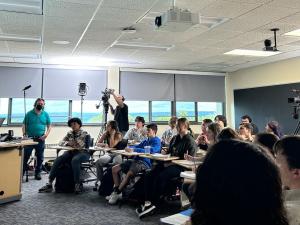
COURSE DESCRIPTION: Exposes students in the Environmental Studies/Science program to environmentally relevant research, examples of careers in the environmental field, and opportunities to meet local and regional professionals. This course will feature a variety of viewpoints surrounding the controversial techniques of hydraulic fracturing and horizontal drilling that have made the regional Marcellus Shale a viable resource for natural gas.
COURSE FORMAT/STYLE: Seminars, discussion and readings in environmental studies and science.
COURSE REQUIREMENTS & GRADING: Attend at least 11 seminars. Pass/Fail only.
ENVS 11200-01 SUSTAINABILITY PRINCIPLES AND PRACTICES NS
3 credits
INSTRUCTOR: Paula Turkon, Administrative Annex 118, Ext. 4-3280, pturkon@ithaca.edu
ENROLLMENT: 35
PREREQUISITES: None.
STUDENTS: Intended for all students.
COURSE DESCRIPTION: Course informs students on sustainability by using systems thinking approaches to examine the connection between the four primary components of sustainability: economic, environmental, social equity and health. Students will research sustainability practices on campus and in the community and propose sustainable solutions for various scenarios.
COURSE FORMAT/STYLE: Lecture.
COURSE REQUIREMENTS & GRADING: Based on attendance, participation, tests and project work.
ENVS 12100-01 ENVIRONMENTAL SCIENCE AND TECHNOLOGY: LECTURE LA NS 2a
4 credits
INSTRUCTOR: Anne Stork, Admin. Annex, Ext. 4-3575, astork@ithaca.edu
ENROLLMENT: 42
PREREQUISITES: None.
STUDENTS: Intended for Environmental Science & Studies majors but open to others with a serious interest.
COURSE DESCRIPTION: This course will focus on the scientific principles and technological advances fundamental to understanding human impact on the environment. We will investigate how technology contributes to as well as reduces our impact on the environment. Topics include: global climate change, water quality and availability, air quality, sustainable food production, biodiversity loss, and chemical and biological waste remediation. We will tie together the political, social, and economic aspects of environmental studies using a global perspective.
COURSE FORMAT/STYLE: A combination of discussion, lectures, projects, written assignments and oral presentations.
ENVS 12100-02 through 04 ENVIRONMENTAL SCIENCE AND TECHNOLOGY: LABORATORY
0 credits
INSTRUCTORS: Anne Stork, Jake Brenner
ENROLLMENT: 14
PREREQUISITES: None.
H&S Supplement Spring 2012 66
COURSE DESCRIPTION: Field and laboratory exploration of concepts addressed in ENVS 12100 Lecture above.
COURSE FORMAT/STYLE: Laboratory.
ENVS 13100-01 EARTH SYSTEMS SCIENCE II - LECTURE
4 credits
INSTRUCTOR: Chris Sinton, CNS 257, Ext. 4-5806, csinton@ithaca.edu
ENROLLMENT: 15
PREREQUISITES: ENVS 13000.
COURSE DESCRIPTION: The course serves as an introduction to geology as it relates to the human environment. We will evaluate various regions, including the Finger Lakes, in terms of geologic and environmental issues by making observations and gathering relevant information. Students will analyze geological data sets in order to predict the potential impacts of earth processes on human activities and vice versa. We will also cover basic geological field and lab techniques in order to identify rocks and minerals as well as the processes that create them.
COURSE FORMAT/STYLE: Lecture.
ENVS 13100-01 EARTH SYSTEMS SCIENCE II - LABORATORY
0 credits
INSTRUCTOR: Chris Sinton, CNS 257, Ext. 4-5806, csinton@ithaca.edu
ENROLLMENT: 15
PREREQUISITES: ENVS 13000.
COURSE DESCRIPTION: Field and laboratory exploration of concepts addressed in ENVS 13100 lecture above.
COURSE FORMAT/STYLE: Laboratory.
ENVS 20100-01 through 05 ENVIRONMENTAL RESEARCH: INTRO
1-3 credits
INSTRUCTORS: 01: Susan Allen-Gil, CNS 253, Ext. 4-1066, sallen@ithaca.edu
02: Jake Brenner, CNS 258, Ext. 4-3967, jbrenner@ithaca.edu
03: Jason Hamilton, CNS 252, Ext. 4-1439, jhamilton@ithaca.edu
04: Michael Smith, 320 Muller Center, Ext. 4-1290, mismith@ithaca.edu
05: Leann Kanda, CNS 159, Ext. 4-3986, lkanda@ithaca.edu
06: Anne Stork, Admin. Annex, Ext. 4-3575, astork@ithaca.edu
07: Susan Swensen, CNS 254, Ext. 4-3511, sswensen@ithaca.edu
ENROLLMENT: 5 each section
PREREQUISITES: Permission of instructor.
COURSE DESCRIPTION: For students who desire hands-on research in issues relating to sustainability and the environment. Research can involve participation in continuing projects or new, student-proposed projects. Students will work closely with a faculty member to guide their study.
COURSE FORMAT/STYLE: Independent research.
COURSE REQUIREMENTS & GRADING: Both vary, depending on professor.|
ENVS 20200-01 TOPICS IN SUSTAINABILTY: SOCIAL JUSTICE AND SUSTAINABILITY
4 credits
INSTRUCTOR: Elan Shapiro, 275-0249, eshapiro@ithaca.edu
ENROLLMENT: 18
PREREQUISITES: One ENVS course (ideally with significant sustainability focus) and one Social Science course (ideally with significant community focus).
COURSE DESCRIPTION: This course will explore the historic links now being forged between eco-sustainability oriented and justice oriented movements and the pivotal role they can play in reversing gross injustices and power imbalances while saving and regenerating our ecosystems. We will be intimately linked to a nationwide ―Breakthrough Communities‖ network of activists and communities as active participants in the successful network. This course will enable students to deepen their understanding of sustainable
H&S Supplement Spring 2012 67
community development and directly contribute to our local community, through hands-on project-based learning coupled with training and practice in skills for effective community work. It includes close engagement with community educators, leaders, and residents, and has a strong emphasis on social justice as an integral part of sustainability work, including facing and undoing our own internalized race and class biases. If uncertain about engaging with this part of the work, please check in with instructor. The skills trainings (on Mondays), following introductory sessions on community sustainability and social justice basics, will include: cultural competency and cross-cultural communication; systems thinking and design; sustainable behavior change; appreciative inquiry and community surveying; group facilitation; and constructive feedback. Other skills linked to the specific projects will also be shared. Projects (6 hours a week, including Wednesday class slot) cover areas such as food security and community gardening, home energy conservation, educational equity and sustainable institutional behavior change.
COURSE FORMAT/STYLE: Mondays: Skills trainings, feedback sessions between project teams, journals with project and reading reflections, presentations. Wednesdays and other times: Team projects.
COURSE REQUIREMENTS & GRADING: Regular, prompt attendance and contribution to all course components; Short weekly readings; Reflection Journals; Community-based Team Projects (teams of 3 or 4) with community guides, including presentations; Final reflective writing assignment. Grading is based on attendance, participation, journal, final writing assignment, demonstration of skill development, and quality of group project work and presentations.
ENVS 22100-01 INTERDISCIPLINARY PHYSICAL SCIENCE: LECTURE/LAB LA NS 2a
4 credits
INSTRUCTOR: Jason Hamilton, CNS 252, Ext. 4-1439, jhamilton@ithaca.edu and Chris Sinton, CNS 257, Ext. 4-5806, csinton@ithaca.edu
ENROLLMENT: 20
PREREQUISITES: ENVS 12100.
STUDENTS: Intended for Environmental Studies majors but open to others with a serious interest.
COURSE DESCRIPTION: Physics provides insight into how matter and energy interact and chemistry addresses transformations and interactions of substances. This course examines physics and chemistry from an environmental perspective while retaining the critical and analytical thinking skills of those disciplines.
COURSE FORMAT/STYLE: Combined lecture and laboratory.
COURSE REQUIREMENTS & GRADING: Participation in discussions, field trips and lab exercises; written reports and/or essays; oral presentations.
ENVS 30100-01 though 08 ENVIRONMENTAL RESEARCH: INTERMEDIATE
1-4 credits
INSTRUCTORS: 01: Susan Allen-Gil, CNS 253, Ext. 4-1066, sallen@ithaca.edu
02: Jake Brenner, CNS 258, Ext. 4-3967, jbrenner@ithaca.edu
03: Jason Hamilton, CNS 252, Ext. 4-1439, jhamilton@ithaca.edu
04: Michael Smith, 320 Muller Center, Ext. 4-1290, mismith@ithaca.edu
05: Leann Kanda, CNS 159, Ext. 4-3986, lkanda@ithaca.edu
06: Anne Stork, Admin. Annex, Ext. 4-3575, astork@ithaca.edu
07: Susan Swensen, CNS 254, Ext. 4-3511, sswensen@ithaca.edu
08: Chris Sinton, CNS 257, Ext. 4-5806, csinton@ithaca.edu
ENROLLMENT: 5 each section
PREREQUISITES: Permission of instructor.
COURSE DESCRIPTION: For students who desire hands-on research in issues relating to sustainability and the environment. Research can involve participation in continuing projects or new, student-proposed projects. Students will work closely with a faculty member to guide their study.
COURSE FORMAT/STYLE: Independent research.
COURSE REQUIREMENTS & GRADING: Both vary, depending on professor.
ENVS 33100-01 TOPICS: LAND USE AND LANDSCAPE CHANGE NS
H&S Supplement Spring 2012 68
4 credits
INSTRUCTOR: Jake Brenner, CNS 258, Ext. 4-3967, jbrenner@ithaca.edu
ENROLLMENT: 16
PREREQUISITES: ENVS 22000 – Cultural and Physical Geography.
STUDENTS: Intended primarily for students in Environmental Studies, Environmental Science.
COURSE DESCRIPTION: This course takes a human-environment geographer‘s perspective, posing the following questions. What are the vital roles played by land in specific cultures in specific places? What are the biophysical and social processes that determine land-use patterns and shape landscapes? In addressing these questions we will engage diverse, interdisciplinary perspectives on landscapes and their utilization by society, paying particular attention to multi-scalar causes and consequences of land-use change. In the geographic tradition, this course engages multiple dimensions of land-use change, including history, economics, policy, politics, ideology, ethics, culture, and of course, science--all in pursuit of sustainability. The centerpiece of the course is a collaborative land management plan.
COURSE FORMAT/STYLE: Combined seminar and lab/field exercises.
COURSE REQUIREMENTS & GRADING: Participation in seminar discussions, field trips and lab exercises; written reports and/or essays; oral presentations; collaborative group project.
ENVS 34000-01 TOPICS: ENVIRONMENTAL HEALTH AND MEDICINE NS
3 credits
INSTRUCTOR: Susan Allen-Gil, CNS 253, Ext. 4-1066, sallen@ithaca.edu
ENROLLMENT: 20
PREREQUISITES: ENVS 12100 and junior standing.
STUDENTS: Intended primarily for students in Environmental Studies, Environmental Science, and Biology
COURSE DESCRIPTION: Intermediate course with a different focus each semester. This semester we will focus on the effects of chemical, physical and biological agents on human health. Discussion of a variety of environmental vectors of disease, routes of exposure, physiological effects, risk assessment and techniques to diagnose, treat, and regulate environmentally induced disease.
COURSE FORMAT/STYLE: Lecture.
COURSE REQUIREMENTS & GRADING: Full participation, individual research project, mock clinics, exams and essays.
ENVS 35000-01 TOPICS: NATURAL RESOURCES & ECOLOGY: FARMING THE FOREST NS
3 credits
INSTRUCTOR: Jason Hamilton, CNS 252, 4-1439, jhamilton@ithaca.edu
ENROLLMENT: 16
PREREQUISITES: BIOL 27100; or two courses in Environmental Studies & Sciences; or Permission of instructor.
STUDENTS: Open to all with a serious interest.
COURSE DESCRIPTION: Be prepared to go outside and get your hands dirty doing something real! In this hands-on Learning-by-Doing experience students will manage, produce and sell maple syrup, edible mushrooms, honey, edible and medicinal plants, and other non-timber forest products. You will gain valuable experience working in at least three student-run businesses. In addition we will participate in such projects as wildlife monitoring through tracks and sign, management of endangered species and invasive species of the finger lakes area, monitoring and habitat improvement of wetland plants and animals, assessment and management of forest diseases and insect outbreaks, sustainable nature reserve design that integrates human communities as stakeholders, and the interplay of exploitation of abiotic resources such as natural gas with goals of sound land management.
COURSE FORMAT/STYLE: Combined lecture and laboratory.
COURSE REQUIREMENTS & GRADING: Extensive outside time producing and selling products; short assignments and a term review paper with presentation.
ENVS 38000-01 SELECTED TOPICS IN FIELD STUDIES: SUSTAINABILITY IN THE AMAZON
H&S Supplement Spring 2012 69
1 credit (Block II)
Instructor: Susan Allen-Gil, CNS 253, Ext. 4-1066, sallen@ithaca.edu
ENROLLMENT: 12
PREREQUISITES: Students intending to enroll in ENVS 38000 MUST enroll in ENVS 38200; Permission of Instructor.
STUDENTS: Intended primarily for majors and minors in Environmental Studies and Environmental Science.
COURSE DESCRIPTION: On campus, we will familiarize ourselves with the cultures, communities, and logistics of the international trip. In May, we will travel to Ecuador, where we will immerse ourselves in the ecology and cultures of the headwaters of the Amazon Basin. Ecuador offers us the ability to look at two indigenous cultures, the Karanki and the Achuar, that are choosing sustainability over development. In the Andean Highlands and headwaters of the Amazon, the Karanki community collectively decided to abandon their tractors in favor of more sustainable farming practices and to pursue ecotourism as a source of income. The Achuar‘s territory of two million roadless acres of pristine rainforest is under pressure for oil development on the scale that ruined the northern part of the Ecuadorian Amazon Basin (Chevron‘s ongoing lawsuit). They are also pursuing limited ecotourism as a way to stave off this oil development. We will have the opportunity to experience sustainability as these two cultures practice it on a daily basis, including trekking, canoeing, and homestays. This course can be used to fulfill the ENVS cultural immersion requirement. Additional course fees apply (approximately $2900 plus airfare).
COURSE FORMAT/STYLE: Field work.
COURSE REQUIREMENTS & GRADING: Reflective essays, participation.
ENVS 38200-01 TOPICS IN ENVIRONMENTAL POLICY: SUSTAINABILITY IN THE AMAZON SS
3 credits
INSTRUCTOR: Susan Allen-Gil, CNS 253, Ext. 4-1066, sallen@ithaca.edu
ENROLLMENT: 20
PREREQUISITES: 2 ENVS courses and junior standing.
STUDENTS: Intended primarily for majors and minors in Environmental Studies and Environmental Science.
COURSE DESCRIPTION: Intermediate course with a different focus each semester. Topics may include local and regional policy, select national issues, or the role of indigenous peoples in national and international agreements. This semester we will focus on the ecology and cultures of the Amazon Basin through the lens of sustainability. Through reading and discussing primary literature, historic accounts, and popular books, we will learn about the environmental and economic importance of the Amazon River Basin and the various cultures that have developed and adapted to this ecosystem. We will investigate the threats to the Amazon Basin from agricultural development, mineral exploration, oil and gas operations, and tourism. We will then explore the role of indigenous groups in national and international environmental policy and community based plans to achieve sustainability. Can be used to fulfill Policy Perspective for ENVS majors. This course is a prerequisite for ENVS 38000: Special Topics in Field Studies above.
COURSE FORMAT/STYLE: Seminar/discussion.
COURSE REQUIREMENTS & GRADING: Exams, papers and participation.
ENVS 40100-01 ENVIRONMENTAL SEMINAR II NS LA
0.5 credits
INSTRUCTOR: Chris Sinton, CNS 257, Ext. 4-5806, csinton@ithaca.edu
ENROLLMENT: 45
PREREQUISITES: ENVS 10100.
COURSE DESCRIPTION: Exposes students in the Environmental Studies/Science program to environmentally relevant research, examples of careers in the environmental field, and opportunities to meet local and regional professionals. This course will feature a variety of viewpoints surrounding the controversial techniques of hydraulic fracturing and horizontal drilling that have made the regional Marcellus Shale a viable resource for natural gas.
COURSE FORMAT/STYLE: Seminars, discussion and readings in environmental studies and science.
COURSE REQUIREMENTS & GRADING: Prepare questions for speakers based on readings, attend at least 11 seminars, introduce 1 speaker and/or attend one dinner with speaker. Pass/Fail only.
H&S Supplement Spring 2012 70
ENVS 45000-01 SENIOR RESEARCH
1-4 credits
INSTRUCTOR: Jake Brenner, CNS 258, Ext. 4-3967, jbrenner@ithaca.edu
ENROLLMENT: 7
PREREQUISITES: Permission of instructor.
STUDENTS: Primarily Environmental Studies and Environmental Science majors.
COURSE DESCRIPTION: This research aims to understand key issues and processes driving land-use and land-cover dynamics in the region, including open space prioritization, planning and management, conservation, agriculture, and industrial development. Potential methodological approaches are diverse, including social-scientific surveys and interviews, remote sensing, geographic information system (GIS) analysis, global positioning system (GPS)-assisted field mapping, and census research. Students‘ individual sub-projects will be integrated to answer collaboratively defined research questions pertaining to regional landscape change.
COURSE FORMAT/STYLE: Seminar.
COURSE REQUIREMENTS & GRADING: Research proposal, lab work, final report.
ENVS 45000-02 SENIOR RESEARCH
4 credits
INSTRUCTOR: Paula Turkon, Admin. Annex 118, Ext. 4-3280, pturkon@ithaca.edu
ENROLLMENT: 7
PREREQUISITES: Permission of instructor.
STUDENTS: Primarily Environmental Studies majors.
COURSE DESCRIPTION: The goal of this research is to link past Native American land use practices with present land use strategies-especially ones that might help in the strategic planning of Ithaca College Natural Lands. After becoming familiar with ongoing work, students will develop their own research projects. Among the choices: historic and ethnographic research to examine forest management strategies and resource extraction, such as maple syruping; analysis of wood charcoal remains from a 17th century Seneca village to understand cultural selection and management of trees for different uses; analysis of botanical remains from the Seneca village trash areas to understand the production, extraction, and selection of plant foods.
COURSE FORMAT/STYLE: Seminar.
COURSE REQUIREMENTS & GRADING: Research proposal, lab work, final report.
ENVS 45100-01 CAPSTONE DISCUSSION GROUP: ENVIRONMENTAL SCIENCE/STUDIES
1 credit
INSTRUCTOR: Susan Allen-Gil, CNS 253, Ext. 4-1066, sallen@ithaca.edu
ENROLLMENT: 20
PREREQUISITES: Senior standing, ENVS 45000 (may be taken concurrently).
STUDENTS: Environmental Studies and Science majors.
COURSE DESCRIPTION: Discussion group for seniors in environmental studies and environmental science. Course focuses on summative reflection on educational and personal growth. Career preparation is also highlighted in the form of resume and cover letter assistance, networking, interviewing, and job searching.
COURSE FORMAT/STYLE: Seminar.
COURSE REQUIREMENTS & GRADING: Written assignments, in-class presentations. Grading is based on regular attendance, class participation, and quality of written papers and presentations.
ENVS 49000-01 INDEPENDENT STUDY: ENVIRONMENTAL SCIENCE/STUDIES LA
1-4 credits
INSTRUCTOR: Jason Hamilton, CNS 252, 4-1439, jhamilton@ithaca.edu
ENROLLMENT: 5
PREREQUISITES: Permission of Dean.
COURSE DESCRIPTION: The program of study may be a reading program of materials of special interest to the student or one involving developing and executing a research project on a specific topic. Reading or research is undertaken under faculty direction.
H&S Supplement Spring 2012 71
COURSE FORMAT/STYLE: Independent study.
ENVS 49500-01 INTERNSHIP: ENVIRONMENTAL SCIENCE/STUDIES LA
1-12 credits
INSTRUCTOR: Susan Allen-Gil, CNS 253, Ext. 4-1066, sallen@ithaca.edu
ENROLLMENT: 5
PREREQUISITES: Permission of Dean.
COURSE DESCRIPTION: Permits students to explore environmental studies through a variety of work experiences. Students are expected to submit, as part of their course obligations, a thorough written evaluative report based on their experiences. Internships may be taken at national, state, and local levels.
COURSE FORMAT/STYLE: Internship.
COURSE REQUIREMENTS & GRADING: Varies by instructor.
ENVS 49500-02 INTERNSHIP: ENVIRONMENTAL SCIENCE/STUDIES LA
1-12 credits
INSTRUCTOR: Jake Brenner, CNS 258, Ext. 4-3967, jbrenner@ithaca.edu
ENROLLMENT: 5
PREREQUISITES: Permission of Dean.
COURSE DESCRIPTION: Permits students to explore environmental studies through a variety of work experiences. Students are expected to submit, as part of their course obligations, a thorough written evaluative report based on their experiences. Internships may be taken at national, state, and local levels.
COURSE FORMAT/STYLE: Internship.
COURSE REQUIREMENTS & GRADING: Varies by instructor.
ENVS 49500-03 INTERNSHIP: ENVIRONMENTAL SCIENCE/STUDIES LA
1-12 credits
INSTRUCTOR: Susan Swensen, CNS 254, Ext. 4-3511, sswensen@ithaca.edu
ENROLLMENT: 5
PREREQUISITES: Permission of Dean.
COURSE DESCRIPTION: Permits students to explore environmental studies through a variety of work experiences. Students are expected to submit, as part of their course obligations, a thorough written evaluative report based on their experiences. Internships may be taken at national, state, and local levels.
COURSE FORMAT/STYLE: Internship.
COURSE REQUIREMENTS & GRADING: Varies by instructor.