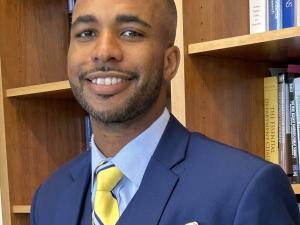
Nestled in East Tower, Rory Rothman's office is at the heart of Ithaca College, if not at the geographic center. And as director of both residential life and judicial affairs, he is well positioned to make an impact on students' experience from orientation to graduation.
The concerns of the two offices overlap more than might be self-evident: residential life oversees the safety and the quality of life in the 26 residence halls and the Garden Apartments; the judicial system is an advocate for students and protects their rights and responsibilities. Both offices thus strive to ensure "security and comfort and an environment that's conducive to learning," in and out of the classroom. Ultimately, both nurture leadership skills, celebrate diversity, and work to build respectful and responsible communities.
As he describes his responsibilities, Rothman repeatedly praises the dedication, talent, and flexibility of his colleagues, stressing, "It's not about me; it's really about all of us working together."
Whether through residential programming or judicial intervention, his staff is committed to students' success, helping students work through conflicts, crises, career decisions, or challenges to their value systems. "Our focus is student development, growth, and education," Rothman says. "We try to treat students as adults and give them freedoms and responsibilities, but with that comes . . . the expectation that they're going to be considerate of others and abide by the rules."
In the residence halls, Rothman says, "There is a very strong commitment to ensuring that we are providing something to students that goes beyond just a place to live." A cadre of student resident assistants supervised by professional residence directors schedule 1,000 educational and cultural events annually, from ice cream socials to time management sessions. Based on a wellness model called SHADES, programming is aimed at enriching students' social, academic, emotional, and spiritual lives and at fostering good health, diversity awareness, and service.
When students violate rules-in about 2,000 cases annually-the goal is not to intimidate or punish but to balance maintaining community standards against helping the erring individual. At what is potentially "a very teachable moment," judicial affairs takes a disciplinary counseling approach-helping students to raise self-awareness, to set limits, to become more conscious of how their behavior is affecting others, and to strategize more effectively in the future.
A student who is believed to have violated a provision of the residence hall rules or the student conduct code will be seen by a professional staff member in a judicial hearing (or, under certain circumstances, a conduct review board composed of volunteer student, staff, and faculty justices). If the student is judged responsible for the violation, an appropriate sanction is assigned. Judicial sanctions range from warnings to expulsion from the College, but many sanctions are educational programs-community service, an alcohol intervention program, an ethics workshop-that Rothman's office has developed. He reports that this approach has been very successful in helping students change. Many have come up to him to say, "I don't know if you remember me, but we had this meeting . . . to talk about a situation, and that really made a difference."
Rothman grew up in Brooklyn and holds a bachelor's degree in psychology and a master's degree in counseling. He joined the College in1984, and continues to work professionally as a counselor, currently with the College counseling center. His wife, former Ithaca College staff member Penny Chick, is associate director for Planned Parenthood, and they have two sons, Jade, 14, and Kyle, 4. Rothman is a sports fan but says his major after-hours priority is "just having family time."