|
|
|
Volume
23, No. 9 January 22, 2001
|
‘Reverberations’ features African Music and MoreThe yearlong lecture and performance series "Reverberations: Music of the African Diaspora" begins its spring offerings with three exciting February programs. On Thursday, February 1, music scholar and pianist Guthrie Ramsey will present a lecture/demonstration, "The Blues and the Ethnographic Truth," at 7:00 p.m. in the recital hall of the James J. Whalen Center for Music. On Friday, February 2, Tutu Jones & the Texas Crew will perform at 8:15 p.m. in Ford Hall in the Whalen Center. Art Jones, an image and sound manipulator, will be the artist in residence for a series of presentations and master classes from Sunday, February 25, through Tuesday, February 27. The series will conclude later in the spring with a March panel discussion and screening of Gotta Make This Journey: Sweet Honey in the Rock and Stormé: The Lady of the Jewel Box, and an April performance by Jimmy Bosch and his all-star salsa band. All events in the series are free and open to the public. "The ‘Reverberations’ series was introduced last fall and turned out to be a tremendous success," says Tanya Saunders, assistant provost for special programs. "People from all walks of life found something to enjoy because there’s something powerful in music that can bring us together regardless of any factors that might otherwise separate us. While our audiences have been captivated by the music in performance, they have also been introduced to history, music theory, and the people who are its creative source." "Reverberations: Music of the African Diaspora" is the result of a collaboration between the School of Music and the Center for the Study of Culture, Race, and Ethnicity. The February events are presented in cooperation with the Office of Multicultural Affairs in observance of Black History Month.
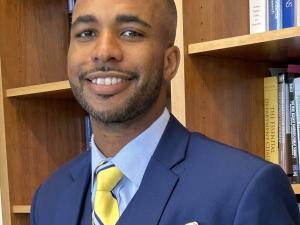
Ramsey has lectured widely on black music topics and serves on the editorial boards of American Music and Black Music Research Journal. He has served on the executive board of the Sonneck Society for American Music. Joining him for his Whalen Center presentation will be Warren Oree, acoustic bass; Kasem Shaheed, drums; and Rick Tate Jr., saxophone.
Jones––whose given name is Johnny––got his nickname as a baby from his guitar-playing father. Born in Dallas, Jones began his musical career at the age of six, playing drums for his uncle’s band. As a teenager, he got the opportunity to play backup for Barbara Lynn, Little Milton, Z. Z. Hill, and Little Joe Blue. Through his work with Blue, he took an interest in the guitar, which led him to playing drums with one band and guitar with another. In 1989 he formed Tutu Jones and the Right Time Showband, which supported Clarence Carter and Denise LaSalle, among others. He has released three albums — Blue Texas Soul, I’m for Real, and Staying Power — and in both his original material and his covers, his playing reveals the acknowledged influences of such Texas blues legends as Freddie King and Stevie Ray Vaughan.
Jones has performed with a variety of musicians and artists, including DJ Spooky That Subliminal Kid, Soundlab, DJ T-Ina, Amiri Baraka, Alec Empire, and Philip Virus. He is currently working on a trilogy of music videos and a new CD-ROM and performs regularly at Deadtech in Chicago and the VOID bar in New York City. During his visit Jones will teach three master classes on music videos and give two presentations: "Music and Political Activism — The Not Channel Zero Retrospective" and "Digital Imaginations of the African Diaspora." "African American Women, Music, and Activism," also in conjunction with Cinema on the Edge, will feature a screening of two films on Wednesday, March 7, at 7:00 p.m. in Park Hall Auditorium. Gotta Make This Journey: Sweet Honey in the Rock, a 1983 work, profiles the all-woman a cappella group Sweet Honey in the Rock, whose members blend musical styles from the African diaspora to communicate their progressive message about race, environmentalism, and feminism. The film was produced by Michelle Parkerson, who directed the 1987 film Stormé: The Lady of the Jewel Box. During the 1950s and 1960s Stormé DeLarverie, an African American transgendered male impersonator, crossed the barriers of homophobia and segregation as the emcee of the legendary Jewel Box Revue, America’s first integrated female impersonation show. Through archival clips, Stormé looks back on the grandeur of the Jewel Box Revue and its celebration of pure entertainment. A panel discussion will follow the screenings, with Gina Marchetti, associate professor of cinema and photography; Naeem Inayatullah, assistant professor of politics; and Louise Mygatt, lecturer in the School of Music. Christina Lane, assistant professor and James B. Pendleton fellow in cinema studies, will moderate.
By age 13 Bosch was playing professionally with local groups. Before he was 20 the top orchestras in the New York salsa scene were calling on him to play, which led to recording sessions and concert tours with some of the greatest artists in Latin music: Manny Oquendo y Orquesta Libre, Ray Barretto, and Israel "Cachao" Lopez. This is when he attended what he calls "the real music university" and learned the monas (musical riffs) that he honed into his current intriguing improvisation skills. For more information on the series, visit the "Reverberations: Music of the African Diaspora" website.
|
|
|
|
|
Andrejs Ozolins, Ithaca College Office of Publications. 19. Jan. 2001