Dissident
poet Yi Ping becomes the first resident writer in Ithaca City of Asylum
-- with some IC help.
by Christi Cox
 |

Yi Ping (right) with writing professor Jerry Mirskin
Photo by Christi Cox |
When Liz Bishop
'04 first read the phrases "Baby grass lead along sunlight" and "Times step in pace
of wedding," she was baffled. She was expected to take these words
--- loose translations from a Chinese poem --- and turn them into
poetry that accurately conveys the poet's intent. Bishop's writing professor Jerry Mirskin had arranged for her
poetry class to help translate several poems written by Chinese
writer Yi Ping, who is living in exile in Ithaca.
A playwright, essayist, fiction writer, and
poet, Yi Ping taught for years at a Beijing university. Because
of his pro-democracy activism he was "relieved" of his job soon
after the 1989 demonstrations in Tiananmen Square. Forbidden
to teach or publish, and with his previously published books
slated for purging, he went into exile.
After a few difficult years, at first in Poland and then in the
United States, he was invited to Ithaca through the auspices of
the Paris-based International Parliament of Writers, which finds
communities that offer asylum and sponsorship to writers needing
protection and help; in return, the writers are available for various
activities. The city of Ithaca is the second such community in
this country. Cornell University, Hobart and William Smith Colleges,
and Ithaca College all contribute to --- and benefit from --- the
Ithaca City of Asylum Project.
Poet Bridget Meeds '91, writing professor Barbara Adams, retired
professors Harvey Fireside and Miriam Brody, and Paul Hamill, Ithaca's
director of academic funding and special programs, serve on the
project's board. With other board members they found housing and
made arrangements for Yi Ping --- with his teenage son, Mao, and
wife, Lin Zhou --- to take an early-morning bus, two years ago,
from New York to Ithaca. It turned out to be a good time to leave
Manhattan. It was September 11, 2001.
Hamill, currently chair of the Ithaca City
of Asylum Project, is delighted with Ithaca College's participation. "This is a unique
opportunity for students to have a close connection with an internationally
known poet and to learn to deal with translation issues," he says. "They
learn an enormous amount about language and culture as well as
about poetry."
After the 20 class members received bare-bones
translations of one or another of Yi Ping's poems, they met
individually with the poet to try to flesh out his intent and
meaning. Some asked about the cultural context in which the poems
were written; others listened to the poet read his work in its
original Chinese to get a sense of its cadence and rhythm. All
were charmed by Yi Ping and fascinated by his experiences during
the Chinese cultural revolution. Maria Cataldo '03 notes that
an important part of the process for her was discovering the
roots of Yi Ping's poetry, "where he gets
his energy and motivation."
For Bishop, it was more than an exciting experience.
As a poet herself (she's part of a winning slam poetry team that
competes nationally), she was concerned about meshing her own
very Western poetic sensibility with that of Yi Ping. "I wanted to be respectful
and do justice to his poetry," she says. What surprised her was
that the Chinese poet told her to make the poem her own --- in
other words, he was encouraging a true collaboration.
Such generosity of spirit, unusual in most
writers, is typical of Yi Ping. "He's a person of great stature and quality," notes
Hamill. Mirskin concurs. "He has not only shared his work, he has
shared his humanity," he says.
This humanity --- as well as the brilliance of his poetry ---
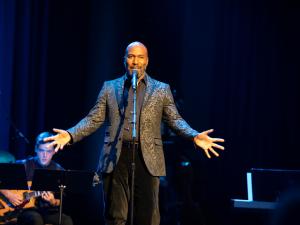
was recently on display at a public reading by dissident writers
of worldwide stature. Yi Ping, one of three featured writers, graciously
asked several of his Ithaca students to join him at the podium
to read their versions of his poems.
 |

Yi Ping's book The Speech of Pebbles, with translations
by Ithaca College students, was published in October by Ithaca
publisher Vista Peridista. |
Yi Ping is pleased with the results of the
students' work. "I'm
very impressed," he says of how the students managed to invoke
the spirit of his original work while pushing the imagery beyond
its original classical Chinese form. "Some used very vivid language," he
observes, adding that he may integrate into his own work some of
the more emotion-laden Western approaches to poetry.
As for Bishop, she's forged a transformation.
After considering Yi Ping's explanations of the phrases, she
has enfolded the meaning in new linguistic and cultural wrappings: "pushing his imagery
in a contemporary direction," she says. "I never would have imagined
myself participating in a translation project; now I know that
the potential is there to share this way as poets. It's been a
fantastic experience."
And what of the "baby grass" and "pace of wedding"? Now, as part
of a longer poem that Bishop has refashioned, they've become "A
wandering union/Where blades of green light shine." |