|
By Robert Hill |
In two recently published books, writing profesor Fred Wilcox recaptures his turbulent salad days and records the memories of a friend, the activist priest Philip Berrigan . |
|
|
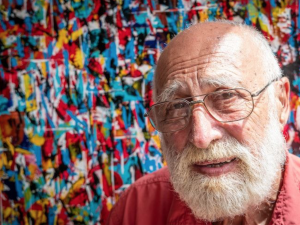
This shiny idealism in his countenance comes, ironically, from having seen it all, or most of it anyway. He has been all-American boy and eccentric adolescent, by turns a pride and a deep puzzlement to his working-class Iowan parents. He has been or been thought to be mental patient, prodigal son, wino, homeless urban drifter, failed college student, successful college student, doctoral candidate, professor of writing, peace activist, author of political tracts, and, most recently, memoirist. He remains fundamentally an ardent moralist, reminiscent of social radicals of the 1930s -- working-class credentials on his sleeve, one eye slightly askance at this academic life he is leading as assistant professor in the College’s Writing Program. Everything began to disintegrate, he remembers, around 1960, the immediate problem being poetry and those crazy beatniks. "When I was about 19 years old and I had dropped out of college, I was writing poetry, I was getting published, and my mother decided that I was pretty crazy. I was, in fact, rather depressed. But a doctor came along and said to my mother, ‘I can straighten your son out.’ " The doctor, being a man of his word, admitted the young man and administered 13 electric shock treatments over a six-week period. "When I got out of the hospital, I felt like my brain had been destroyed. I felt like I had wet sand between my ears. . . . I didn’t recognize people that I’d known all my life." His response was to leave college and Iowa behind. "I went up to San Francisco: I was looking for Jack Kerouac; I was looking for Ginsberg." In 1960 poetry and beatniks were widely considered a recipe for national disaster, and the mixture did not work well for Wilcox either -- unskilled, unschooled, and still reeling from his recent electrification program. But he was quickly disillusioned with the pretentiousness and the middle-class smugness of the North Beach beats who could check out of Bohemia at will and return to the suburbs. "I was just a working-class kid," he says. "I grew up in poverty -- my grandfather was a coal miner, left 19 dollars and a gold watch when he died. That’s the way I saw the world." San Francisco was not to change his perspective on personal fortune: very soon, he had pawned everything and was left to scrounge in Golden Gate Park trash cans for discarded picnics, scoring lunches out of someone else’s cast-off boxes of fried chicken. In that town where little cable cars climb halfway to the stars, there was no foothold. So, in his ’49 Dodge, with a dollar in his pocket, he "coasted" back into Iowa and into a mental ward again -- "pretty much a lifetime label," he reflects. That label was a powerful incentive to leave town. Even though he was never threatened with electrodes again, the fear remained that some doctor might consider them integral to Wilcox’s well-being. By 1961 he was well lost in New York, no longer looking for Ginsberg but rather over his shoulder towards Iowa. "I was not a hippie. I was just more or less a street kid, a poor, working-class kid from the Midwest who was trying to survive and who had determined that I was never going to go back to the hospital again." It is the period from 1961 until 1968 that is chronicled in Chasing Shadows, a "factional" memoir published in October. "I use fictional techniques to write nonfiction," he explains. "So the characters in the book are definitely a compilation of many characters that I met and an attempt to recreate the sound, or the voices, that I heard in the ’60s on the Lower East Side of New York, and in Tompkins Square Park, which is where I hung out for many years." There is Zarro, the quixotic street urchin who changes identities the way he changes tawdry costumes -- spouting Ginsberg in May, in a subterranean Tolkien world by June, each persona enhanced by his latest pharmaceutical preference. There is Mumford, the surly-with-a- heart-of- gold African American who discovers in mid-threat that he and Wilcox shared time in the Iowa state mental facility; Siobhan, a waif who lives with an oversized, saliva-spangled dog in a tenement room crammed with trash collected in street ramblings; Beryl, a stormy Anglo-Saxon transplant whose fortunes rest upon her capacious ability to cajole male affections. The narrative is studded with vignettes of unphilosophical bartenders, philosophical dinner parties, Lady Bird Johnson’s flying appearance (all the flowers and shrubs hastily planted as part of her urban renewal program are promptly dug up and carted away before her limousine hits the airport). The memoir is populous with friends; it imparts a sense of mutual support, sundry kindnesses interspersed with acts of drunken or desperate cruelty. This sense of tempestuous camaraderie seems even more alive in contrast to the stark codas Wilcox has appended to his chapters, briefer passages that tell the parallel story of his ordeal in the mental hospitals of Iowa, detached from the running narrative as a chilling backdrop to the other sort of zaniness that prevails in the main text. Writing the story, he says, proved a critical act of his own growing up. "I started the book 25 years ago . . . little fragments, putting little pieces together. I think what I needed to do was come to terms with my anger, my frustration, and the albatrosses I carried with me." Peeling away layers of his own history while he overlaid his manuscript with new and deeper lines. By 1968, eight years away from college, he reenrolled in the University of Iowa, graduated, and returned to the East Coast, enrolled this time in the antiwar demonstrations over Vietnam. On May Day, 1971, attempting to shut down the national capital in protest, Wilcox had his kneecap smashed by a policeman’s club. "The Vietnam War changed my perspective on everything. I was a true believer when I graduated from high school -- I was an anti-Communist, I was an all-American. . . . The more deeply I got involved in the antiwar movement, the more I began to reconsider and reevaluate much of what I had learned." Forms of dissent have evolved since the early ’70s; its focus has shifted, its characters have come and gone. The activist priests Daniel and Philip Berrigan have remained perennials. Wilcox’s first brush with the brothers was a meeting with Daniel in the early days of his rising social consciousness. "I had heard about the Berrigans, heard about Catonsville -- that is, when the Berrigans went into the draft board office and poured blood on draft files. I was back in Pennsylvania and we went to Mary Bye’s farm outside of Bucks County. Dan Berrigan was speaking there. He was on his way back to prison, and he basically lambasted the people there. ‘This is a nice sunny day. It’s a nice thing to be out here and be all comfy, but it’s not enough and you’re not doing enough.’ He was not very friendly; he was not very kind to us who had come out to hear him. To be honest, I kind of liked that: I realized that I wasn’t doing enough, that I wasn’t really doing much of anything." This was his second lesson in civil disobedience, the first being his broken kneecap. The Vietnam War no longer a point of focus, Wilcox recognized that while American dissidents had been concentrating on that single issue the international arms race had gone unabated and nearly unnoticed. The lesson of Daniel Berrigan on that autumn afternoon in Pennsylvania had taken root. "I concluded, at least for myself, that I could talk about the arms race, that I could teach about the arms race, that I could write articles about the arms race, but that wasn’t enough. I really felt that I needed to take some direct action: I needed to put my body and my well-being, so to speak, on the line. I needed to go to Seneca Army Depot, climb that fence, jump to the other side, commit an act of disobedience." That action, taken during the war in the Persian Gulf in 1991, earned him 200 hours of community service. His friendship with the Berrigans, especially Philip Berrigan, has continued for a decade now. He and Philip met at Atlantic Life Retreat, an annual gathering of antiwar and Plowshares activists. Wilcox’s 1991 book, Uncommon Martyrs, describes some of the characters and actions of the Plowshares movement, in which the Berrigans and their associates committed acts of protest on military bases. And Wilcox has just written, based on interviews with Berrigan, an imaginatively constructed narrative in the form of the priest’s autobiography. Fighting the Lamb’s War: Skirmishes with the American Empire was published last fall, about the same time as Wilcox’s own memoirs. His personal history has politicized him, and it shows in what he writes. "My writing is, I suppose, fundamentally political and I have been writing, for many years, things that are critical of the United States government, critical of the military." Published in 1981, his first book, Grass Roots: An Anti-Nuke Source Book, is something of a how-to manual of protest against the growing American nuclear arsenal. His second book, the 1983 Waiting for an Army to Die: The Tragedy of Agent Orange, recounts in novelistic form the cases of particular soldiers exposed to the defoliant widely used by the American military in Vietnam. "And yes," he readily admits, "I bring those things into the classroom because I find that my students are remarkably uninformed. I look at them and I see the 18-year-old kids that went off to Vietnam. I think it’s important for me to go into the classroom and talk about people that my students have never heard of and talk about what I consider the great issue of our time. And that’s violence, and how, as Americans or as people of the world, we’re going to end violence. "My effort," he continues, "is to combine scholarly research with compassion. One of my complaints about academia is that it tries to make people live from the neck up. It makes things very abstract -- violence, racism, poverty, homelessness. I try to bring my experiences into the classroom carefully. I think it’s very beneficial for students to hear of my experiences. I think it helps them to understand that homeless people are not ciphers, they’re not abstractions, but they’re real people who, through a variety of circumstances, wound up down and out." This rising level of social awareness in his students is also part of their personal development, and Wilcox artfully cultivates these in his pedagogy. "I try to get my students to realize they make a difference, and they make a difference just by what they say and just by what they write. Once they realize that, they leap from the passive voice, from abstract phrasing, right into clear phrasing, active voice, being able to take responsibility for what they’re writing. When they do that, I think they’re beginning to take responsibility for how they’re living."
|
Table of Contents -- ICQ Home Page -- Ithaca College Home Page