Ithaca College Quarterly 1999/No. 4

Class Notes -- Profiles


Winging It

John Del Giorno '92 brings stories to his New York audience — live from his chopper.

By Dan Higgins

"When I left high school," says John Del Giorno ‘92, "I was going either into the coast guard to learn to fly, or to Ithaca College to do television and radio. Frankly, I chose what I thought would be easier — and went to Ithaca." Now Del Giorno gets to spend his days in the air and use the training he received in the Roy H. Park School of Communications.

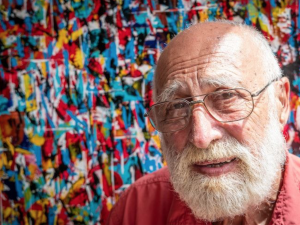
John Del Giorno ‘92Del Giorno is the lead reporter and camera operator for NewsCopter 7 — the eye in the sky for New York City’s ABC television affiliate. Although he always dreamed about flying, Del Giorno never thought he would have the opportunity. He started his career on the radio, as an afternoon traffic anchor and producer for Metro Networks, a freelance news service. "One day my boss asked if anyone had video experience. I said, ‘Hey! I have a degree in that.’ " Channel 7 contracted with Metro Networks to provide helicopter coverage, and Del Giorno suddenly found himself flying high above the breaking news and traffic snarls of the New York metropolitan area.

He begins his workday monitoring the morning commute. "That takes two hours," he says. "I do five or six traffic reports an hour, and then I go back to the heliport with my pilot and stand by, waiting for the beeper to go off. It’s kind of like being a firefighter — waiting around for something to happen." What Del Giorno is waiting for, in news parlance, is a "chopper-tunity."

"A ‘chopper-tunity,’ " Del Giorno says with a laugh, "is anything we can take a picture of from the air: a fire, a car accident, something like that. A helicopter can often be the first news resource on the scene, and we can deliver the five Ws quickly." As an example, Del Giorno says he and his pilot can fly to the scene of a fire and moments later deliver the preliminary (but nonetheless important) information. "We can at least tell you what is happening, whether or not people are being removed on stretchers, the number of alarms called in, and which streets are closed off as a result."

When the beeper stays quiet, Del Giorno and his pilot take off again in the late afternoon. "From about 4:30 to 6:30, we ‘cruise for news,’ " he says. "We get 30 to 40 percent of our stories that way." Del Giorno says he looks for telltale signs of something news- worthy, like plumes of smoke or a caravan of emergency vehicles. Just the other day, he says, "we saw a thick cloud of smoke about five miles away, and we checked it out. It turned out to be a pretty big fire, and we used it as our evening story."

News helicopters have come into their own in the past six years. "A news chopper used to mean a guy with a shoulder camera leaning out the door. Now the video and broadcast equipment we have on board is easily worth more than the helicopter," Del Giorno reports. "A camera is mounted outside the helicopter. It can read a license plate from 1,000 feet and costs about $300,000." A gyroscope built into the camera prevents it from shaking — gone are the days of vibrating, nausea-inducing helicopter images.

Del Giorno says he uses almost everything he learned as a television-radio major in the Park School in the space of a 60-second report. "In the ‘ship’ I’m the talent, the director, the engineer, and the camera operator." He uses a foot switch to move from the outside camera to the camera he trains on himself for live reports. He also sets up the microwave broadcast link between the helicopter and the studio.

Del Giorno’s first big story was the 1996 crash of TWA flight 800 off the coast of Long Island. The enormity of the tragedy didn’t register with him until the next day. "We just concentrated on getting the story out," he says. "We flew out to the crash site again the next day — and there was nothing there. That’s when I realized just how tragic the event was. The flip side of the incident was that it proved helicopters are a legitimate tool for gathering news."

More recently, Del Giorno was on assignment over Martha’s Vineyard in the wake of John F. Kennedy Jr.’s plane crash. "That marked the first time the networks pooled their video footage," he notes. "There were four helicopters circling the area, because we all wanted video of the recovery [of the crashed airplane and its victims]. The problem was we had no idea when the recovery would happen, and the time we could spend waiting was limited by our fuel tanks." Del Giorno says that pooling the video allowed some networks, like MSNBC, to run continuous footage from the search site all day, and none of the networks would miss the shot they needed while they were refueling.

Del Giorno credits two Ithaca College professors for helping him get where he is today. He calls his former adviser, TV-R professor Wenmouth Williams, "one of the best guys I ever met in my life." Del Giorno cites Williams’s "down-to-earth approach" to teaching, as well as his willingness to talk about things other than school, as traits he admired. And former speech communication professor and chair Gus Perialas taught Del Giorno a skill that has become vital to his work: extemporaneous speaking. Del Giorno says he admired the way Perialas challenged him, because, he says, "I never did a lot of public speaking. When I worked for ICTV, I was a behind-the-scenes guy — directing, engineering, and producing. These days I don’t get a chance to write much down while I’m in the helicopter. Almost every report I give is an extemporaneous speech."

As far as the risks of flying every day are concerned, Del Giorno isn’t worried. "I’ve been doing this for over four years, and I’ve never reported on a helicopter crash. I compare that with reporting two to three fatal car accidents a week. I trust my helicopter, and I trust my pilot. It’s inherently safe."

And does Del Giorno enjoy his job? "It’s different every day," he says, and that makes it always interesting. And there are other benefits, as well. For instance, he adds, "I’m never stuck in traffic."

 
noneTable of ContentsIthaca CollegeIthaca College Quarterlynone

Created and updated by Andrejs Ozolins, Ithaca College Office of Publications 2. Jan. 2000