| |
by Lorraine Berry
At 23, David Klein quit
his job, moved in with his parents, and started his own business.
Five years later he sold that business for $5.3 million. Since
then, his business ventures have netted him close to $30 million.
Yet now, at 33, Klein is much more interested in the things that
money cannot buy.

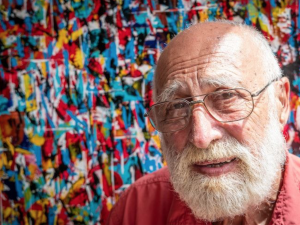
Klein at a favorite getaway ("The most beautiful place I've
ever been"), where he goes to recharge |
Klein first got the idea to start his own business
while driving one day. "I was working in the car business, financing and leasing
cars," he says. "I was traveling to my parents' house, and I saw
a billboard that said Your Ad Here. There was a phone number listed,
so I called it. It turned out that that billboard rented for more
in a month than I was making in a year." And an idea was born.
Klein left his job, moved back home, and started
Klein Outdoor Advertising. "I went to the library every day for six months," he
says. "I read every article I could find --- anything to do with
billboards. I read articles on general terminology, where the industry
was going, its direction --- really anything to learn what ever
I could. It worked because I devoted myself full-time to it.
"Once I knew what I was doing, I scouted for billboard locations," he
says. "I went from property owner to property owner to get permission
to place them." While looking at maps of the New Jersey highway
system, Klein noticed that the railroad tracks ran parallel to
the roads. So he contacted Conrail's real estate department, negotiated
a deal --- and an ad business was born. "It took 18 months from
the time I started [research] to the time I built my first sign."
The work of placing a billboard, says Klein,
is a series of negotiations --- with property owners to lease
the land and with various state
and local planning boards to secure the necessary permits. Klein
credits his personal success to his political skills, acquired
in part from his coursework. "Being a politics major at Ithaca
College taught me how things work," he says. "Everything in the
world is politics. You learn who can help you how --- both with
your friends and with people you do business with. Real estate
development is the same process as politics --- personal relationships
are the key to success. It's who you know." It's not a process
that happens overnight, Klein admits. "I can't tell you how many
phones were hung up on me, how many doors were shut in my face." But
persistence paid off: "Now everyone calls me," he says.
"Ithaca College was a great place to grow up and learn to deal
with other people," he continues. "There were many times in the
classroom when I wondered how what I was learning [would do anything]
for me in the real world. Now I recognize that the things I learned
apply to other things besides what was in the textbook."
Klein sold the original business five years
ago and now travels between a Manhattan apartment, a New Jersey
house, and a Florida
condominium. He is still in the billboard business, but in a different
capacity. His company now does the legwork necessary to build the
billboards --- acquiring permits, leasing the space, etc. --- then
sells multiple billboard locations as a package deal to other companies.
He has a staff of two: "a personal assistant who handles my life,
and Eric Bosniak, a friend, who handles all the day-to-day operations," he
says.
At 33, Klein would appear to have it all: money,
multiple homes, a jet-setter lifestyle. But something happened
October 19, 2001,
that irrevocably changed his life. "I was driving with my girlfriend,
Lillian, on a street in South Beach [Miami]," he says, "when we
were hit by a motorcycle going 130 miles per hour. The motorcycle
driver was riding on one wheel, doing Evel Knievel - type tricks." The
motorcyclist was killed; Lillian was permanently disfigured. Klein
suffered severe burn injuries on his arms, hands, and shoulders,
and he has had 11 surgeries since.
All of the struggle that went into creating
his business is puny, Klein says, compared to the everyday reality
post-accident. "I
would give every cent I have and then some --- I would borrow money
--- not to have gone out that night," he avers. But he refuses
to dwell on the accident. He thinks of everything that has happened
to him this past year as further learning. "I've learned that there
is no such thing as control. I've learned the importance of good
people and good friends."
Klein says he used to smile indulgently when
his grandparents would tell him that health was the most valuable
thing you could
possess. "Even when the business had taken off, my parents would
always tell me that the most important thing was not the money
--- it was to just be happy. My financial success is not everything
that I used to think it was. It's the people and family around
you. Now I understand and appreciate the value of a day. You never
know when it's your turn."
|