Back

H&S

  Music from All Over

Multicultural Perspectives in Music Education, taught by second-year assistant professor Baruch Whitehead, is giving students a chance to learn about music traditions they're not familiar with. Whitehead also teaches Worlds of Music, a new course for nonmajors that explores these same musical traditions, but without the pedagogical focus.

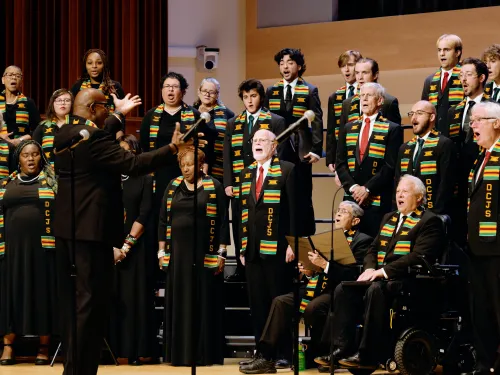
Whitehead and musicians
Whitehead with some of his young musicians

An oboist by training, Whitehead was director of athletic bands at Marshall University before coming to Ithaca. One of his specialties in music education is the Orff-Schulwerk method, a creative teaching approach developed in the 1920s that relies on kids' instincts to get them started with various instruments. Whitehead has taught numerous certification workshops in Orff and frequently attends workshops in African drumming, Native American music, and the music of Asian cultures.

Unlike in other music education classes, where students come in al ready familiar with the music they're learning to teach, the students need to learn the sources of what they will one day be teaching. The course covers Native American, African and African American, gospel, Chinese, Japanese, Indian, Jewish, and Appalachian music. Wherever possible, students actually perform the music they study, using instruments from the school's collection as well as instruments Whitehead has acquired or, in some cases, made himself.

To illustrate the value of understanding a genre's context, Whitehead cites the music of Africans who were forcibly assimilated into North American culture as slaves: "Music was really the only outlet they had; their whole spiritual side was poured into it, and their hope for a better future came alive in music. We can perform their music today, but that understanding of why it was created and how it was used gives a richness of meaning and depth of emotion that's really essential."

Another example he gives is the music of India. There, says Whitehead, "techniques that are for us [considered] really advanced are quite basic. Their simplest rhythms, instead of being regular, might be what we call compound, with irregular beat lengths. They simply think differently. Ithaca students, once they stop trying to figure out what the meter would be in their comfort-zone Western system, can pick up the idea quite quickly."

Whitehead's student Kristin Zaryski '04 says, "I appreciate the way Dr. Whitehead blended teaching about the different musical genres, having us perform them, and discussing and demonstrating how to teach them. We observed and practiced a wide array of teaching styles. I particularly had fun with the African drumming -- all of us beginners just sat down and drummed for 45 minutes, and I wasn't bored for a minute!"

A valuable resource for observation for this class is an outreach project that White head began last year. With the Greater Ithaca Activities Center, he and his students work with some 30 local children, mostly minorities, in an after-school program. GIAC Fe Nunn '80, a musician and music educator, and musician/songwriter Jeff Claus, associate professor in IC's Center for Teacher Education, are collaborators. The groups meet to make music twice a week. Each participant selects from keyboards, djembe (an African drum), or xylophone-like Orff instruments for his or her performance medium.

"Our purpose," says Whitehead, "is twofold: to expose the children to a wide array of the performing arts through contact with the Ithaca College students and their performances, and to give them the experience of performing." And perform they do: last year they performed for Martin Luther King Day at GIAC, with the Ithaca Children's Choir at IC, in the Ithaca Festival, and at Juneteenth festivities downtown. This year they're lined up to perform with a Syracuse gospel choir, IC's klezmer band Schmutz, and the community-based Multi cultural Chorus, which White head leads.

At a recent session some new drummers were starting out with the djembe group. After a brief greeting Whitehead wordlessly showed them how to tilt the drum slightly, then played a short rhythm. The group played it back and began repeating it. White head called out to the player standing on a chair to play the huge bass Orff instrument. The bass line joined in. Whitehead gradually demonstrated how various drummers should change their rhythm slightly, and the texture became more complex and interesting. Finally, White head burst into song over the drumming in a call-and-response style, the drummers echoing.

So within about five minutes, several 8- to-10-year-olds were making music, some for the first time, without any explanation or reference to printed music. When an observer expressed awe, Whitehead smiled and replied, "That's the aural tradition."

Photo by Tom Hoebbel
   

Contacting the College Directories Site Index Ithaca College Home Ithaca College Home

A. Ozolins, Ithaca College Office of Publications, 3 March, 2004