|
 |
An innovative staff program helps people from across campus build managerial skills.
by Bruce Stoff |
Not long ago Jill Moreland was asked to climb a 40-foot pole, stand atop it, and then dive off. She did. The lessons she learned on the way down are benefiting Ithaca College students and staff today.
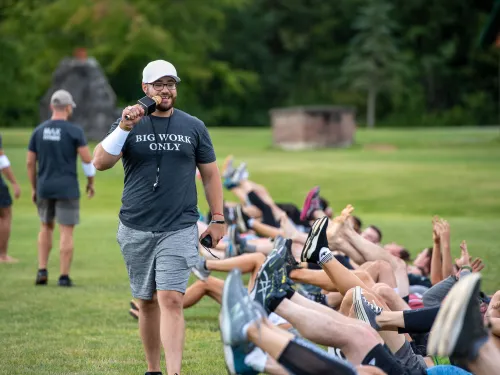
Moreland, IC's associate director of financial aid, was participating in the College's "LeaderShip" staff development program. The "Pamper pole," with its white-knuckled climb and carefully tethered descent, was just one of many obstacles she and her colleagues overcame during a day of LeaderShip training. Named for the popular diaper (a piece of protection that participants claim is every bit as appropriate as a harness), the Pamper pole is a key feature at the Hoffman Challenge Course, a Cornell University site in Varna, New York. With its high ropes, catwalks, rappelling walls, zip lines, and physical puzzles, the course is designed to help participants overcome personal limitations through teamwork and group problem solving.
"It was an amazing, eye-opening experience," Moreland said. "I did things there that I never would have done before." Moreland says the jumping experience especially was a leap of faith. From the pole top, she was asked to jump to a trapeze and from there be lowered to the ground. Although she was protected by a harness and safety line, it was still a monumental challenge. "I'm not athletic," she says. "I'm not sure I'd have been able to do it without the support and encouragement of my group."
Of the 14 workshops that comprise the LeaderShip program, the high-climbing challenge course is among the most memorable for participants. But it's actually the program's least unique feature. "Management training programs are everywhere, and a lot of them use challenge courses," says Mary Tomaselli, staff development manager in human resources and the driving force behind the LeaderShip program. "That's not what sets ours apart. LeaderShip is unique because it's open to everyone. I don't know of any other program that says leadership is for everyone."
The only prerequisite for entering LeaderShip is an aspiration to lead, no matter the participant's current job level. The program helps participants develop the core skills of self-assessment, relationship building, networking, communication, coaching, and teamwork that ultimately become the tools of leadership. The goal is to help employees at all levels become able to be professional leaders, thereby aiding the institution in its overarching goal of setting the standard for comprehensive colleges in the United States. "LeaderShip gives you a toolbox of skills: communications, decision-making, team-building, dealing with interpersonal situations. It's a good foundation for moving forward, both professionally and for the institution," says David Weil '87, M.S. '88, director of Web, systems, and departmental services.
LeaderShip is a comprehensive, yearlong program built around a series of full-day, off-site workshops that address a variety of management skills--from reflective self-awareness to using humor in the workplace. Participants meet monthly and augment the sessions with Web-based discussions and small-group assignments. With attendance capped at 26 per session and carefully managed to ensure that participants don't have reporting relationships in their divisions, the program is intimate, lively, and highly interactive. "You check your job title at the door and get to know each other as individuals," says Tomaselli.
Moreland concurs. "It really forces you to think about yourself and how you interact with other people. The internal piece is way more challenging than the physical. I'd get done with a workshop and be exhausted from thinking all day."
LeaderShip stresses cultivating a sense of group purpose. Such a focus might seem obvious at an institution where everyone has the same purpose--to give students the best possible academic and residential experience. But not everyone on campus has the same function, of course, and often people in one section of the College don't interact with people in other areas. "Working in human resources," says Tomaselli, "I'm in a position to know many people on campus. It's amazing how much more you can accomplish when you have personal connections. But most people don't have that luxury."
Tomaselli got the chance to change things for her coworkers when her staff development position was created three years ago. The job had no set agenda, just a mandate from President Peggy R. Williams to succeed. "I had a clean slate," Tomaselli says. "So I got out the Institutional Plan and looked at where I could make a difference with staff development."
Tomaselli first checked other institutions to determine if existing programs could be tailored to meet the specific needs of Ithaca College. She found none. "I didn't want to reinvent the wheel, but I guess that's what we ended up doing," she says. She assembled a 16-member advisory committee, representing diverse departments and position levels across the College. Tomaselli credits this group for LeaderShip's success and the overwhelming support and excitement the program has garnered. (There are three applicants for every available seat and a six-month waiting list to get in.)
In part, the demand stems from the quality of LeaderShip's expert presenters. They are among the best in the business, coming from within the College, from the Ithaca community, the region, and the nation. Among them, nationally known lecturers and management consultants Suzanne Forsyth and Mary Parish conduct workshops on emotional intelligence. Judy Saul, executive director of the Ithaca Community Dispute Resolution Center, offers expertise on conflict management. Clint Sidle, director of the Leadership Fellows Program at Cornell University's Johnson Graduate School of Management, works on leadership communication skills. And President Williams conducts seminars on the power of humor in the workplace. "I gave everybody red foam clown noses to wear that day," Tomaselli remembers. "The look on Peggy's face was priceless."
In an era of lean budgets, such frivolity might seem difficult to justify. In that respect, LeaderShip offers another surprise. By creating and administering the program in-house, the per-person cost is almost half that of commercially available products. "And," says Tomaselli, "we have a better program. LeaderShip is customized exactly to our needs."
And it is producing results. Graduates have told Tomaselli that they are actively contributing ideas to improve campus management, something they wouldn't have attempted before. Others say LeaderShip training was instrumental in earning promotions. On one occasion, subordinates of a LeaderShip grad contacted Tomaselli to rave about their supervisor's on-the-job improvement. Later, that supervisor's boss came forward with an identical report. Neither boss nor subordinates were aware of the other's report. "You seldom get that kind of unsolicited, 360-degree feedback," Tomaselli notes. "That's the kind of information that tells me this is really working."
And in subtle but tangible ways the program is directly benefiting students. In her role as assistant to the bursar, Terri Reyna often works with students on complex billing and payment issues. Her ability to discuss those issues with the students and their families has improved through LeaderShip training. "It helped my communication skills," she says. "People perceive what I'm saying the way I intend it."
Moreland noticed the same thing working with students in her office. "My interaction with students has definitely benefited," she says. "Students are coming back to me with fewer questions. I find better ways to explain the complexities of financial aid to people who aren't as familiar with the subject as I am."
Both Reyna and Moreland found yet another benefit. Through LeaderShip they made valuable personal contacts with people in other offices. "I've got personal contacts all over campus," says Moreland. "Now when a student needs help from another office, I can call someone I know from LeaderShip and say, 'I've got a student here with a problem.' We can work together and get it resolved right away." David Weil concurs: "LeaderShip is building more cohesive groups and partnerships among staff throughout campus. That translates directly to better services for students."
It's a testament to what people can accomplish--after they've shared a leap from a 40-foot pole.