Can You Dig It?Rich Newberg '69 brings lessons of the 1960s to his work as a journalistic seeker of truth.
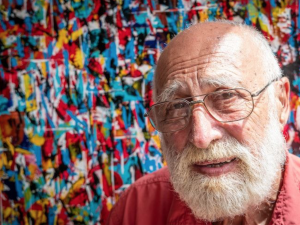
Something in the young business administration major’s mind must have told him he was destined not to follow in his father’s footsteps and become a CPA. Rich Newberg arrived at Newberg managed to complete the requirements for the business administration minor, but he switched to a TV-R major in his sophomore year. From then on he practically lived in the Dillingham basement, where TV-R was housed. It was “experimental, a real ’60s place,” he says, “where we were just starting to learn that TV can be used as a medium to affect social change.” Newberg learned that lesson well. Four decades later, he is a senior correspondent for Newberg’s early inspiration began in classes with Rod Serling, creator of the Twilight Zone TV series, who was then a visiting professor. “Serling would have us watch Twilight Zone episodes, which always carried a moral message—about discrimination, greed, lust, et cetera,” Newberg recalls. CBS newsman Edward R. Murrow, whose work lent a voice to the downtrodden, was another important influence. “I always got it,” says Newberg, “and that purpose has stayed with me ever since.” Newberg remains “committed to TV journalism for the sake of social justice.” After getting a master’s degree in news and public affairs at Michigan State University, he landed his first job—back in Ithaca as anchor and news director at the cable station WCIC-TV. After two years he left to take a cross-country trip with a friend, during which he used a tape recorder to “interview everybody across Newberg went on to three successive jobs as an “action reporter” and “troubleshooting reporter” in In 1978 he joined his current station, WIVB, and spent 16 years in the anchor chair. But his reporter’s notebook was perpetually in hand, and he found himself jumping at any opportunity to work on documentaries. His first departure in that direction came in 1983, when the station sent him to That same year he turned full attention towards what had become a lifelong search to understand the Holocaust. It had been sparked by a 1968 trip to Europe during which he visited Ann Frank’s house and walked through the The “Over a period of six months I was able to sit down one-on-one with people whose lives were deeply affected by this tragedy,” he says, “and it was then, for the first time in my life, that I could finally grasp the depth of the horror of the Holocaust.” That experience reinforced an important journalistic lesson for him: personal stories are valuable as a vehicle for grasping a bigger picture. Around the same time, Newberg had several in-depth interviews with Nobel laureate and Holocaust survivor Elie Wiesel, who applauded Newberg for the film. Wiesel “taught me that one voice can break a chain of evil,” Newberg says, “and that to say nothing in the face of evil is to become a part of the problem.” His next Holocaust film came a decade later. In 1994 a After these documentary successes, the station realized his real passion and talent were in reporting. In 1999 he was named senior correspondent. While he still contributes to the nightly news broadcasts, that position has allowed him to knock out a steady stream of social-issues documentaries, among them A Life in the Balance (1999), about the stigmas faced by psychiatric patients, and Our Two Most Cherished Rights (1999), about the abortion debate, for which he won his first Edward R. Murrow Award for Writing. He won his second for a film about black Buffalo-area jazz musicians and has done several documentaries on the city’s African American history. Last year he hosted and coproduced a doc on the history of Shea’s Buffalo Theater movie palace, another Emmy winner, and in December his special on the Newberg’s own family has become the subject of his documentaries, including one set on a vacation in Newberg increasingly frets that there is “never enough in-depth reporting on social issues on TV, or shows educating the public about important events and ideas.” He finds this disheartening. “TV is too ratings-conscious,” he says. “We wait until there is an explosion rather than presenting the issue while the fuse is burning. As a result, journalists are unable to play a constructive role in giving the public the critical information needed to address the issues before they explode in our faces.” The solution? “More documentaries,” Newberg says. “TV in general must also do a better job of shaping social conscience. These [may be] ’60s-sounding words, but they apply today.”
|
|||||||||||||||||||
|
|
|||||||||||||||||||