Coach Confidential

By Patrick Bohn, September 19, 2025
Four IC coaches share how their unique recruiting processes bring students to IC and lead to success on the fields, pool, court--and classroom.

Tara Stilwell ’19 M.S. '22, IC’s head volleyball coach, might have been a tad overwhelmed when she walked into the 350,000-square-foot Georgia World Congress Center in Atlanta last March for the Big South Qualifier—the largest indoor girls’ junior volleyball tournament held in one weekend in North America. “There’s approximately 200 courts with 1,200 teams competing on them over the course of three days,” she said. “When you’re inside, you just see thousands and thousands of athletes and hear nothing but whistles.” The resulting cacophony may seem chaotic. But Stilwell (and her assistants) are experts at deriving calm from the commotion, using events like this to find a handful of athletes to make up the next recruiting class for volleyball.

Victory over Cortland and IC’s other rivals isn’t achieved just on the field of play. For the two dozen head coaches at Ithaca College, the most crucial part of their job takes place as they travel to high schools and convention centers across the country to scout their next class. “I’d say that more than half my time as a coach is spent focused on recruiting in one way or another,” said Mike Toerper, IC’s head football coach. “We’re always in some phase of looking at our next group of student-athletes.”

These student-athletes collectively represent a quarter of the enrollment of the Ithaca College student body—which means coaches’ job descriptions go far beyond athletics. “Our coaches are more than enrollment ambassadors. I view them as recruitment experts whose efforts attract students who make IC a better place,” said Rock Hall, the college’s vice president for enrollment management and student success. “Coaches amplify our efforts and build lifelong relationships not only with each student-athlete that they recruit but their families as well.”

IC’s Division III sports each have their own strategies for bringing in the latest group of student-athletes, focusing not just on their athletic skill but their personalities as well.

A Numbers Game

Like many colleges, especially in the Northeast, Ithaca is battling shifting demographics as it strives to meet its enrollment goals. With fewer students projected to graduate from high school in the Northeast over the next 10–15 years, colleges are contending for pieces of a smaller pie where student-athletes are a critical component of the college’s overall success.

In 2023, Ithaca had 236 first-year student-athletes, out of a total of 1,025 students in the class, representing 23% of all first-year students—compared with just 16% in 2015. That robust figure is possible in part because the yield rate, the percentage of accepted students who choose to enroll, for student-athletes is significantly higher than the rest of the student population. According to the Office of Admission, this year’s yield for recruited athletes is over 30%, while the average yield for all other students is around 13%. But enrollment success isn’t just measured by the number of students stepping onto campus for the first day of classes. Seeing a student graduate with a degree is the ultimate goal.

“Our coaches not only shape the futures of young minds but also foster a supportive and inspiring environment. I deeply appreciate collaborating with such exceptional professionals who play a pivotal role in our students' success."

Nicole Eversley Bradwell, MS ’02, executive director of admission

Once on campus, student-athletes are more likely to stay. On average, student-athletes have higher third- and fifth-semester retention rates, meaning fewer transfer or leave school completely, and they graduate at a higher rate as well. This has everything to do with the coaches who are skilled at supporting the success of each of their players as athletes and as students. “Our coaches not only shape the futures of young minds but also foster a supportive and inspiring environment,” said Nicole Eversley Bradwell, MS ’02, IC’s executive director of admission. “I deeply appreciate collaborating with such exceptional professionals who play a pivotal role in our students' success."

But there’s no one-size-fits-all approach to bringing in a recruiting class. Because of the structure of some high school sports, recruiting travel is more of a priority, meaning massive invitationals rather than individual games are key. And coaches sometimes need more help scouting in order to bring in as many as 30-40 players each season, the way football requires each year.

Football: The Road Warriors

If you’re looking for podcast or audiobook recommendations, the best place to start may be with Mike Toerper and his staff. IC’s head football coach and five of his assistant coaches spend most of their time in early May on the road, traveling to high schools across the state as well as Pennsylvania, New Jersey, Massachusetts, and the Delaware-Maryland-Virginia beltway area.

How many stops? All told, Toerper estimated that his staff visits 250–300 schools during their mid-May recruiting swing, meeting with more than a thousand athletes. This past spring, Drew Miller '21, the offensive line coach, visited 59 high schools in just 10 days (May 12–22). “It’s definitely a lot of traveling,” he admitted. “The key to successful recruiting in Division III is organization, efficiency, persistence, and consistency.”

That organization starts with a divide-and-conquer approach. Each assistant coach is responsible for an area of the team’s recruiting footprint in addition to an out-of-state area. Toerper is responsible for Florida—a state with no Division III football programs—as well as the program’s top overall targets. And plenty of thought goes into which coach goes where. “Everything about the recruiting process is relationship-based,” Toerper said. “Our job is to turn those relationships into commitments. So, when we hire a new coach, we’ll shuffle around recruiting responsibilities based on their existing relationships.”

That’s why Miller, who went to high school in central Pennsylvania and recruited the eastern part of the state while on the staff at St. Lawrence, is responsible for recruiting those areas for the Bombers. “It was a natural fit for me because I already knew lots of the coaches and programs in that area,” Miller said. He also serves as the team’s recruiting coordinator, which means he oversees that second pillar of recruiting success: efficiency. He keeps spreadsheets that provide hour-by-hour breakdowns of the high schools each coach is visiting each day. “That way, if there’s a problem or a question, they can come to me first, rather than Coach Toerper,” he said.

But the May travel schedule is just two weeks of the team’s yearlong recruiting calendar, which also includes periods where they visit prospect camps, make phone calls to players and coaches, and invite players to campus for their own camps and official visits. The team holds a pair of prospect camps on campus over the summer for a combined 160–200 athletes. This chance to compete under the Butterfield Stadium lights and see Ithaca is a huge draw. Toerper said that 18 players in his incoming 2025 recruiting class attended one of those camps in 2024.

“Mike Toerper and his coaches help to saturate our prime markets ... and their visits give Ithaca College greater exposure beyond academics or the arts. The multi-pronged recruitment strategy creates familiarity with Ithaca College and the high schools within [New York, Pennsylvania, and New Jersey], and building and maintaining relationships in these states is a focus of our overall recruitment efforts.”

Rock Hall, vice president for enrollment management and student success

September through November means he and his staff are focused on the season, but recruits are invited to watch a game at Butterfield. Players’ official visits come during the winter months. “Our goal is to get a player to visit campus at least three times during their recruitment,” Toerper said. “For us, that equals a high yield rate.”

Every time one of his staff meets with a player, they emphasize three things: the quality of the football at Ithaca, the elite academic experience and alumni connections offered by the college, and the fact that Ithaca is routinely named one of the top college towns in the country. This all adds up to the Ithaca name and brand consistently reaching high schools in the region, as more than 80% of the players on the team’s roster hails from New York, New Jersey, or Pennsylvania.

But it’s not just players and coaches who know Ithaca College. “I love talking to players’ parents when we’re on the road at prospect camps,” Toerper said. “It’s important that they’re excited about our program, too. And we’re able to find out more about what they’re looking for in a college experience for their sons, which is critical.”

“Mike Toerper and his coaches help to saturate our prime markets,” Hall said. “His staff visit many of the same high schools that our central admissions team does, and their visits give Ithaca College greater exposure beyond academics or the arts. The multi-pronged recruitment strategy creates familiarity with Ithaca College and the high schools within these three states, and building and maintaining relationships in these states is a focus of our overall recruitment efforts.”

Volleyball: Everything Everywhere All at Once

Because elite high school volleyball players compete as part of traveling club teams, Stilwell and her staff don’t need to bounce from high school to high school seeing a few recruits at a time. Instead, they attend massive tournaments where the best players in the country compete with and against each other.

How does Stilwell make sense of the chaos at a place like the Big South Qualifier? There’s an app for that. “It’s called University Athletes, and it’s got every club player in the country in it,” she said. “So when I’m planning to attend a tournament, I can open the app, see all the athletes we’re recruiting who are going to be there, and then when the tournament starts, I can see who’s playing on what court when. Last year, we tagged more than 200 athletes at the Big South Qualifier.”

Throughout the year, athletes can upload film from their club competitions and email coaches to let them know where their club teams will be playing. Likewise, Stilwell can let potential recruits know what events her staff will attend. “The club system allows us to see so many athletes at once without needing to go to their hometowns,” she said. “I’ve got an incoming player from Michigan, and I never went there to recruit her.”

“The club system allows us to see so many athletes at once without needing to go to their hometowns. I’ve got an incoming player from Michigan, and I never went there to recruit her.”

Tara Stilwell ’19, M.S. '22 head volleyball coach

In addition to massive invitationals, Stilwell and her staff attend camps across the country in Los Angeles, Wisconsin, Illinois, and Connecticut hosted by club teams that allow college coaching staffs to attend. Some are even created specifically for student-athletes with high academic aspirations, so they know the athletes playing there will thrive in IC’s academic environment.

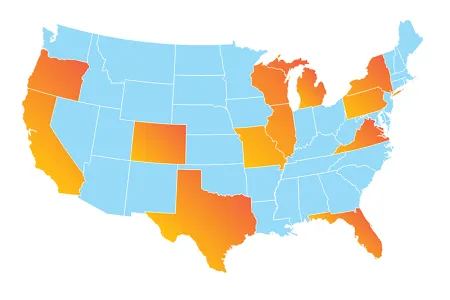
Because she already knows the academic fit is strong, Stilwell can focus on another important aspect of her staff’s recruiting strategy: its vast geographic footprint. The team’s 2025 roster has 15 players from 12 states, including Florida, California, Colorado, and Oregon. This national recruiting approach means they must address what this means for players. “One of our biggest challenges in recruiting is that we’re asking athletes to play a long way from home,” she said. “But I tell our recruits that they’re young and this is a great time for them to explore and try something new. And I can speak from experience because I grew up in Hawaii and went to high school in Colorado and I loved playing here at IC—and now I coach here.”

Map of US

The volleyball team's 15-player roster includes student-athletes from 12 states across the country, including Florida, Texas, and Oregon. (Graphic by Shelly Jackman)

This national recruiting strategy, part of the Bombers’ philosophy for many years, helps new recruits bond more quickly with teammates over their shared experience, which ultimately helps that critical retention component. “Our players are honest with recruits,” Stilwell said. “They’ll say, ‘Yes, you’re going to get homesick, but we’ve all been there. We’re going to be in this together, and you’re going to do great here.’”

As the college deals with geographic shifts of high school enrollment, Hall sees the volleyball team’s recruitment philosophy as being especially valuable. “Their strategy expands the Ithaca College brand and builds awareness,” he said. “Our volleyball program creates an avenue for a student-athlete to attend a college hundreds of miles away from home and find family within the team. Coach Stilwell’s ability to build trust with families and recruit student-athletes from geographically diverse states enriches the athletic program and Ithaca College as a whole.”

Swimming and Diving: Casting a Wide Net

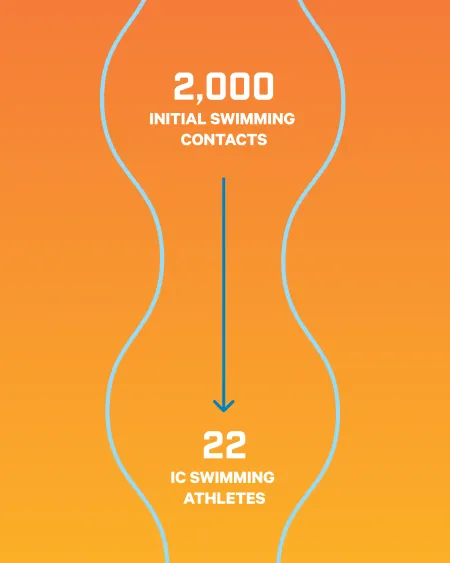
“There’s a lot of swimmers out there,” said IC’s head swimming and diving coach, Mike Blakely-Armitage '00, when asked about the recruiting process he oversees for both the men’s and women’s swimming and diving teams. “Our initial net is an email I send out to 1,500 to 2,000 athletes.”

Blakely-Armitage can engage in such massive outreach due to the nature of the sport—where athletes compete against a clock as well as each other. “We have criteria for the times we’re looking for in our recruits,” he said. “Usually, it’s based on the times we’re seeing in the Liberty League because our primary goal each year is to be the best team in our conference. There’s a website that posts high school swimmer profiles and inputs their times, so we’ll go there and filter the results to get our initial cohort.

Swimming graphic saying 2,000 initial swimming contacts and 22 IC swimming athletes

This past year, IC’s head swimming and diving coach, Mike Blakely-Armitage worked from an initial outreach to 2,000 high school students to find the best 22 athletes for IC. (Graphic by Shelly Jackman)

“We are also recruiting based on academics and potential to add to team culture,” he continued. “It isn't strictly based on their swimming times, or their diving scores and dive lists.” While it may seem like producing a recruiting class from an initial number that big is easy, Blakely-Armitage and his staff have a lot of work to do. “I’ve only got 35 roster spots on each team, which means an incoming class can only be so big,” he said. “We don’t want to promise a spot that we can’t deliver to a prospective athlete.”

Though Blakely-Armitage’s initial outreach email gets its fair share of non-responses, the ones who do respond and then later fill out a recruit questionnaire become those he and his staff can focus on during their on-the-road recruiting. He estimates that 500 prospects fill out the questionnaire each year.

Similar to volleyball, swimming and diving focuses attention on events with lots of participants. “Usually, it’s not worth the travel unless I’m going to talk to at least a dozen swimmers at an event. And sometimes, you get a surprise. One year, I noticed we were getting a lot of interest from kids in Ontario, so I made a trip to their big provincial meet,” he said.

Though close to 100 prospective athletes apply to IC each year, Blakely-Armitage’s staff invites a handful to come to campus on official visits during their senior year. The 2024–25 squads each had 11 first-year athletes on their rosters.

“I’m a walking billboard for Ithaca College. Showing up to a meet, talking to coaches—it shows an interest in that athlete, which makes it more likely they’ll come here. It also allows me to develop a relationship with their coach, so in a few years, if that team has other athletes who are swimming similar times, that coach will tell them about Ithaca. That’s how we build our brand.”

Mike Blakely-Armitage, head swimming and diving coach

He admits that with access to swimmers’ videos and times, a coach could theoretically do all their recruiting online. But that’s not something he’s interested in. “I’m a walking billboard for Ithaca College,” he said. “Showing up to a meet, talking to coaches—it shows an interest in that athlete, which makes it more likely they’ll come here. It also allows me to develop a relationship with their coach, so in a few years, if that team has other athletes who are swimming similar times, that coach will tell them about Ithaca. That’s how we build our brand.”

Going to events also means the staff can interact with parents. “Developing that relationship pays off,” he said. “Most of our prospective athletes apply early, which means that once they’re committed to coming here by mid-February, their parents will start wearing Ithaca College gear to their child’s meets, which gets our name and brand in front of even more people.”

But the name and brand only go so far. Four-time diving national champion Kailee Payne ’25 originally enrolled at Division I Marshall University. Yet she realized that Division III athletics—with its strong focus on the person outside of the pool—was where she wanted to be. So she transferred to IC after her sophomore year. “Ultimately, I realized it’s about the culture of a program,” she said. “When your coach cares about you as a person, that’s what makes or breaks your success as an athlete, and it’s what drew me back to IC.”

Chris Griffin, who is the program’s diving coach, added that a recruiting pitch isn’t always about the hard sell: “Ithaca’s an elite college, and we have a great program. We can show that and present a real, authentic version of the college and our program to recruits.”

Field Hockey: Focus Drives Success

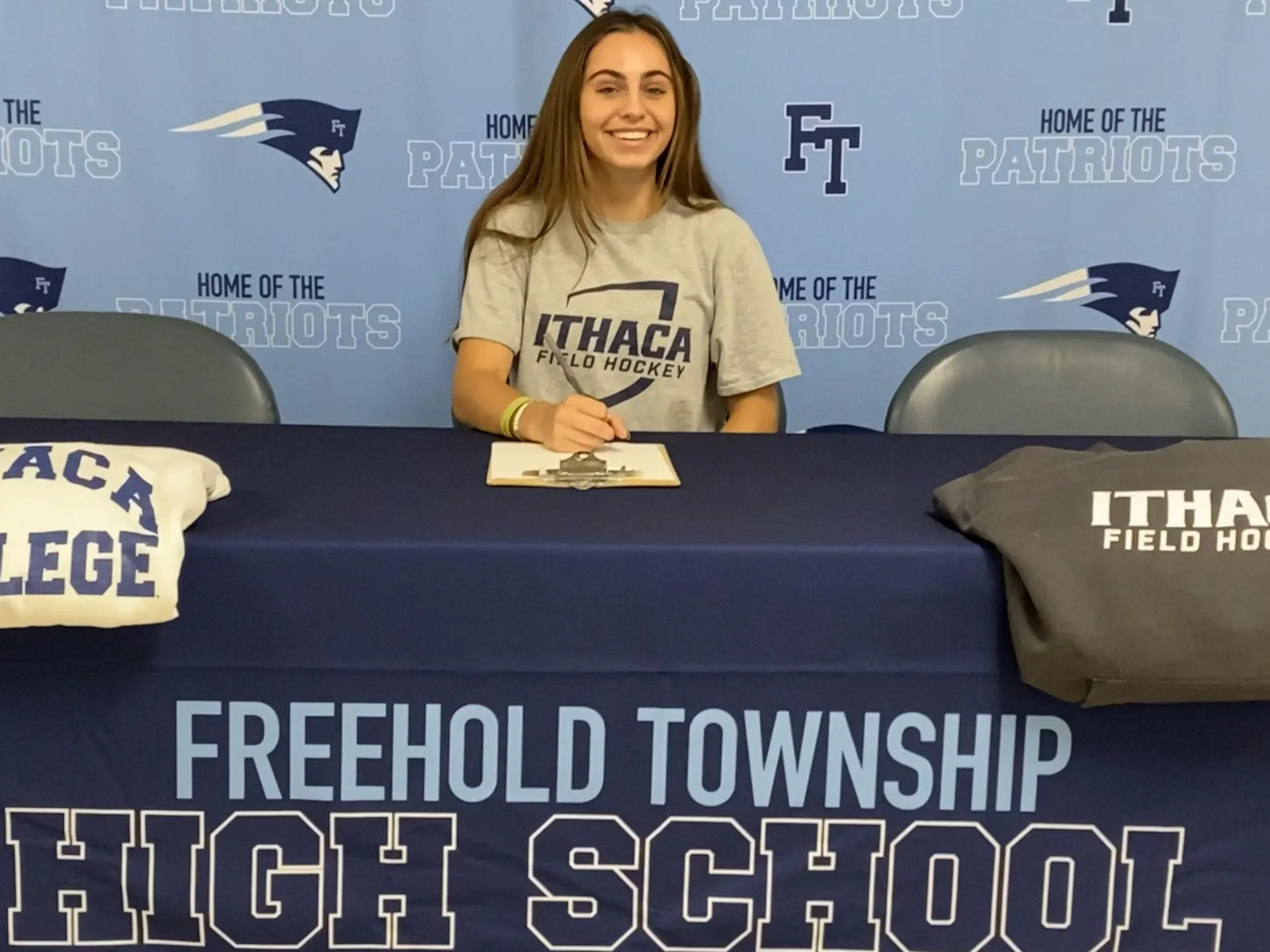
Recruiting the type of class that will lead to team success requires more than a year’s worth of work, as coaches take the time to get to know each student-athlete and their families and learn about their goals both on the field and off. Kaitlyn Wahila, MS ’07, IC’s head field hockey coach, has invested that time and energy into each of her incoming athletes. This approach has driven back-to-back NCAA tournament appearances. “Recruiting for us is as much about the person as it is the athlete,” she said. “This mentality is part of what makes Division III athletics so great. And taking the time to ensure [IC is] the right fit for an athlete is part of the process.”

Catherine Papa ’25, a midfielder, excelled on the field and in the classroom at IC. She started nearly every game during her senior season and was a three-time member of Liberty League’s all-academic team. “I got my first email from IC the summer after my sophomore year in high school,” she recalled. “The staff had seen me play at a tournament and let me know I was a top recruit. So in September of my junior year, I came to a clinic the team put on,” Papa continued. “What really stood out to me was Coach Wahila taking the time to coach me on a specific skill they wanted me to improve on during the day.”

The clinic also gave Papa an opportunity to take a campus tour and listen to a panel discussion hosted by current athletes. “I was really drawn in by the strong health sciences curriculum the college had,” said Papa, who majored in health sciences at IC. “But I also felt connected to the players on the team.”

That’s exactly what Wahila and her staff were aiming for when they designed the programming for these clinics. “For a prospective student-athlete to hear directly from our current student-athletes about their experience is meaningful and something they will remember,” she said.

Following her visit, Papa heard from Wahila and her staff every few months while also updating them on her season. She recalled seeing them at showcases and tournaments throughout her junior year, saying it made her feel “wanted” by the program.

“Recruiting for us is as much about the person as it is the athlete. This mentality is part of what makes Division III athletics so great. And taking the time to ensure [IC is] the right fit for an athlete is part of the process.”

Kaitlyn Wahila, MS ’07, head field hockey coach

After a Zoom call with team captains in April, where the current players shared their experiences on the team, Papa had her official campus visit that July, meeting with professors, touring the town, and getting an offer from the team that weekend.

According to Wahila, ideally recruits will commit by August prior to their senior year, which means that it’s all hands on deck for the crucial official visit. “We’ve established relationships with professors across campus who talk to our prospective student-athletes during their official visit,” Wahila said. “It shows that we all work together to achieve our goals.”

Building successful sports programs at IC is about finding those student-athletes who will thrive as competitors as well as members of the campus community. Shifting demographics for colleges, particularly in the Northeast, continue to make the landscape of higher education more unforgiving as colleges work to meet their enrollment goals. And the student-athlete arena is no different when searching for those who are the best overall fit at Ithaca. IC’s coaches represent the excellence they are looking for in their recruits, and they have tried-and-true strategies for bringing in those who will contribute to IC’s pride and success in athletics and beyond.

Start YOUR Athletic Journey to Ithaca College

Interested in playing a varsity sport at IC? Fill out a prospective student-athlete form on the athletics website or contact the head coach of the sport you're interested in playing.