The Effects of Gravity

By Sloan MacRae, June 5, 2025
How a physicist, a poet, and a guitarist brought the universe to life on stage

Luke Keller, Ithaca College professor of physics and astronomy, showed up at the jam session with a laptop full of astronomical images.

Poet David González told him to bring it to his home so they could project the images and see what happened. González had a stack of poems. Álvaro Domene, a guitarist known for his wild sonic palette, brought his seven-string guitar, pedals, filters, and improvisational instinct.

Keller had met González at a conference at Lincoln Center years before, where the two had been panelists on science and storytelling. Afterward, González approached him with a poem about quantum entanglement to see if it was accurate.

“It’s risky business writing poetry if you don’t know the science in detail,” González says of that initial meeting. “It can be dangerous, especially because everyone’s writing about quantum this and quantum that right now. It was important to me to read this poem about quantum entanglement to Luke, and he affirmed that I understood the essence of it.”

The affirmation turned into a friendship. And that friendship, once Domene entered the picture, became The Effects of Gravity, a live, immersive performance that fuses poetry, music, astrophysics, and real astronomical visuals to tell the 14-billion-year story of the universe. The team is preparing to tour the show under a new title, Spacetime: The Universe Story and Our Place in It.

“We knew immediately that we had a really good collaboration and rapport,” Keller recalls of that first session. “And that people might like to see us do this.”
Whitmanesque

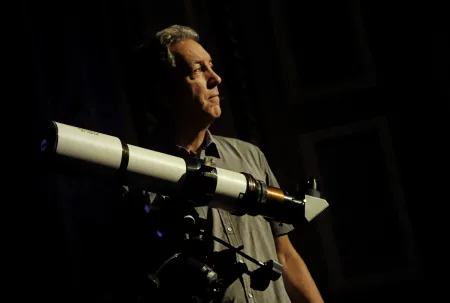
A man stands with a telescope.

Poet David González performs "The Effects of Gravity." (Enid Farber Fotography)

The trio held a workshop performance at Ithaca College in late 2019. The feedback? Enthusiastic but confused.

“People said, ‘This is amazing and gorgeous—but we need somebody to tell us what the hell’s going on,’” Keller says. “That’s when my role really started to form.”

That role isn’t just science explainer—it’s also permission to be blown away by the wonder and mystery. González provides the poetry and narrative thread. Domene is the composer and sonic force. Keller gives voice to the science that’s helped humanity achieve mind-boggling revelations. The fourth member of the band, they all agree, are the projected visuals, high-resolution simulations and real astronomical images, drawn from Keller’s research.

The show opens with a reversal of Walt Whitman’s “When I Heard the Learn’d Astronomer,” a poem that dramatizes the disconnection between sterile scientific analysis and poetic awe. González reads it; Keller responds.

“That poem pisses me off,” Keller says. “Not Whitman, but the quote ‘learn’d astronomer’ he heard. How could someone who studies the universe fail to inspire a poet? It’s a huge failure of imagination.”

For Keller, collaboration with Domene comes naturally. “I often make an analogy that scientific equations are like musical notation,” he says. “If you don’t read music, it looks complicated and technical and overwhelming. But composers see that musical notation, and they hear the music. It’s the same with scientists and equations.”

Music at the Edge of Understanding

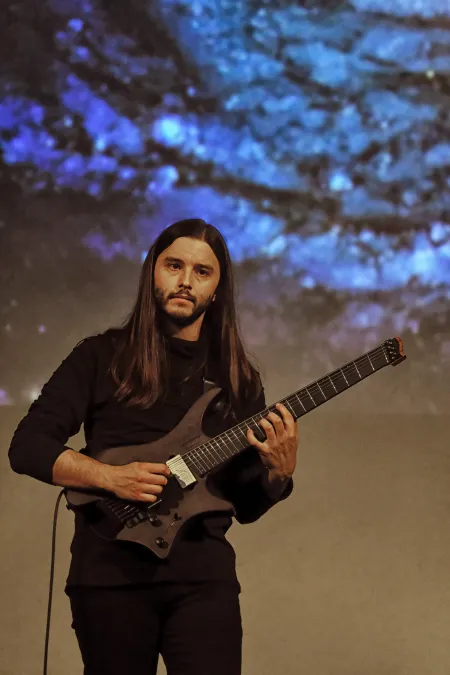
A man plays guitar onstage.

Guitarist and composer Álvaro Domene performs in "The Effects of Gravity." (Enid Farber Fotography)

Domene, who once debated whether to pursue astrophysics or music, embraced the opportunity to bridge both worlds. His score for The Effects of Gravity is about 40% composed and 60% improvised—tightly structured in identity but fluid in delivery.

“Each segment has a very strong and defined musical identity,” he says, “but within those I give myself tons of freedom and flexibility to be able to manipulate those elements.”

In performance, that means his music adapts, feeding off González’s and Keller’s delivery and the energy of the audience. He doesn’t accompany the visuals, he interprets them.

“The music helps people understand what they’re seeing,” Keller says. “Álvaro plays what it feels like to look at stars being born or a galaxy torn apart.”

One of the show’s most haunting moments explores black holes. Keller lays down the mathematical framework. Domene’s music helps the audience imagine an experience transcending human comprehension. González's poetry leans into the spiritual unease—the pull between wonder and dread:

We’ve stepped off the four-square map
into an uncharted opening
beyond the continents and the canyons of the sea.
The world was flat, then round,
now it is upside down/inside out,
we're falling, flying, suspended
in a kaleidoscope of curvatures and possibilities,
it is all mind/heart/soul in this new world.
Arms up,
palms open,
eyes closed,
head back,
Breathing in deeply,
With this gesture the body beckons,
The answer we get is a sigh.
We’ve stepped into the unknown,
beneath the left foot is truth,
beneath the right foot is trust,
We claim this territory, and it claims us, in the name of love.

The Pandemic Shift

The COVID-19 pandemic hit just as the show was taking shape. Instead of pausing, the collaborators shifted to Zoom, livestreams, and shared Google Docs.

“It was actually one of the anchors of sanity,” González says. “To have this rich mining of the intersection of music and poetry and astrophysics. It was a source of solace for me.”

That period allowed the team to refine their work, deepen their connections, and emerge with a show ready for wider audiences. Since then, The Effects of Gravity has been performed across New York State in theaters and community arts centers.

Twice, the trio has performed for middle school audiences—not the intended demographic, and notoriously hard to impress. Aside from cutting the runtime, the creative team didn’t simplify or edit the material.

“They were rapt,” Keller says. “They got it.”

Earth, Zoomed In

While the performance opens with and explores the 14-billion-year history of the universe, it always zooms back in on Earth. It’s a show about galaxies light years away, but also about climate change and the fragile miracle of our home planet.

“It’s a great way to tell the Earth story and our stewardship of Earth,” Keller says, “to inspire people by the 14-billion-year relationship of our universe, how much went into making our planet, and how much insight and work went into understanding it.”

The juxtaposition can be intentionally jarring: immense cosmic scale followed by the intimacy—and urgency—of human impact. The Effects of Gravity isn’t just a performance. It’s a call to feel deeply—and act accordingly.

The trio aims to do more than educate. They want to awaken something visceral. The idea is simple: when people feel wonder, they might also feel responsibility.

“I’ve always been interested in bringing science to the general public in ways that they can experience it at more than an intellectual level,” Keller says. “To appreciate on a gut level what science and the scientific approach can do for us.”

That gut-level reaction can move audiences, not just emotionally but ethically. As the performance sweeps from galaxy collisions to the climate crisis, it challenges the audience to act on the knowledge and perspective they’ve gained.

“As a poet,” González says, “I’m very mindful of Joseph Campbell’s dictum, which is that for mythologies to remain relevant, they must be informed by the knowledge of the day.”

The Effects of Gravity employs poetry and music not just to complement science, but to restore the sense of wonder it often loses in translation. It invites audiences to feel the awe of cosmic scale—and then challenges them to bring that feeling back down to Earth. “I hope the show can trigger a loving rage within people to create change,” Domene says.

The goal isn’t for audiences to leave with a textbook understanding of black holes or quantum entanglement. It’s for them to leave with a clearer sense of perspective of Earth’s rarity, their place in the cosmos, and what it means to care for a planet shaped by 14 billion years of chance and force. It’s the experience Whitman wanted when he stepped into that lecture hall—the kind that science, when approached with imagination and empathy, can absolutely deliver.

Fall in love with the universe.

Study with boundary-pushing faculty at the School of Humanities and Sciences who inspire, chalenge, and ignite your curiosity.