Finding Their Voices

By Sloan MacRae with reporting by Patrick Bohn and Kim Wunner, August 26, 2025
The Class of 2029 begins its journey with a call to dialogue.

Daivat Mehta ’29 knows a thing or two about navigating new territory. After two gap years playing professional tennis in Germany, the exploratory student from India arrived on South Hill with plans to play for IC and merge his interests in politics, communications, and screenwriting. Like his classmates, he came ready to connect—and ready for the challenge that will define their time here: Dialogue.

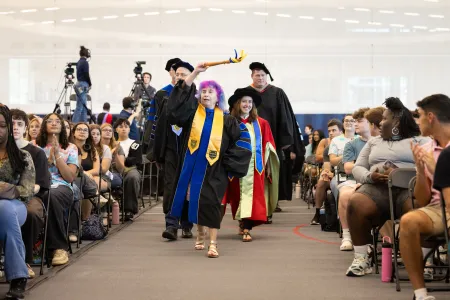
Convocation doesn’t begin with a lecture; it begins with motion. On August 22, more than 1,200 first-year and transfer students streamed through a chute of cheering faculty and staff, marking their first formal rite of passage as members of the college. The African Drumming and Dance Ensemble’s pulse filled the Athletics and Events Center, and the faculty followed that beat into the arena in full academic regalia, a vivid welcome into the academic community they’ll join for the next four years.

Music filled the space again as Haley Rayfield ’25, a music performance education major (voice), delivered a soaring national anthem that drew cheers from the crowd. This year’s incoming class reflects Ithaca College’s broad reach: students represent 12 different nations, most hail from beyond New York’s borders, others come from the state’s cities, suburbs, and rural towns, and about a dozen are children of IC faculty and staff.

The next time these students gather in this space alongside faculty in their robes, they’ll be wearing regalia of their own—mortarboards and gowns at Commencement. On this day, though, the milestone was about beginnings: a welcome into the academic community and an introduction to the challenge that will define their first year and beyond: Dialogue.
The Art of Genuine Dialogue

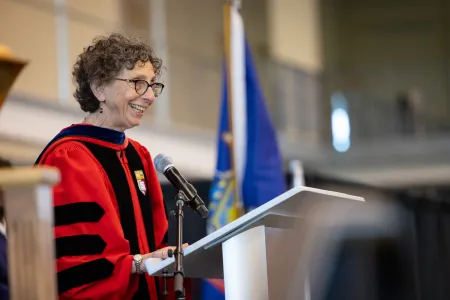
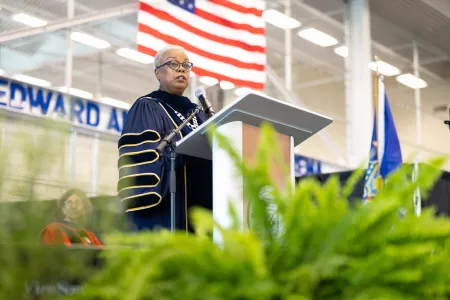
A woman wearing academic regalia speaks at a podium.

Melanie Stein, Provost and Executive Vice President for Academic Affairs. (Photo by Chris Kitchen)

Provost and Executive Vice President for Academic Affairs Melanie Stein greeted the students first. Her remarks cut straight to what the theme asks of them: learning the art of genuine dialogue.

“As you look around, you will see faces from across the country and beyond, each bringing their own unique experiences, perspectives, and world views to our campus,” she said. “This diversity is one of our greatest strengths. It is an opportunity for you to live and learn with others who may have different backgrounds, beliefs, and cultures. Embrace this opportunity with open arms.”

Stein didn’t sugarcoat the work ahead. “One of the most important skills you will develop here is the art of genuine dialogue,” she said. “In a world marked by polarization, dialogue becomes our bridge across differences. It's easy to converse with those who share our views, but true growth happens when we engage with diverse perspectives.”

She urged them to expect challenge and lean into it. “It can be profoundly uncomfortable ... But it is critical that we learn to accept this discomfort, to listen openly to our neighbors or classmates. In order for our pluralistic society to thrive and support all members, our democratic system requires that we engage with and listen to a wide array of opinions and points of view.”

“In a world marked by polarization, dialogue becomes our bridge across differences. It's easy to converse with those who share our views, but true growth happens when we engage with diverse perspectives.”

Melanie Stein, Provost and Executive Vice President for Academic Affairs

"Welcome to La Familia"

A woman in academic regalia speaks at a podium.

President La Jerne Terry Cornish. (Photo by Chris Kitchen)

Trustee Traci Hughes ’85 introduced President La Jerne Terry Cornish with her own reminder: “Every single one of your here has something to add, has something to gain. We from you, and you from us.”

“Welcome to la familia,” Cornish said, before laying out what Dialogue means to her: not a slogan, but “a lived approach to learning, leadership, and community-building.”

“Dialogue means asking meaningful questions, listening actively, and engaging in respectful exchange across cultures, across disciplines, and across experiences,” she said. “At its best, dialogue sparks creativity, empathy, and real transformation.”

Cornish challenged the students to make Dialogue part of their daily lives:

  • Think deeply, question boldly, and seek knowledge not just for yourself but for the betterment of others.
  • Live our institutional values—integrity, respect, inclusion—in tangible ways.
  • Commit to lifelong connection with this community, as students now and as alumni later, as a learners, as leaders, and as people who give back.
  • Use your education to lead, serve, and make a difference on South Hill and the world beyond.

    “Well, you made your choice,” Cornish said. “Here you are. So let the intellectual grounding begin. Embrace dialogue. It will be your compass, and it will also be your strength.”

Dialogue Isn't Easy

People wearing academic regalia walk among a large group of students.

Faculty lead the procession. (Photo by Chris Kitchen)

Not every speaker painted Dialogue as easy or neat. Derek Adams, professor of literatures in English, admitted he was a little nervous when he was invited to speak about dialogue. “This is supposed to be a festive celebration, after all,” he said, and “any discussion of dialogue necessitates addressing the array of societal issues we want to use dialogue to resolve. Things like codifying trans rights, decriminalizing reproductive healthcare, ending racist policing, big things which sit heavily on our hearts.”

He offered a candid warning: “when we call for dialogue, we don’t all mean the same thing. In fact, calls for dialogue are regularly made in bad faith. Some people ask for dialogue simply because they have something to say, and they don’t care to listen to anyone else ... far too often, insistence on dialogue becomes a way of fostering animosity between all of us so that nothing actually gets done.”

He underscored reciprocity. “One-sided dialogue is not dialogue. It requires partners giving and getting from one another equitably. We are all responsible for giving as much as we get in any situation.”

Near the end of his remarks, a powerful line landed: “Dialogue is never about being right, it’s about getting it right.”

Luca Maurer, executive director for student equity, inclusion, and belonging, expanded on that point. “Dialogue is messy, complicated, and sometimes awkward,” he told the students. “You'll need humility, empathy, compassion—and yes, a little courage.”

He cautioned against expecting a neat, linear path. “We need a compass, not a map. A map tells you where to go. A compass helps you navigate when the terrain changes, and trust me, it will change.”

And he reminded the students that participation is part of the deal: “Each one of us should not only be accepted but expected. Expected to show up fully as your whole self, to have what you need to succeed, to contribute, to show up for others … you deserve to be treated with dignity and respect. And you are responsible for giving that in return.”

The last word belonged to Student Governance Council President Rishabh Sen ’26, a chemistry major who knows both what it’s like to be new on campus and what the next four years might be like. His advice—and Dialogue call to action—was both practical and challenging.

“Go forth, and find your people,” he told the Class of 2029. “Talk to one new person, however daunting it may seem.”

Meet the Class: Dialogue in Their Own Words

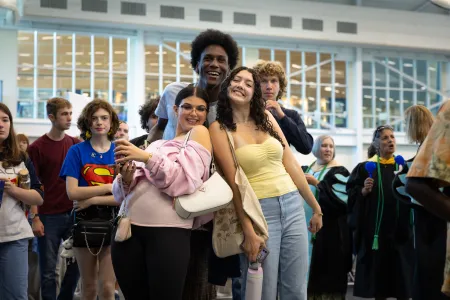
Students embrace for a group photo.

Members of the Class of 2029 "finding their people." (Photo by Chris Kitchen)

Koko Basu, an education studies major from Baltimore, first connected with sociology major Jasmina Vahle of San Francisco in the Class of 2029 Instagram group. “She looked like a bubbly, sweet person,” Koko said. The two met in person for the first time on campus.

A few others met for the first time in the breakfast line earlier that day. Grafton Norris, a film major from Maynard, Massachusetts, was with fellow film major Marshall Murray from North Reading, Massachusetts; sports media major Jake Blumberg from Freehold, New Jersey (“hoping to go to the Super Bowl”); computer science major Robby Rightmyer from Ithaca; and documentary studies and production major Luke Jameson from Wilton, Connecticut. “Most of us are floor mates,” one of them noted.

They weren’t alone in feeling that sense of possibility.

Gabe Rogers, a music education and performance major from Beverly, MA, said, “I was really impressed by the music program and the people I met—they made me feel at home.”

Evan Spiegel, sports media, Doylestown, PA: “I really like the opportunities to get involved and get hands-on experience right away.”

For Lucas Fernandez, a music education and vocal performance major from Arlington, MA, it was the personal connections that sealed the deal: “The voice faculty I met on tours were so kind and encouraging. I really wanted to work with them.”

Maeve Van Jura, physical therapy, Poughkeepsie, NY, liked the pace: “It was quicker than some of the other programs, and I’m on the crew team.”

And Naomi Bozenski, environmental science, Rhinebeck, NY, summed it up simply: “Everyone seemed so nice, and I like the location, and my older sister goes here.”

And then there’s Daivat Mehta ’29, the exploratory student from India who opened this story. After two gap years playing professional tennis in Germany, he’s already found an “evolving group” of friends and a campus alive with conversation. Along with his classmates, he’s beginning to live out the charge they heard from the stage—to embrace dialogue, reach beyond their comfort zones, and start building the kind of community they want to belong to.

Find YOUR Voice.

Dialogue begins before you arrive. Plan your visit, take a virtual tour, or attend an open house