Joan Esmie MS ’26 Named PAEA Student Health Policy Fellow

By Kim Wunner, January 29, 2026
Reflecting Ithaca College’s Commitment to Community-Minded Leadership
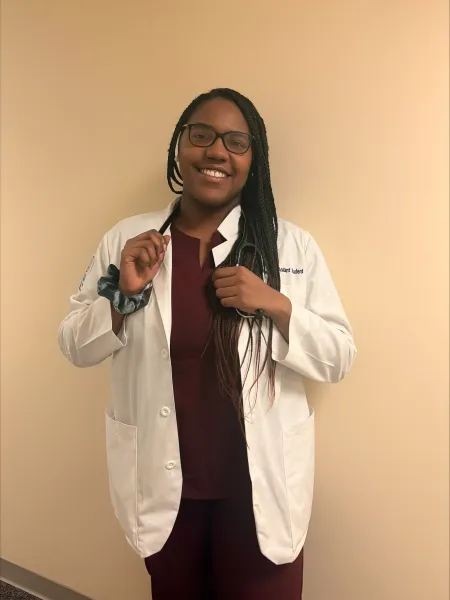
Joan at her short white coat ceremony

Joan Esmie MS '26 taken at her short white coat ceremony. Short white coats are given to physician assistant students when they start their clinical rotations. Photo submitted. 

Joan Esmie MS ’26, a physician assistant studies student in Ithaca College’s School of Health Sciences and Human Performance (HSHP), was named a 2025 Student Health Policy Fellow by the Physician Assistant Education Association (PAEA), a national organization dedicated to advancing PA education and the profession earlier this year. Chosen from a highly competitive pool of applicants, Esmie was one of just 18 students nationwide to receive the distinction—and the only fellow representing New York State.

The fellowship recognizes emerging leaders who demonstrate a commitment not only to clinical excellence, but also to shaping the broader systems that influence health care delivery, access, and equity. For Esmie, the opportunity aligned seamlessly with the way she approaches her future profession: as a physician assistant deeply attuned to the intersection of patient care, public policy, and social justice.
“As I think about my career, I don’t just think about my role as a PA. I think about the larger system that role exists within."

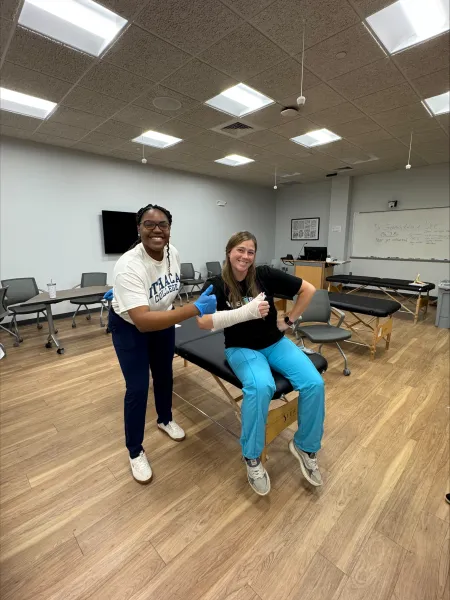
Joan Esmie MS '26 working with a client as she completes her degree.

Joan Esmie MS '26 working with a client as she completes her degree. Photo submitted. 

“As I think about my career, I don’t just think about my role as a PA,” Esmie said. “I think about the larger system that role exists within.” That systems-level perspective is what drew her to the fellowship, which seeks applicants interested in “making a significant impact on their health care system, profession, and PA education for future generations.”

It is also emblematic of the type of student Ithaca College consistently attracts and prepares—individuals who see leadership as service and understand that meaningful change happens both in communities and through institutions.

Esmie’s selection reflects the values embedded in the School of Health Sciences and Human Performance, where experiential learning and community engagement are central to professional preparation. Christina Moylan, dean of HSHP and Esmie’s faculty advisor for the fellowship, emphasized the alignment between the program and the school’s educational mission.

“This Fellowship gave Joan a meaningful opportunity to apply the academic concepts she has learned in the classroom to real world challenges as she prepares for a career as a physician assistant. By engaging in hands on, community-based work, she was able to deepen her professional skills while making a tangible impact—it is an experience that aligns well with the school’s commitment to student-centered, experiential learning."

The fellowship began with an intensive orientation designed to immerse students in the mechanics of health policy and advocacy at the federal level. Over two days, fellows received training on how legislation is developed, and enacted, gaining insight into the policy processes that directly affect PA education and workforce development. The cohort met with national leaders in the profession, including the president of the PAEA and Tate Hauer, vice president of federal advocacy for the American Association of Physician Assistants.

A central focus of the program was Title VII of the Public Health Service Act of 1944, the primary source of federal funding for physician assistant education through the U.S. Department of Health and Human Services. Title VII plays a critical role in supporting workforce development and increasing the presence of physician assistants in underserved and rural communities—areas where access to care remains a persistent challenge.

As part of the fellowship, Esmie engaged directly in advocacy, contacting the offices of U.S.Senator Charles Schumer and Representative Josh Riley to discuss the importance of sustained investment in PA education. For Esmie, the experience reinforced the power of professional voices in shaping policy.

“I liked the advocacy aspect,” she said. “Congressman Riley is new to his position and hadn’t given much thought to the PA profession. I was able to let him know we are here, in his district, and how we help the community.”

That emphasis on local impact is a defining feature of the fellowship’s next phase. Each fellow selects a community-based project to pursue throughout the duration of the program, applying policy knowledge to address real-world needs. In Tompkins County, Esmie is convening a roundtable of health and wellness organizations to explore collaborative approaches to shared challenges—an effort grounded in relationship-building, collective problem-solving, and long-term community benefit.

When asked about why this work is important, Catherine Majewski, Manager of Government Relations at PAEA said, "Joan’s fellowship project strengthens the PA profession by building connections between PA students, practicing PAs, and community stakeholders who influence local health planning. Through a structured community roundtable, her work elevates awareness of how PAs address workforce shortages and fosters dialogue that can inform future advocacy and policy conversations. By amplifying the PA voice at the community level, Joan is helping ensure the profession is more visible, engaged, and included in health care decision-making."

Esmie’s path to Ithaca College reflects both geographic breadth and a consistent commitment to health and equity. Born in Jamaica, she moved to Orlando, Florida, at age four. A rower in high school, she credits the sport with sparking her early interest in health sciences and teamwork. Those interests led her north, where she earned an undergraduate degree in Human Biology, Health, and Society with a minor in Inequality from Cornell University, while also competing on the women’s crew team.

She was later accepted into Ithaca College’s Physician Assistant Studies program, where through coursework, experiential learning, and now national-level policy engagement, Esmie is developing a professional identity rooted in service—to patients, to communities, and to the shaping the systems that support them. She even spent time in Guatemala learning Spanish, because "I live in a state (Florida) where understanding that language can be important in healthcare."

Her recognition as a PAEA Student Health Policy Fellow underscores not only individual achievement, but also the broader role Ithaca College plays in cultivating leaders who think expansively about their professions.

Wellness as Leadership

HSHP offers graduate programs in fields that cultivate a passion for wellness while preparing its students to navigate the world they will practice in.