Strength in Community: Inside IC’s Wellness Clinic

By Sloan MacRae, August 7, 2025
A hands-on training ground where students build skills, confidence, and careers.

The moment Exercise Science major Mike Giglio ’25 got the job offer, he knew the time he’d spent in the Ithaca College Wellness Clinic had paid off.

“The fall of my senior year, I had an internship at Infinity Athletics,” Giglio says. “A lot of the things I learned from the clinic, I was able to apply immediately to the gym. I felt like I had a head start. This is the real world, and these people don't know that I'm a student. My boss said, ‘Listen, we like you, and we have clients that are coming up to us and asking for you and saying you're great with them, and they're requesting you by name. We want to hire you.’”

That kind of outcome isn’t unusual for students working in IC’s Robert R. Colbert Sr. Wellness Clinic, a supervised, real-world training environment operated by the School of Health Sciences and Human Performance. The clinic is staffed almost entirely by undergraduates and graduate students studying exercise science, athletic training, physical therapy, and related fields, who gain hands-on experience by working with actual clients, including IC faculty, staff, grad students, retirees, and their spouses and partners. (The clinic provides free services for faculty, staff, and retirees. Grad students, spouses, and partners pay a modest membership fee that gives them access to all services.)

Each semester, 20 to 25 students help run the clinic, from conducting intake assessments to designing and leading fitness programs, to managing daily operations. What sets the Wellness Clinic apart is the level of attention members receive every time they walk through the door. Certified exercise professionals and trained student staff are always on the fitness floor, offering guidance with workouts, support for managing health conditions, and a focus on overall wellness.

Beyond this daily fitness floor support, the clinic also offers personal training, tailored exercise plans, fitness assessments, group classes, and ongoing monitoring of blood pressure and heart rate, all in a supportive, hands-on environment.

“The job-readiness that comes out of the clinic is incredible,” says Jennifer Hunter ’00, MS ’03, the clinic’s director. “Our students work directly with clients, conducting fitness testing, designing exercise programs, coaching, teaching, training, building rapport, and communicating just like they would on the job, but with the mentorship of certified fitness professionals. It’s not a simulation—it’s the real thing.”
From Introvert to In-Demand

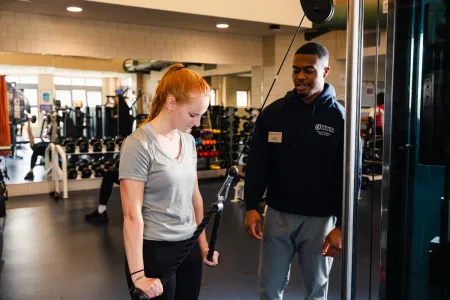
A student trainer assists another student in a fitness center.

Students and staff work one-on-one with clients from the IC community at the Wellness Clinic. (Photo by Allison Usavage '11)

Giglio transferred to IC in 2022 after brief stops at SUNY Oswego and SUNY Morrisville. “I didn’t really know what specifically to do in the fitness industry,” he says, “but I felt this is where I belonged.”

What surprised him, though, wasn’t the hands-on learning. It was how personal the clinic turned out to be.

“I spent that first semester being kind of introverted,” he says. “So going out on the floor and talking to people and making conversation was the last thing I wanted to do. And in my mind, it was the last thing I thought they wanted.” Joe O’Haire, manager of the clinic, would tell him, “Hey, get out from behind the desk.” So Giglio forced himself to go out there and talk to people, and he says, “It got easier over time.”

“Talking and trust is a huge piece of this work,” Giglio says. “Talking to clients about their goals, or why they work out... Working with a client one-on-one is a different dynamic than leading a group. You have to command the room, but you also have to show respect and give individual attention.”

“The job-readiness that comes out of the clinic is incredible. Our students work directly with clients, conducting fitness testing, designing exercise programs, coaching, teaching, training, building rapport, and communicating just like they would on the job, but with the mentorship of certified fitness professionals. It’s not a simulation—it’s the real thing.”

Jennifer Hunter ’00, MS ’03, director of the Wellness Clinic

Mentorship, Mangos, and Motivation

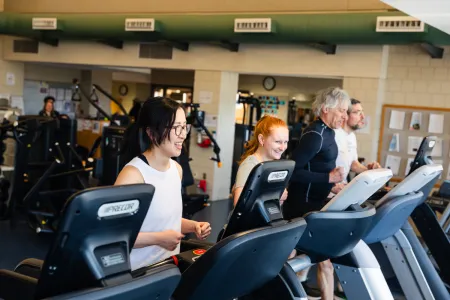
An intergenerational group of people run on treadmills.

Moving in step: one community, different generations at the Wellness Clinic. (Photo by Allison Usavage '11) 

Since its founding in 1999, the Wellness Clinic has emphasized connection as much as conditioning. Originally only open for a few hours a day, the clinic now operates weekdays from 6 a.m. to 7 p.m. and serves a range of IC community members, but its most loyal visitors are often retired faculty and staff.

“The morning crew comes in almost every day,” says Giglio, “and they've seen students come and go for the past 25 years or more, and they're really interested in us and where we're headed.”

Among them are Pat Cornell ’86, a retired nurse practitioner who worked at IC’s Hammond Health Center, and her husband, Phil, a retired pharmacist. The Cornells visit the clinic daily, attend student events, and have become informal mentors—and sometimes even stand-in grandparents—for many of the student staff.

“We're fortunate, most people our age don't get to interact with young people, maybe just their grandkids,” says Phil. “And in some respect, we've become local grandparents ... maybe they've lost their grandparents, or they don't live near them anymore, or some people didn't get to grow up with grandparents around, and they've never interacted with older folks before.”

“Now that we are grandparent-aged,” Pat adds, “you know some of these students have lost a connection with family by being here. And we’re happy to provide that connection in a small way.”

Pat and Phil’s support extends well beyond the clinic floor. After a family member’s health emergency underscored for them just how life-saving CPR skills can be, they decided to support student learning in a more lasting way.

“Student CPR certification is required by the Wellness Clinic, and we know how important CPR is for everyone, no matter what age,” Pat says. “We also realize that costs add up for college students, so the funding is available for them.”

That funding comes from the Patricia Cornell ’86 & Philip Cornell Wellness Clinic Student Advancement and Support Fund, which provides students with support to pay for professional certifications, exam fees, conference registration, and continuing education.

“Plus,” Pat adds with a grin, “we feed them.”

She’s not joking. Every week they bring the students oranges, apples, and banana bread, and, for finals, care packages. Last summer, they even shopped for each student based on their fruit preferences.

“I’d go through the produce section, thinking this one likes watermelons, this one likes bananas, this one likes mangos,” she says.

Giglio, it turns out, is the one who likes mangos.

“It’s a learning lab. And learning goes both ways. We learn from them, and they learn from us.”

Pat Cornell '86, daily client at the Wellness Clinic

Where Human Connection Meets Career Preparation

A yoga class.

Group classes like yoga and Stretch & Core keep flexibility flowing. (Photo by Allison Usavage '11)

Hunter, who was one of the first students to work in the clinic as an undergrad in 1999, returned to IC in 2015 and became director in 2022. For her, the job is personal.

“I had an amazing experience here at IC. I graduated in 2000 and ended up staying for my graduate degree,” she says. “The clinic helped me grow as a person and a professional and made a huge difference in my life. I just loved what this facility was about ... not only my experience, but what we could do here for everyone involved.”

That spirit of care still defines the clinic.

“We're not just looking out for your safety,” Hunter says. “We're trying to help in every capacity and supporting our clients’ overall wellness. We have the fortune of being able to help our clients without having to worry about sales, so we don't have to limit how much help we give out on the fitness floor.”

As Pat Cornell puts it, “It’s a learning lab. And learning goes both ways. We learn from them, and they learn from us.”

Phil agrees: “We've all been in places where the people at the gym have their headphones on and don't say Boo to anyone.”

Here, students not only say hello; they learn how to listen, teach, program, adapt, and connect. For Giglio, that training made all the difference.

“Working with retired faculty and staff, current faculty and staff, and even students, that actually forms a client base,” he says. “You as a trainer see tons of people throughout the semester. So you get a baseline that you can take with you into the profession.”

That kind of applied learning builds more than confidence, it builds foundations for careers.

“The Wellness Clinic provides unique, experiential learning that allows our students to apply their knowledge and skills to address the performance and wellness needs of our diverse IC community,” says Chris Hummel, clinical professor and chair of Exercise Science and Athletic Training. “Their experience enables them to be career ready upon graduation.”

That readiness even leads to entrepreneurship. In a recent alumni survey, Hummel found that 152 out of 989 respondents—about 15%—listed “business owner” as their job titles. In fact, Exercise Science graduate Brian Oberther ’12 co‑owns Ithaca’s Infinity Athletics, the same gym where this story began, with Mike Giglio’s internship that turned into a job offer.

“These are students who are starting their own facilities, becoming independent trainers, or building their own practices,” Hummel says. “That mindset starts with the confidence and skill they build in places like the Wellness Clinic.”

Flex your future.

The School of Health Sciences and Human Performance offers undergraduate programs in athletic training, exercise science, and physical therapy and graduate programs in exercise science and physical therapy.

Follow the Cornells' lead.

Pat and Phil Cornell turned a personal experience into lasting support for Wellness Clinic student staff through the Patricia Cornell ’86 & Philip Cornell Wellness Clinic Student Advancement and Support Fund —helping cover professional certifications, exam fees, conference registration, and other essentials that launch careers. You can make a difference, too, by giving in a way that reflects your own passions and values.