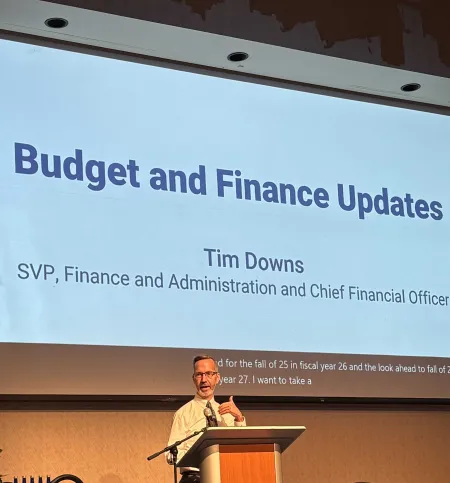
At the fall State of the College gathering on Oct. 21, Ithaca College President La Jerne Terry Cornish and other administrators provided the campus community with a variety of status updates.
Melanie Stein, provost and executive vice president for academic affairs, said that the draft of the Middle States reaccreditation self-study is nearing its final stages, with every constituency of the college having provided valuable feedback. The reaccreditation team will consider that feedback as it fine tunes the self-study, with a second draft being shared with the campus community later this semester. The Middle States evaluation chair assigned to the college—King’s College (Pa.) Provost Joseph Evan—will visit in November, and the full evaluation team will visit in the spring.
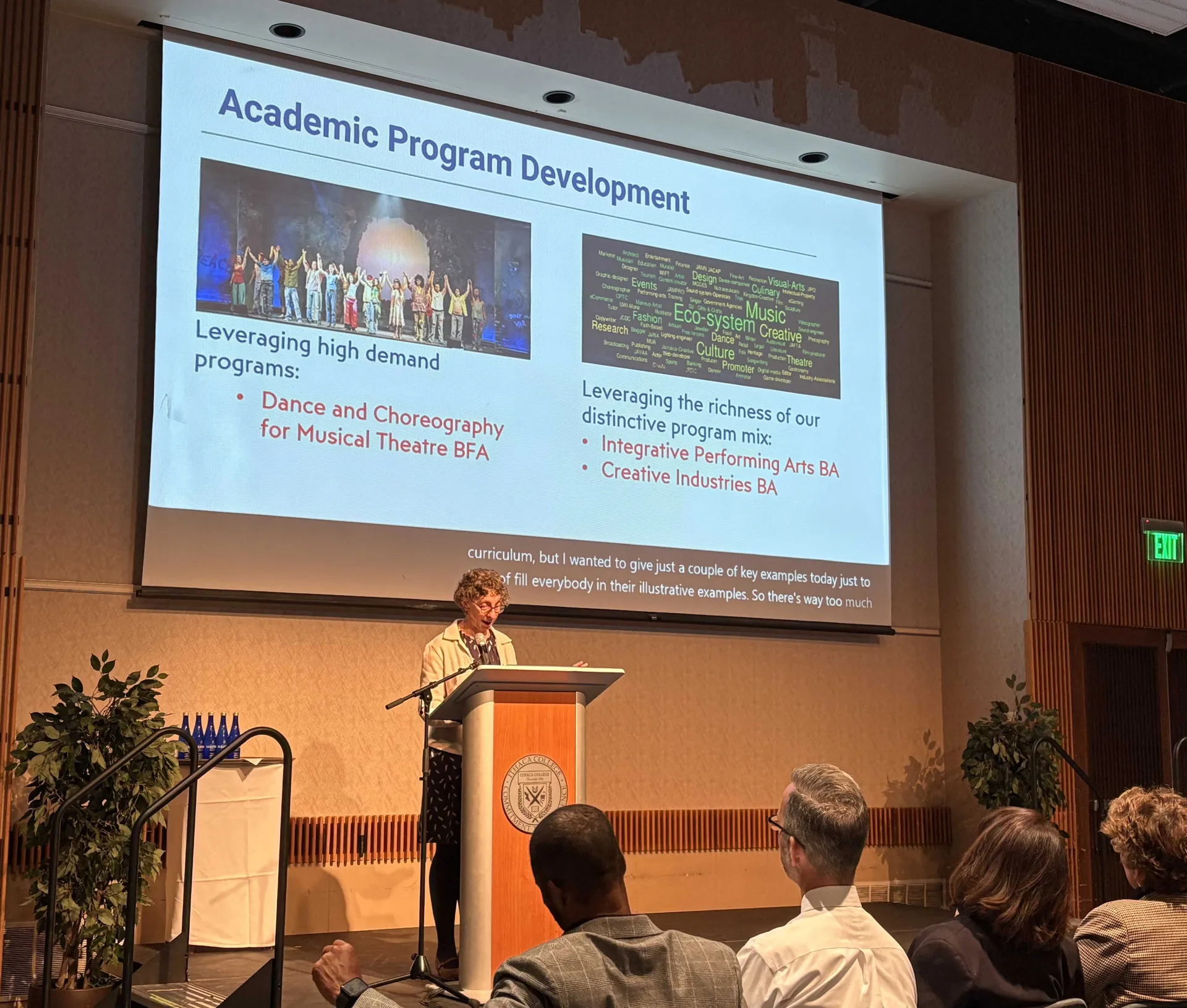
Stein also provided a curriculum update.
“We’re working in parallel with the rest of the college on aligning what we do with the resources we have,” she noted. “And we are asking ourselves, as I hope everybody is asking themselves, what of what we’re doing is the most important to our mission? What should we stop doing? And what shall we do differently?”
Stein gave as some examples the recently approved degree program in dance and choreography for musical theatre, and potential degrees in integrative performing arts and creative industries, which leverage the college’s academic strengths while helping to expand the applicant pool. She said the college is having discussions with Tompkins Cortland Community College about a dual admission initiative and is looking at ways to improve the overall transfer process.
The college is also developing micro-credentials, which let students complete a set of existing courses and acquire expertise to earn a credential that appears on their academic transcript, signaling to potential employers that they have attained a specific, marketable skill. Three such micro-credentials are currently available through the Department of Computer Science—in data-centric programming, in the computer programming language Python, and in web development.
“These [micro-credentials] are very small clusters of courses, typically between two and four courses, that teach a student a very specific identifiable skill,” said Stein. “They might lead to a major or a minor or not. They can be in a completely different field from a student’s major course of study but can complement that by demonstrating that a student has acquired those skills. These are just a couple of examples of the way that we are growing and adapting the curriculum to meet the challenges of the current moment.”
Rock Hall, vice president for enrollment management and student success, said that the college is building on the accomplishment of achieving this year’s incoming class goal, with applications for next year’s class currently up by over 30%. He credited new strategies for introducing Ithaca College to families earlier and segmenting communications to families and students.
“We’re going to create familiarity and a sense of welcoming that will hopefully result in a larger class,” Hall said. “I want to say thank you to every single person in this room. What we do cannot be accomplished without the efforts of all of you. Whether you answer an email or a phone call, direct someone walking across campus, shake a hand, give a smile, all of that matters.”