Ithaca College Sustains Green Momentum

By Dave Maley, February 19, 2026
Recent recognitions highlight IC’s efforts.

Ithaca College has been recognized for its continuing commitment to sustainability by both the Association for the Advancement of Sustainability in Higher Education (AASHE) and the Princeton Review. The college recently earned a STARS Gold rating from AASHE and was named as one of the Top 50 Green Colleges in the nation in the 2026 edition of the Princeton Review Guide to Green Colleges.

AASHE uses the Sustainability Tracking, Assessment & Rating System (STARS) to measure and encourage sustainability in all aspects of higher education. With more than 1,200 participants in 52 countries, the STARS program is the most widely recognized framework for publicly reporting comprehensive information related to a college or university’s sustainability performance. Participants report achievements in five overall areas: academics, engagement, operations, planning and administration, and innovation and leadership.
gold seal

“STARS was developed by the campus sustainability community to provide high standards for recognizing campus sustainability efforts,” said AASHE Executive Director Meghan Fay Zahniser. “Ithaca College has demonstrated a substantial commitment to sustainability by achieving a STARS Gold rating and is to be congratulated for their efforts.”

“This rating serves as a validation of the tremendous collective efforts by our entire campus community over the last several years as well as some impressive documentation by our staff and student team,” said Scott Doyle ’98, parent ’28, director of energy management and sustainability.

For more information about AASHE and the STARS program, visit www.aashe.org.

The Princeton Review Guide to Green Colleges profiles institutions that foster a culture of environmental responsibility and demonstrate a commitment to sustainability, based on a survey that looks at sustainability-related policies, practices, and programs at colleges across the country. The education services company also surveyed students attending the colleges about their “green” campus experiences. The school selections were based on more than 25 data points from the surveys.

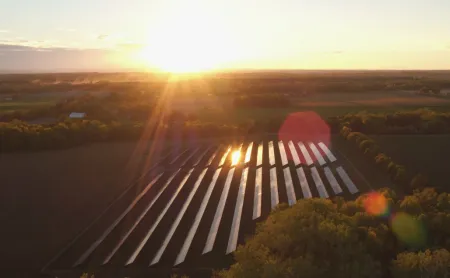
solar farm at sunset

Ithaca College solar farm.

“Among the hundreds of schools we surveyed for this project, Ithaca College, which offers excellent academics, is also a stand-out for its record of environmentally-responsible practices, and we are delighted to recommend it to college applicants who want their ‘best-fit’ college to also be a ‘green’ one,” said Rob Franek, Princeton Review's editor in chief.

The profiles in the guide provide details on the schools’ uses of renewable energy, their recycling and conservation programs, and the availability of environmental studies in their academic offerings. The institutions that made the Top 50 Green Colleges list share superb sustainability practices, a strong foundation in sustainability education, and a healthy quality of life for students on campus.

Visit princetonreview.com/college-rankings/green-guide to view the complete guide.

Signs of the Times
Late in the fall semester, more signs of sustainability—literally, in this case—became visible on campus. As part of an educational campaign by the Office of Energy Management and Sustainability, signage intended to highlight some of the hidden features of sustainability was placed in strategic locations. Designed by the Division of Marketing Communications, created by the Print Shop, and installed by the Grounds Department, the 28 signs are intended as a low-tech way of informing the campus community and visitors about those features and further promoting sustainability and conservation practices.

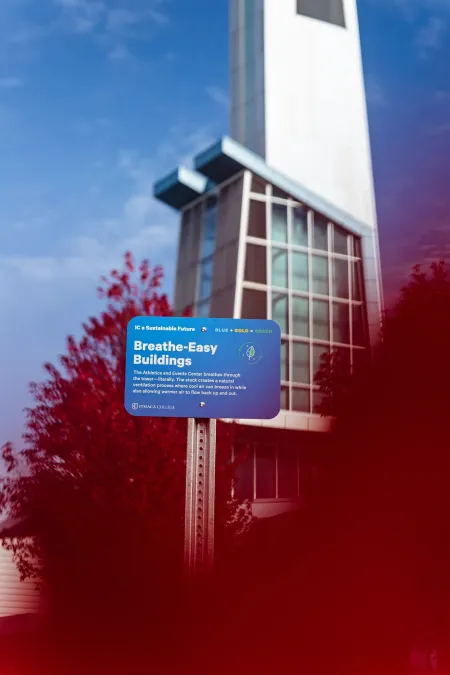
sign outside of a building

Sign sites include the LEED Gold Athletics and Events Center, whose signature tower creates a natural ventilation process where cool air can breeze in while warmer air flows up and out; the A and M parking lots, where bioretention pools slow stormwater runoff and help head off pollutants from entering storm drains; several grassy areas, where a “Mow less. Grow more” message supports keeping such areas natural for pollinators like bees and butterflies while also reducing emissions; and the locations of electric vehicle (EV) charging stations.

“Educating the wider community is one of the priorities of our Blue + Gold = Green campaign,” said Doyle. “It’s an effort we hope to expand on in the spring. And along with our newly expanded public EV charging infrastructure positioning the college as a regional leader in clean transportation, the momentum is clearly with us.”