Scholars for All Seasons (Especially Summer)

By Sloan MacRae, August 5, 2025
Inside the paid, hands-on projects that students design and pursue with faculty support.

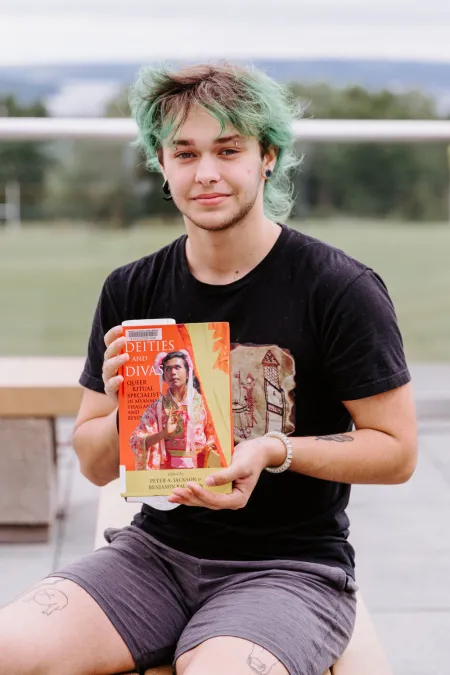
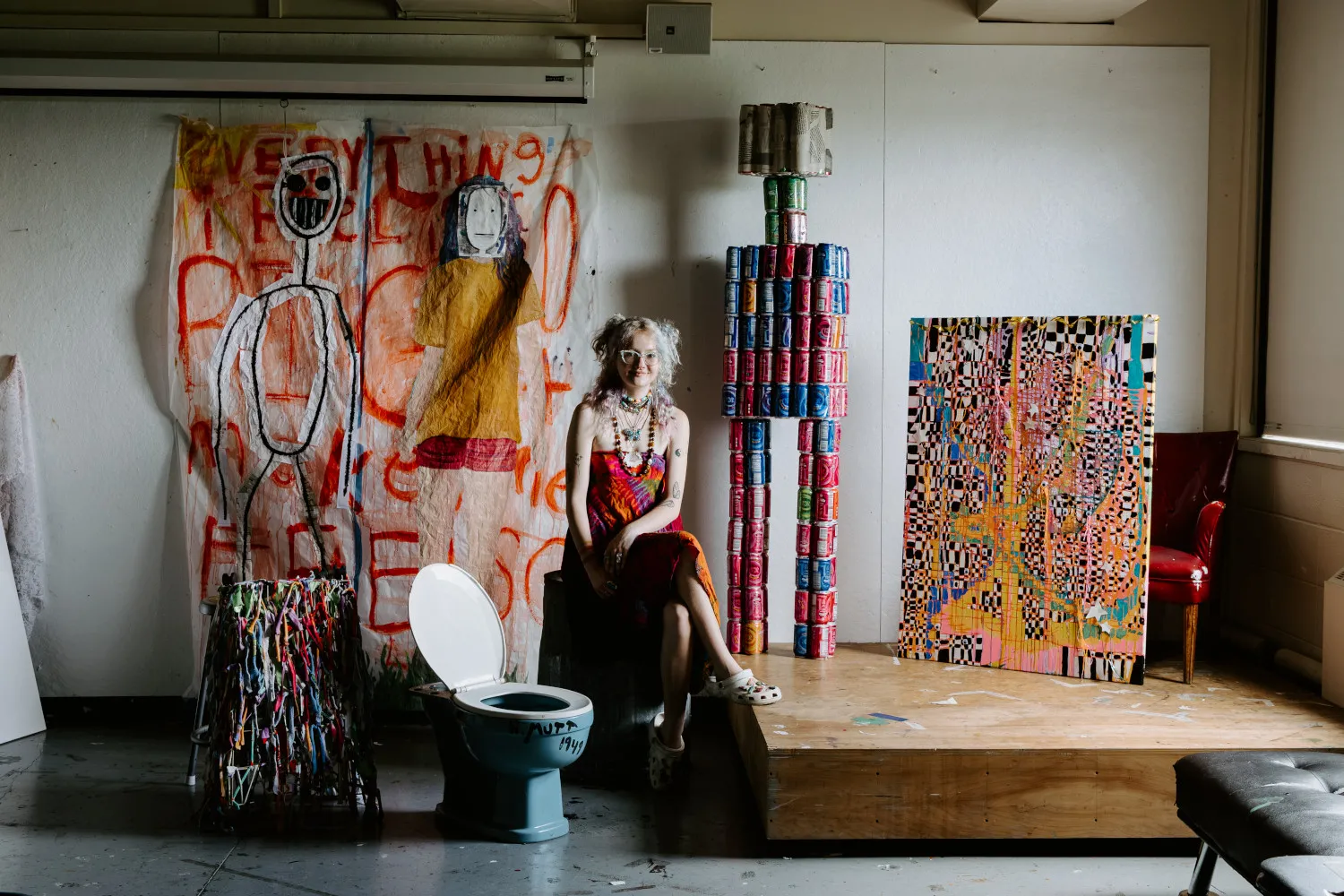
In a studio space in the Ceracche Center, Vic ’26—who only uses their first name for their art—built a robot from empty LaCroix cans. In a lab across campus, Sofia Gross ’27 analyzed variation in the owl genome. In a coffee shop in downtown Ithaca, Zoe Gainer ’25 prepared a questionnaire to survey autistic college students about the barriers they experience in the transition to college life. And with his pet bearded lizard nestled in his palm, Frankie Valens ’26 pored through books and media exploring gender expression in Burmese rituals.

Each of the 35 students in this year’s Summer Scholars Program cohort pursued a line of inquiry that was complex, open-ended, and entirely their own—but they didn’t do it alone. With support from faculty mentors and funding from Ithaca College’s Summer Scholars Program in the School of Humanities and Sciences, they spent the summer doing exactly what scholars do: engaging their curiosity, investigating real-world problems, and uncovering insights—while getting paid for their work.
Dumpster Diving, DNA, Data Ethics, and Duality

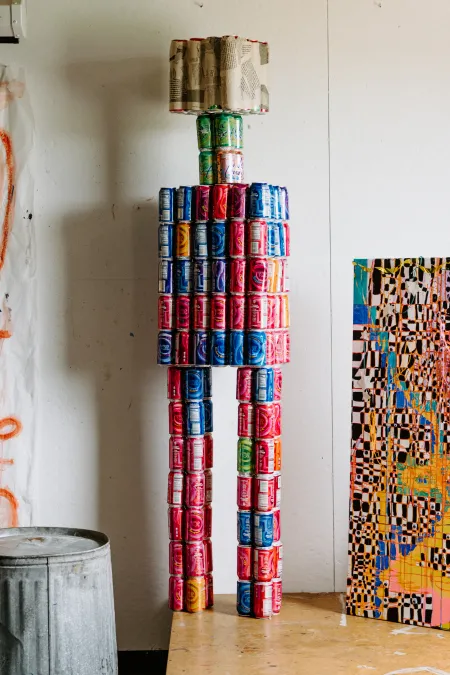
A six-foot-two-inch robot assembled from discarded soda cans.

Work in progress: Vic's robot man from discarded LaCroix cans. (Photo by Allison Usavage '11)

The Summer Scholars Program offers students the opportunity to spend the summer in Ithaca pursuing self-designed projects under the mentorship of a faculty member. Whether in the lab, the field, or a studio, students gain experience while developing skills they will carry forward into careers, graduate school, and beyond.

For art major Vic, that work meant sifting through literal garbage: dumpster diving around campus and town to find materials for their installation titled I found my happiness in the dumpster outside. Vic, a self-described painter first and foremost, used this project to stretch into sculpture and multimedia work. The installation blended found objects, personal reflection, and glittery transformation to explore overlooked moments in daily life and the emotional weight of discarded things.

Among the materials: a toilet left abandoned in the woods, spent vapes, tossed linens, and a cracked six-foot television screen. These were repurposed alongside original paintings, sculptures (including a self-portrait in sculpture), reflective writing, and a towering robot figure made from LaCroix cans, the show’s unofficial mascot. “I’m quite excited,” Vic said. “Any opportunity to get paid and make art at my age is insane. I’m super grateful.”

In IC’s Department of Biology, Sofia Gross studied the genetic future of two owl species: the barred owl (Strix varia) and the spotted owl (Strix occidentalis). As deforestation and habitat loss has pushed barred owls into new territory, they’ve begun endangering spotted owls and participating in invasive behaviors—subsequently creating a hybrid some researchers have dubbed the “sparred owl” that has been wiping out the genetic individuality of the spotted owl.

“I’m quite excited. Any opportunity to get paid and make art at my age is insane. I’m super grateful.”

Art major Vic '26
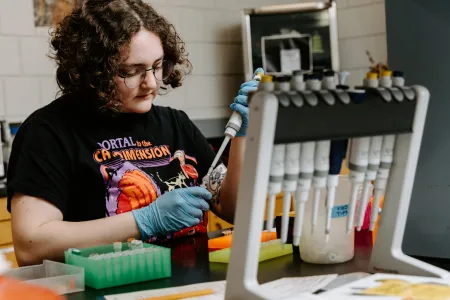
A student works with DNA samples in a lab.

Biology major Sofia Gross ’27 analyzes variation in the owl genome. (Photo by Allison Usavage '11)

To track the implications of that hybridization, Gross relied on both study skins and genetic samples borrowed from museums and research institutions across the country. The study skins—carefully preserved bird specimens—allowed them to examine traits like beak shape, feather patterning, coloring, and skull size. The DNA samples, often just tiny pieces of liver or other tissue sealed in test tubes and alcohol, were used to analyze genetic variation between individuals and across species.

Securing these materials was a project in itself; institutions are cautious about gifting valuable samples, especially to undergraduates. But once they arrived, Gross got to work, using techniques like polymerase chain reaction (PCR) to amplify segments of DNA and look for patterns that might reveal how these species are changing over time.

“Science is really unpredictable,” Gross said. “That’s what I find so exciting, because any time you think something is going to work, it can whip right back and give you something totally unexpected.”

The work of each scholar exemplifies the kind of immersive, hands-on experiences that distinguish the Summer Scholars Program. While some of these projects live in labs and studios, others focus on understanding people—their lives, cultures, challenges, and communities.

Summer scholars don’t just clock in for a summer job. They follow their passions into ambitious, self-directed work, flexing new intellectual and creative muscles, discovering and honing skills, and building confidence that may shape their future careers or academic paths.

Zoe Gainer’s psychology research centered on a community-based survey, and her methods required not just study design and outreach to schools and organizations that serve autistic students but also formal approval from the college’s Institutional Review Board to ensure ethical standards for working with human subjects.

“There’s actually a lot of overlap between the struggles autistic and nonautistic students face during college transitions,” Gainer said. “But I want to dig into what makes those experiences uniquely difficult, or uniquely insightful, for autistic students.”

Gainer’s work is deeply informed by personal experience. Several years ago, she worked for an organization that provided camps and after-school care, where she observed the difference in support given to neurodivergent children, who were often placed off to the side with minimal resources so they wouldn’t disrupt the experiences of neurotypical children. Her colleagues wanted to help these children, but they lacked the resources or direction. That experience stayed with her and ultimately led her to pursue psychology and counseling. This fall, she’s interning at Ithaca’s Greater Ithaca Activities Center, gaining additional training toward her goal of working with neurodivergent youth.

Gainer is on an accelerated path: she’s graduating in December, a semester early, and weighing her options for graduate school. She’s still deciding between psychology and psychiatry, and whether pursuing a PhD makes the most sense. Whatever direction she chooses, both the experience she gained and the insights she uncovered will serve her well. The project helped her sharpen her methods, clarify her academic and professional goals, and build a foundation for the next chapter in a fast-moving journey.

Frankie Valens (who uses ze/zir; he/him pronouns) also explored the human experience—specifically how culture, performance, and identity intertwined. A double major in religious studies and theatre studies, he researched gender expression in Burmese ritual practices, focusing on nat kadaws, or spirit mediums, sometimes described as feminine men or trans women, who perform during nat pwe ceremonies, where worshippers honor supernatural beings called nats through ritual, music, and dance. The mediums who lead the ceremonies are typically women, feminine men, or trans women whose performances embrace gender fluidity as part of the sacred expression. With guidance from Eric Steinschneider, associate professor of philosophy and religion, Valens analyzed media representations, academic literature, and religious texts to explore how sacred performance complicates Western assumptions about gender expression. “It’s not about looking at this as some exotic other,” he said. “It’s about asking what these rituals can teach us about how people survive, express themselves, and live with contradiction.”

What IS a Summer Scholar, Anyway?

Each summer, students in the School of Humanities and Sciences have the chance to stay in Ithaca and dive deeply into research or creative work of their own design. The Summer Scholars Program gives them time, space, mentorship, and funding to pursue a project they care about—whether that means conducting fieldwork, writing a play, analyzing data, programming an app, or building something entirely new.

Students can either join a faculty-led project or propose their own. Most choose the independent route, shaping questions that blend disciplines, build on personal experiences, or explore topics not always covered in class. Throughout the summer, scholars meet regularly with faculty mentors, share updates with one another, and participate in workshops on research ethics, presentation skills, and professional development.

By the end of the eight-week program, each student has created a body of work to present at the Summer Scholars Showcase and, in many cases, a launchpad for what comes next.

“At most institutions, if you’re doing research as an undergrad, you’re joining a lab as an assistant on someone else’s project. Here, the students take the lead.”

Jessye Cohen-Filipic, associate professor of psychology and faculty mentor

Mentorship Without Micromanagement

A professor and college student laugh together at a table.

Jessye Cohen-Filipic (at left), associate professor of psychology and faculty mentor to psychology major Zoe Gainer '25 (at right). (Photo by Allison Usavage '11)

Each scholar is paired with a faculty mentor who helps shape the research but never overshadows it. That balance—support without control—is key to the program’s success, said Jessye Cohen-Filipic, associate professor of psychology and faculty mentor to Gainer. “At most institutions, if you’re doing research as an undergrad, you’re joining a lab as an assistant on someone else’s project. Here, the students take the lead.”

She describes her role as a coach and sounding board, helping students like Gainer navigate research ethics, data collection, and professional standards while encouraging them to shape and pursue their own ideas. “I’ve never mentored a summer scholar project that wasn’t based on a thought conjured by a student,” she said. “That spark is everything.”

The model is especially powerful in disciplines where research isn’t always part of the curriculum. For students like Valens, whose summer work blended religious studies and theatre, the chance to pursue an original, faculty-supported project offered both structure and freedom.

Valens’s research focused on nat kadaws—spirit mediums in Burmese ritual practice who often perform elaborate ceremonies and occupy fluid gender roles. He was fascinated by how these roles, rooted in tradition and spirituality, can legitimize identities that might be marginalized in other social contexts. “As my mentor has brought to my attention, in the Eastern—and many indigenous—traditions, people existing at intersections of genders often hold a spiritual role in their community," he said. His work drew on both sides of his academic background and pointed toward future scholarship or creative work that complicates Western assumptions about gender, ritual, and expression. “In the West, we sometimes reduce ritual to ‘just theatre,’” he said. “But the histories of religion and theatre are deeply intertwined. Ritual is inherently performative. It’s a metaphorical acting out of something bigger.”

More than a Summer Project

A college student holds up a book.

Religion studies / theatre studies double major Frankie Valens '26 with some research. (Photo by Allison Usavage '11)

Summer scholars don’t just clock in for a summer job. They follow their passions into ambitious, self-directed work, flexing new intellectual and creative muscles, discovering and honing skills, and building confidence that may shape their future careers or academic paths. With the freedom to ask their own questions and the support to pursue them in depth, these students have gained more than hands-on experience (which is worth something in its own right). They have also gained a deeper understanding of their interests, their strengths, and how they want to engage with the world.

In Vic’s case, it was not only their sculpture that was evolving; it was their approach to creative inquiry. “I’m using trash as an analogy for those moments in life we throw away,” they said. What started as an art show had grown into a meditation on value, memory, and meaning.

Gross, too, has seen a future ripple effect. Though she was not aiming for a career in ornithology—her plan is to become a veterinarian—the scientific rigor and lab skills she developed this summer will prove invaluable.

And Gainer’s project was designed to generate real-world impact, not just insights. Her findings and recommendations may help institutions like Ithaca College better support neurodivergent students.

As Cohen-Filipic notes, the work done in this program doesn’t end when the next semester starts. “This is the kind of experience that gives students momentum, and it arms them when they walk into an interview or application process.”

“Science is really unpredictable. That’s what I find so exciting, because any time you think something is going to work, it can whip right back and give you something totally unexpected.”

Biology major Sofia Gross '27

Curiosity + Passion = Illumination

Curiosity takes many forms. Sometimes it looks like a question no one’s asked before. Other times like a hunch that won’t let go. Among this year’s summer scholars, it was a common thread. Whether they were exploring artistic expression, neurodivergence, religion, or the natural world, each project began with a desire to understand something more deeply.

Cohen-Filipic saw that drive clearly with Gainer. “I had worked with Zoe, and I’d had Zoe in class. She’s obviously a very bright and hardworking student, but I hadn’t gotten to know her particularly well,” Cohen-Filipic said. “But there was a spark when she started to talk about this project that I hadn’t yet seen, and that’s what often gets me. I was like, ‘Here we go.’”

That spark has shown up in different ways. In Gainer’s case, it was in the care she put into building the surveys to capture the data and insights she needs. For Gross, it was in the meticulous process of scouring base pairs—the tiny chemical units that make up DNA. It was there in Vic’s sculptures, built from salvaged materials, and in Frankie’s close reading of texts spanning religion, history, and performance.

What makes the program stand out is that these projects weren’t assigned—they were initiated and led by the students themselves. The questions they asked reached beyond a single discipline or course, shaped by personal interests and long-term goals.

Each student shared their work at the Summer Scholars Showcase at the end of the program. But for many, that presentation was just one step in a longer process. Projects may have continued into senior theses, graduate school applications, publications, or, in Vic’s case, an exhibition in the Handwerker Gallery on campus. And for many summer scholars, that’s exactly the point: the rare chance to spend a summer following an idea as far as it will go.

To Be Continued: The Final Product

As we hit our deadline for this story, the work of the summer scholars was still unfolding. Students were in the final stretch—finishing experiments, revising drafts, completing installations, and preparing to present their work at the Summer Scholars Showcase.

While this story has highlighted just four students, 35 summer scholars shared their work at the showcase. Want to see how it turned out for them? Stay tuned! 

Curiosity meets opportunity.

Whether it’s summer, fall, winter, spring, or in a lab, a studio, or the community, students in the School of Humanities and Sciences work closely with faculty to turn big questions into real-world experiences.

Discover what’s possible.

Empower student discovery.

Hands-on research. Faculty mentorship. Transformative projects. Your support makes it happen for H&S students year-round.

Support future scholars.