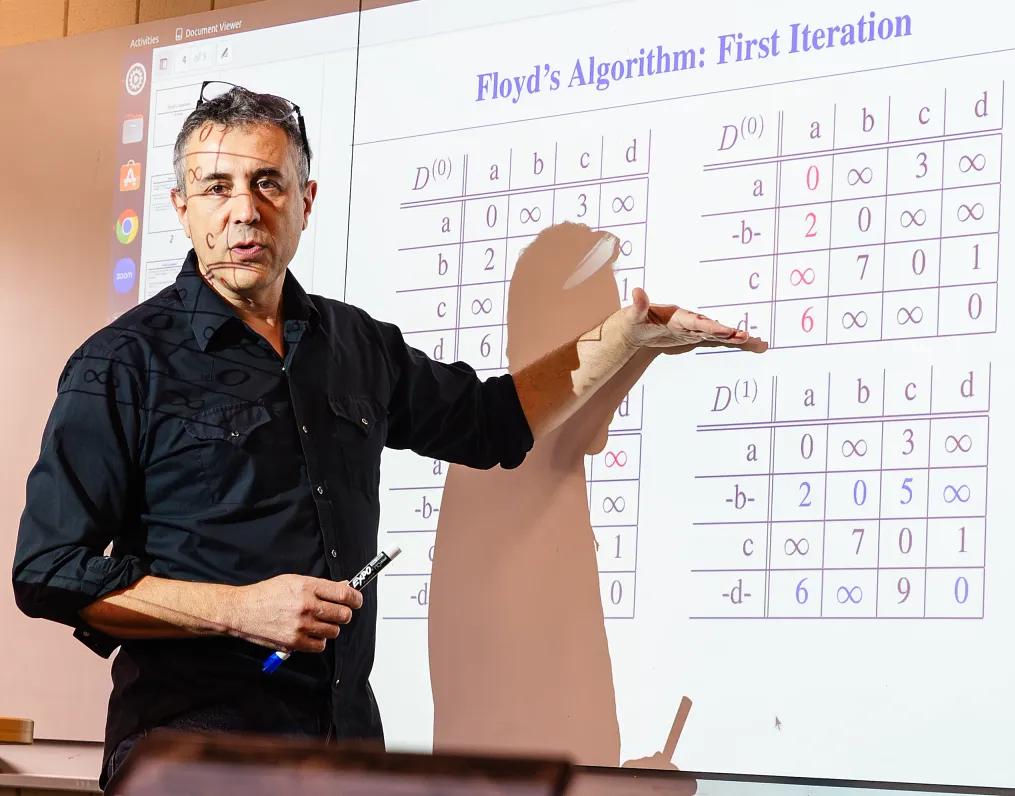
I am a Professor of Computer Science at Ithaca College (CV as of 2025). I earned my Ph.D. and M.S. in Computer Science and my B.S. in Computer Engineering from Lehigh University, where I completed a minor in Economics. Before joining Ithaca College in 2004, I taught at Swarthmore College. During the 2011–2012 academic year, I was a Fulbright Researcher at Koç University in Istanbul. And I play drums.
◂ TEACHING ▸
I have taught across much of the undergraduate computer science curriculum. At Ithaca College, my courses have included introductory computing, discrete structures, data structures and algorithms, computer systems, networks, databases, and computer organization. At Swarthmore College, I taught programming, algorithms, networking, and network modeling with stochastic systems. I teach algorithms at Cornell University as well.
Two courses have shaped much of my recent teaching: Discrete Mathematics and Algorithm Design. In Discrete Mathematics, I introduced spreadsheet-based labs so students could experiment with concepts that are otherwise quite abstract. In Algorithm Design, students implement algorithms and then use those implementations to test hypotheses, compare behavior, and investigate efficiency.
Data is another continuing interest. My database courses cover relational/non-relational databases, structured/unstructured data, and spatial/non-spatial representation. These courses have led to projects involving elections, history, geography, and other areas outside computer science.
◂ SCHOLARSHIP ▸
Much of my recent scholarship has grown directly from teaching. My work on teaching Prim's and Kruskal's minimum spanning tree algorithms received the Best Paper Award at ITiCSE 2018 and was later reprinted in ACM Inroads. More recently, I studied approaches to teaching dynamic programming for deeper comprehension. I focus on data-oriented interdisciplinary work, ranging from computing ideas conveyed through spreadsheets to Geographic Information Systems, for both computer science majors and students in other fields.
Selected funded work:
- National Endowment for the Humanities — Untangling the Web of Historical Thinking: What the Structures of Student Produced Wikis Reveal, with Michael Smith. $50,000 over three years.
- Fulbright Program, U.S. Department of State — Using Geographic Information System for Cross Cultural Scholarship. $20,000 plus residential, travel, and living support for research at Koç University.
- Ithaca College Provost's Office — Educating the Educator, with John Barr. $30,000.
- National Science Foundation — Multidisciplinary Sustainability Modules: Integrating STEM Courses, with Thomas Pfaff, Jason Hamilton, and Michael Rogers. $150,000 over three years.
Srinjay: Why is it bad to write self-modifying code? Ali: It's like walking down the street and [bends over, grunts] rearranging your intestines. Mike: This is why I come to this class!
Selected recent publications:
- Ali Erkan. “Teaching Dynamic Programming: Top Down or Bottom Up?” Journal of Computing Sciences in Colleges, 40(8), 2025, pp. 118–132. DOI
- Ali Erkan and John Barr. “Spreadsheets As Hands-on Learning Tools In a Discrete Math/Structures Course.” Journal of Computing Sciences in Colleges, 38(8), 2023, pp. 158–172. DOI
- Ali Erkan and Adam Lee. “Connecting Majors/Non-Majors Courses Via Tabular Data.” Proceedings of the ACM Conference on Innovation and Technology in Computer Science Education, 2019, pp. 235–236. DOI
- Ali Erkan. “The Educational Insights And Opportunities Afforded by the Nuances Of Prim's And Kruskal's MST Algorithms.” Proceedings of the ACM Conference on Innovation and Technology in Computer Science Education, 2018, pp. 129–134. DOISrinjay: Why is it bad to write self-modifying code? Ali: It's like walking down the street and [bends over, grunts] rearranging your intestines. Mike: This is why I come to this class!
- Ali Erkan, John Barr, Tony Clear, Cruz Izu, Cristian Jose Lopez del Alamo, Hanan Mohammed, and Mahadev Nadimpalli. “Developing a Holistic Understanding of Systems and Algorithms through Research Papers.” Proceedings of the 2017 ITiCSE Conference on Working Group Reports, 2018, pp. 86–104. DOI
- Ali Erkan and John Barr. “Algorithms + Organization = Systems.” Proceedings of the ACM Conference on Innovation and Technology in Computer Science Education, 2016, pp. 65–70. DOI
◂ SERVICE ▸
I have served as Chair of the Department of Computer Science since 2021. Much of my work as chair has involved curriculum and long-term planning. A departmental program review helped us identify problems in the prerequisite structure and rethink how students move through the curriculum.
That work contributed to the development of a new Artificial Intelligence major and new minors in Machine Learning, Data-Centric Computing, App Development, and Computer Systems. I worked with colleagues in Mathematics on a new Data Science major.
In 2023, I co-chaired the Northeast Conference of the Consortium for Computing Sciences in Colleges (CCSCNE) hosted at Ithaca College. My service has included the Ithaca College Tenure and Promotion Committee, the Humanities and Sciences General Education Committee, and the Humanities and Sciences Summer Scholars Committee. I have been a board member of the Northeast Consortium for Computing Sciences in Colleges since 2021.
◂ AWARDS AND RECOGNITION ▸
- Ithaca College Faculty Excellence Award, recognizing work as Chair of the Department of Computer Science, 2025.
- Ithaca College Faculty Excellence Award, recognizing teaching, 2014.
- Level II Dean Merit Award, 2009 and 2024.
- ITiCSE Best Paper Award, 2018.
◂ QUOTES ▸
My students used to record quotes from my classes... I wish they would do it again. For more of the kind of stuff you see below, please check the course name links on the left.
--Srinjay: Why is it bad to write self-modifying code?
--Ali: It's like walking down the street and [bends over, grunts] rearranging your intestines.
--Mike: *THIS* is why I come to this class!