Celebrating Heritage & History

Rooted in Community. Centered in Identity. Powered by Unity.

We honor the diverse histories, cultures, and lived experiences, and contributions of diverse communities through dedicated Heritage & History Months. This is accomplished within the campus community through intentional celebrations and storytelling. These observances are :

  • Hispanic/Latine History Heritage Month,
  • Native, Indigenous, and First Peoples History & Heritage Month,
  • Black & African History Heritage Month,
  • APIDA (Asian, Asian American, and Pacific Islander, Desi Arab) History & Heritage Month.

These observances provide space for reflection, visibility, education, and celebration, uplifting voices that have shaped our shared history and continue to influence our present and future. They are housed under the Unity Center, a space dedicated to equity, belonging, and transformation.

Join us each  month for an opportunity to reflect, learn, and uplift voices that have shaped our world. Through programs, dialogue, and initiatives like Taste of Home Goodie Bags/Boxes, we foster connection and celebrate the richness of identity. These efforts are grounded in the Unity Center’s core values: community and empowerment.

Together, we build a campus culture where every story matters and every identity is honored.
Hispanic/Latine History Heritage Month

Hispanic/Latine History Heritage Month honors the histories, cultures, and contributions of people whose ancestors came from Spain, Mexico, the Caribbean, and Central and South America. At Ithaca College, we celebrate the vibrancy and diversity of the Latine diaspora through storytelling, art, food, and community engagement. This month is a time to uplift voices, reflect on legacies, and recognize the ongoing impact of Latine leaders, creators, and changemakers.

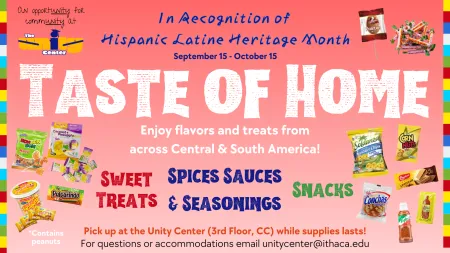
HHM Taste of Home

50 bags are made at a first come first serve basis.

Piloted in September 2024, as a part of celebrating Hispanic-Latine Heritage Month, we present the "Taste of Home" Box, a special care package featuring snacks, treats, and cooking ingredients from across cultures. Our goal is to create a representative and diverse selection that brings a taste of home to students from different cultural backgrounds.

Black History Heritage Month

Black History Month is a time to honor the legacy, resilience, and brilliance of Black communities. At Ithaca College, we recognize the historical and contemporary contributions of Black leaders, artists, scholars, and activists. Through events, dialogue, and celebration, we reflect on the enduring fight for justice and the transformative power of Black excellence.

hhm hhm

Coming Soon

APIDA History & Heritage Month

APIDA (Asian, Pacific Islander, Desi, Arab) History & Heritage Month celebrates the diverse cultures, histories, and identities of Asian, Pacific Islander, and Desi American communities. At Ithaca College, we recognize the richness of APIDA experiences from ancestral traditions to contemporary movements and honor the contributions of APIDA individuals in shaping society, arts, and activism.

hhm hhm

Piloted in April 2024, as a part of celebrating Asia Focus Month, we present the "Taste of Home" Box, a special care package featuring snacks, treats, and cooking ingredients from across cultures. Our goal is to create a representative and diverse selection that brings a taste of home to students from different cultural backgrounds.

Native, Indigenous, and First Peoples History & Heritage Month

Native, Indigenous, and First Peoples History & Heritage Month is a time to honor the original stewards of this land and recognize the enduring cultures, knowledge systems, and contributions of Indigenous communities. At Ithaca College, we commit to learning from Indigenous voices, amplifying their stories, and acknowledging the histories that shape our present.

Learn more about the history behind HHM

National Hispanic Heritage Month honors the culture, heritage, and contributions of Hispanic Americans each year. The event began in 1968 when Congress deemed the week including September 15 and 16 National Hispanic Heritage Week to celebrate the contributions and achievements of the diverse cultures within the Hispanic community. The dates were chosen to commemorate two key historic events: Independence Day, honoring the formal signing of the Act of Independence for Costa Rica, El Salvador, Guatemala, Honduras, and Nicaragua (September 15, 1821), and Mexico’s Independence Day, which denotes the beginning of the struggle against Spanish control (September 16, 1810). It was not until 1988 that the event was expanded to month-long period, which includes El Dia de la Raza on October 12, which celebrates the influences of the people who came after Christopher Columbus and the multicultural, multiethnic society that evolved as a result; Chile’s Independence Day on September 18 (El Dieciocho); and Belize’s Independence Day on September 21. Each year a different theme for the month is selected and a poster is created to reflect that theme.

In response to an effort by many to gain a day of recognition for the great influence American Indians have had upon the U.S., Congress designated a week of October to celebrate Native American Awareness Week in 1976. Yearly legislation was enacted to continue the tradition until August of 1990, when President Bush approved the designation of November as National American Indian Heritage Month. Each year a similar proclamation is issued. President Clinton noted in 1996, "Throughout our history, American Indian and Alaska Native peoples have been an integral part of the American character. Against all odds, America’s first peoples have endured, and they remain a vital cultural, political, social, and moral presence." November is an appropriate month for the celebration because it is traditionally a time when many American Indians hold fall harvest and world-renewal ceremonies, powwows, dances, and various feasts. The holiday recognizes hundreds of different tribes and approximately 250 languages, and celebrates the history, tradition, and values of American Indians. National American Indian Heritage Month serves as a reminder of the positive effect native peoples have had on the cultural development and growth of the U.S., as well as the struggles and challenges they have faced.

The roots of Asian/Pacific American Heritage Month can be traced back to 1976, when Jeanie Jew, president of the Organization of Chinese American Women, contacted government officials in response to the lack of Asian Pacific representation in the U.S. bicentennial celebrations that same year. The observance began in 1979 as Asian Heritage Week, established by congressional proclamation. In May 1990, the holiday was expanded further when President George Bush signed a proclamation making it month-long for that year. On October 23, 1992, Bush signed legislation designating May of every year Asian Pacific American Heritage Month. The month of May was chosen to commemorate two significant events in history: the immigration of the first Japanese immigrants to the United States on May 7, 1843, and the completion of the transcontinental railroad on May 10, 1869 (Golden Spike Day). The diversity and common experiences of the many ethnic groups are celebrated during Asian Pacific American Heritage Month with numerous community festivals as well as government-sponsored activities.

In 1926 Dr. Carter G. Woodson instituted the first week-long celebration to raise awareness of African Americans’ contributions to history. Prior to this time, little information could be found regarding African American history. Important achievements were left out of history books, and there was a general misconception that African Americans had made little contribution to U.S. society or history. 50 years later, the week became a month, and today February is celebrated as African American History Month. The month of February was chosen because it celebrates the birthdays of Abraham Lincoln and Frederick Douglass, both of whom dramatically affected the lives of African Americans. Frederick Douglass (1817-1895) was a writer, lecturer, editor, and civil rights activist who escaped slavery at age 21 and went on to campaign for the abolition of slavery, establish a newspaper, and hold the office of Minister to Haiti. He was a major voice in the anti-slavery/civil rights movement of his time. Abraham Lincoln (born February 12, 1809), as the sixteenth president of the United States, issued the Emancipation Proclamation on January 1, 1863, thereby declaring that all slaves within the Confederacy would be permanently free. Each year, the Association for the Study of African American Life and History, founded by Dr. Woodson, sets the theme for the month.