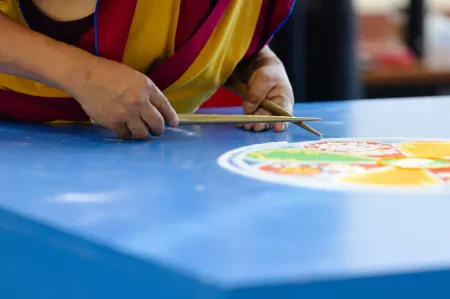
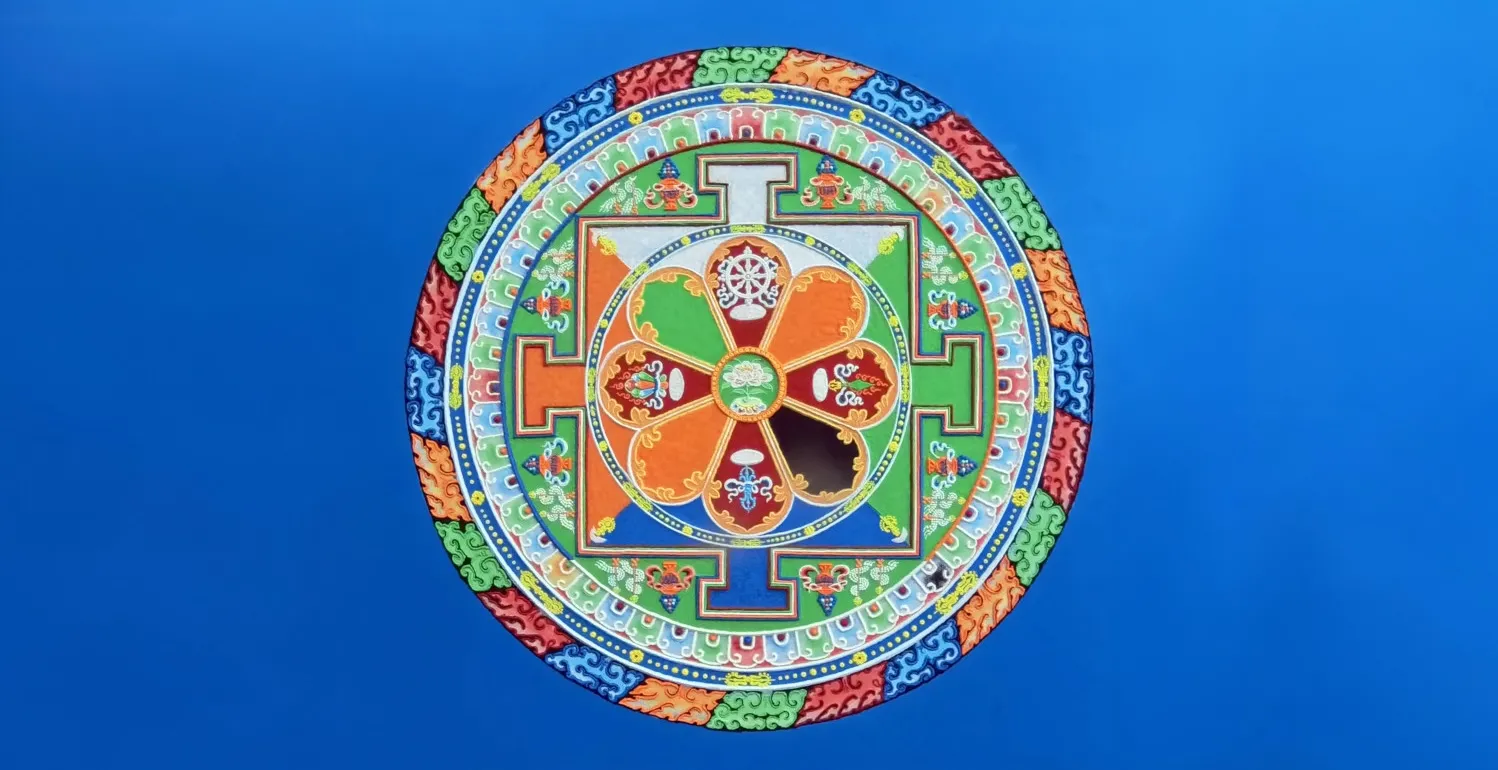
For the past three years, monks from the Namgyal Monastery Institute of Buddhist Studies, just two miles up the hill from IC, have meticulously constructed a sand mandala on campus, building the intricate patterns from memory, constructing it one grain at a time, radiating outward from the center. It takes them six days of continuous effort to construct the mandala, which serves as a ritual tool for meditation, a miniature representation of the universe, and a temporary mansion for the compassionate deity Chenrezig. Assembled and housed in the atrium of the Dorothy D. and Roy H. Park Center for Business and Sustainable Enterprise this year, the mandala offers the entire Ithaca community the opportunity to engage with an ancient form of spiritual and artistic expression that embraces the interconnectedness and transience of all things.
A Ritual Shared, One Grain at a Time

After the diligent work and meditation, the monks—in profound symbolism of universal impermanence—sweep the mandala away, gathering the sand in a sacred vessel that they carry to a dissolution ceremony and pour into the pond next to IC’s Muller Chapel.
- Tibetan Buddhist monks from the Namgyal Monastery draft the mandala’s geometric patterns in pencil.
- A monk places the first grain of sand.
- The monks construct the mandala, one grain at a time, in a pattern that radiates out from the center.
- The mandala takes shape.
- After five days of work and meditation, the monks complete the mandala.
- The monks sweep away the mandala and store it in a sacred vessel.
- A monk pours the sand into the pond next to Muller Chapel in a dissolution ceremony.
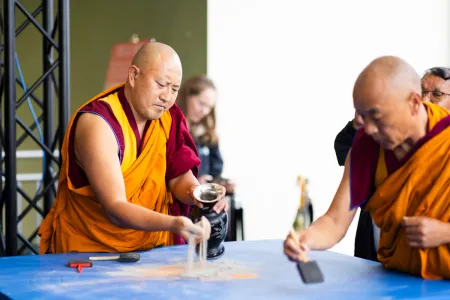
The mandala, and the programming and events that complement its creation, exemplify the diversity of the campus and town. Associate professor of philosophy and religion Eric Steinschneider says the mandala “raises awareness that we live in an incredibly religiously pluralistic society. Here in Ithaca, we have a wonderful Tibetan community with an extremely rich set of cultural traditions next door.” Indeed, the Namgyal Monastery serves as the official North American monastic headquarters of the Dalai Lama himself. Devout Tibetan Buddhists consider the Dalai Lama the earthly manifestation of Chenrezig, the same deity of compassion who temporarily resides in the mandala. Buddhists and scholars from New York City, Buffalo, Rochester, and locations in Pennsylvania visit Ithaca to take part in this experience, in addition to the thousands who follow the mandala’s progress online.

As a meditative tool, the mandala invites us to glimpse a universe beyond the familiar realm of appearances that we experience with our senses, approaching transcendence and compassion. Steinschneider notes that “the very process of constructing the mandala represents an immensely powerful act of karmic merit that is shared with the community.”