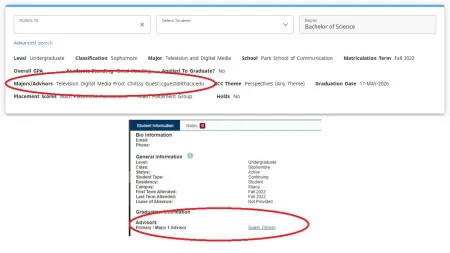
How do I find out who my faculty advisor is?

screenshots of Degreeworks and HomerConnect

You can view your faculty advisor's information in DegreeWorks and HomerConnect

What is a Faculty Advisor?

WHAT YOU CAN EXPECT FROM YOUR FACULTY ADVISOR:

  1. Will be available during posted office hours and will have the opportunity for individual appointments;
  2. Assistance in helping you find academic information, including information on majors, minors, and academic policies, procedures and deadlines;
  3. Referrals to appropriate people and offices if she or he cannot provide the necessary assistance;
  4. Assistance in understanding the purpose of academic requirements and their relationship to your degree program and career plans;
  5. Assistance in helping you to learn how to make academic decisions, how to discover the range of options available to you, and how to think through the consequences.

WHAT YOUR FACULTY ADVISOR WILL EXPECT FROM YOU:

  1. Initiate contact with your advisor;
  2. A meeting, should you want it, each semester during the two-week advising period prior to on-line registration to help with course selection and academic planning;
  3. Contact your advisor during office hours, email or telephone to make an appointment;
  4. Come to appointments on time and cancel appointments if you cannot come;
  5. Access your mid-term grades on the web and make an appointment to discuss unsatisfactory grades;
  6. Discuss important decisions or questions about your education (e.g., choice of major, change of major, change of school) well before on-line registration;
  7. Come prepared for appointments. Prior to on-line registration, come with a list of courses, alternative course choices, and the meeting times of these courses;
  8. Follow through on referrals made by your advisor (e.g., a visit to the Center for Career Exploration and Development) and be willing to discuss suggestions made by your advisor;
  9. After talking to your advisor, accept responsibility for making your own decisions. (Your advisor will provide advice, not make decisions.)
  10. Understand your catalog year and be able to refer to the catalog as needed for degree progress. (https://www.ithaca.edu/catalogs/)
If you're confused or need assistance, we're here to help!

Come to the Academic Support Center in Muller 106 or 201 or set up a meeting with an Academic Development Specialist for assistance.

Click here to book a meeting