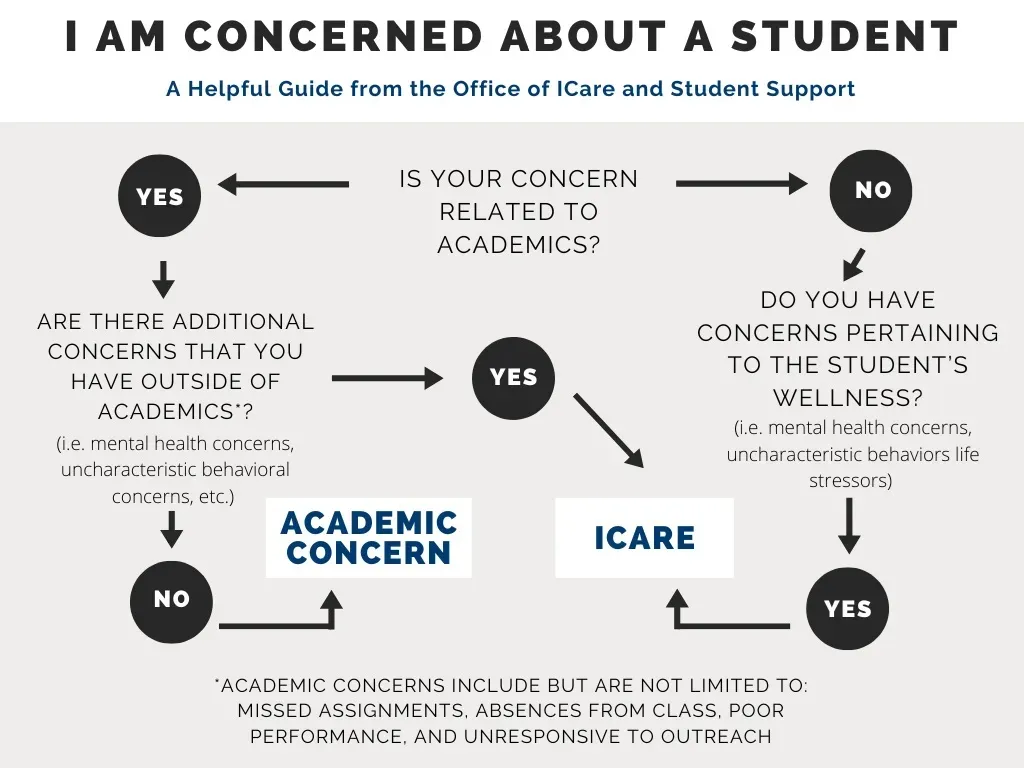
Two Types:
Nudge the student towards support
• Let the student and their school know that you are concerned and that you want to guide them in connecting to support resources. It shows you care and increases the likelihood that the student will get help before the situation evolves into something more serious.
• Students will receive an email notification of the concern submitted and will have the option to meet with one of the Student Success Coaches in the Office of Student Success & Retention.
Activate a professional intervention
• Let the student and their school know about your concern and activate an intervention where the student is required to meet with advising staff to ensure they are getting personalized counsel and guidance on addressing the concerns.
• Students will be required to meet with either Associate Dean MacAlpine if they are a Park student. Students from other schools will be required to meet with a designated member of their Deans office.
Examples of when to submit an Academic Concern:
• Infrequent attendance or completely stopped attending class.
• Procrastination, incomplete assignments, or turning in poor quality work.
• Decline in grades.
• Non-communicative behavior or not responding to email/outreach attempts.
• Difficulty managing course load
• Exhibiting disruptive classroom behavior (i.e. argumentative, confrontational, harassing)
What happens when I submit an ICare on a student?
1) ICare referrals are reviewed every work day.
2) Follow up is determined by ICare team- students may receive phone calls and/or email outreach.
3) Meetings with a member of the ICare team are always offered. There are times when meeting with the Office of Case Management may be required.
4) Team members work with the student during meeting offering referrals, discussing next steps and providing support.
5) When a student is connected with the appropriate support, their case will be closed.
*ICare is not the same as CAPS- students who get an ICare are not required to meet with CAPS, but will be given the opportunity if that is what fits their needs the most.
Examples of when an ICare can be submitted:
• Significant changes in mood or daily functioning.
• Decline in personal hygiene and appearance.
• Difficulty caring for self (i.e. irregular sleep pattern, concerning eating pattern, routinely overexercises).
• Being under an unusual amount of stress.
• Difficulty coping with stressful life circumstance (i.e. death of family member, financial strain, physical illness, disability).
• Threatening self or others.
• Taking action to harm self/others (obtaining weapons, overdosing on pills, cutting self).
• Contemplating suicide (i.e. giving away possessions, discussing death as a means to "solve all their problems", wishing they were not alive).
• Increased irritability or aggressive behavior (i.e. resentful, abrasive, hostile, frustrated).
• Alcohol or drug use that jeopardizes relationships, interferes with academic performance, or impairs daily functioning.
• Demonstrating behavioral extremes that are more exaggerated/erratic than normal (i.e. hyper/animated, severely withdrawn, impulsive, or reckless).
• Excessive crying, clingy behavior, rejecting help offered by others, or expressing hopelessness/worthlessness.
• Isolates self.
• Has minimal social support and/or significant disengagement from social activities.
• Death of a friend, family member, or loved one.
• Being subjected to bullying or bullying others.
• Demonstrates verbal or physical aggression towards others.
• Argumentative behavior that is disproportionate to the situation.
• Isolates self.
• Has minimal social support and/or significant disengagement from social activities.
• Death of a friend, family member, or loved one.
• Being subjected to bullying or bullying others.
• Demonstrates verbal or physical aggression towards others.
• Argumentative behavior that is disproportionate to the situation.