Pursue Your Research Interests

Use research to apply classroom learning to study a topic of interest more in-depth.

Our SLPA faculty collaborate with undergraduate and graduate students to conduct innovative clinical research in areas including social communication intervention, augmentative and alternative communication (AAC) use, and laryngeal function. Our research studies take place in the Ewing Clinic, specialized on-campus labs, community partner sites, and throughout the country via telehealth. 

Students and faculty frequently attend the American Speech-Language-Hearing Association (ASHA) Annual Convention to present their research, and many students have had the opportunity to be co-authors on research publications. SLPA students also frequently present their research on-campus at the annual Whalen Symposium.

The department currently operates three research labs, the AAC Lab, GULP Lab, and Social Communication Lab. All of the labs are currently accepting volunteer student research assistants. Interested students should reach out to the Lab Director for more information.
Our Research Labs

Our research labs bring together faculty and students to investigate applied and basic science questions related to communication and swallowing disorders.

Director: Dr. David Hajjar

The AAC Lab focuses on augmentative and alternative communication (AAC) across diverse populations and settings. Students collaborate on projects related to interface design, communication partner training, and promoting meaningful participation in everyday and recreational activities.

The lab emphasizes interdisciplinary collaboration, partnering with faculty and students across fields such as media arts and sciences and recreational therapy, as well as with AAC users and their families.

Learn more: For specific information about previous and current projects, please see Dr. Hajjar’s webpage.

Directors: Dr. David Bayne & Dr. Carly Jo Hosbach-Cannon

The GULP Lab investigates how laryngeal function supports swallowing, voice, breathing, and airway protection in both typical and clinical populations. Research examines how biological and psychosocial factors interact to influence communication, nutrition, and overall well-being.

Through this work, the lab advances evidence-based approaches for assessing and treating conditions such as dysphagia and dysphonia, with the goal of improving quality of life and clinical outcomes.

Director: Dr. Matt Zellner

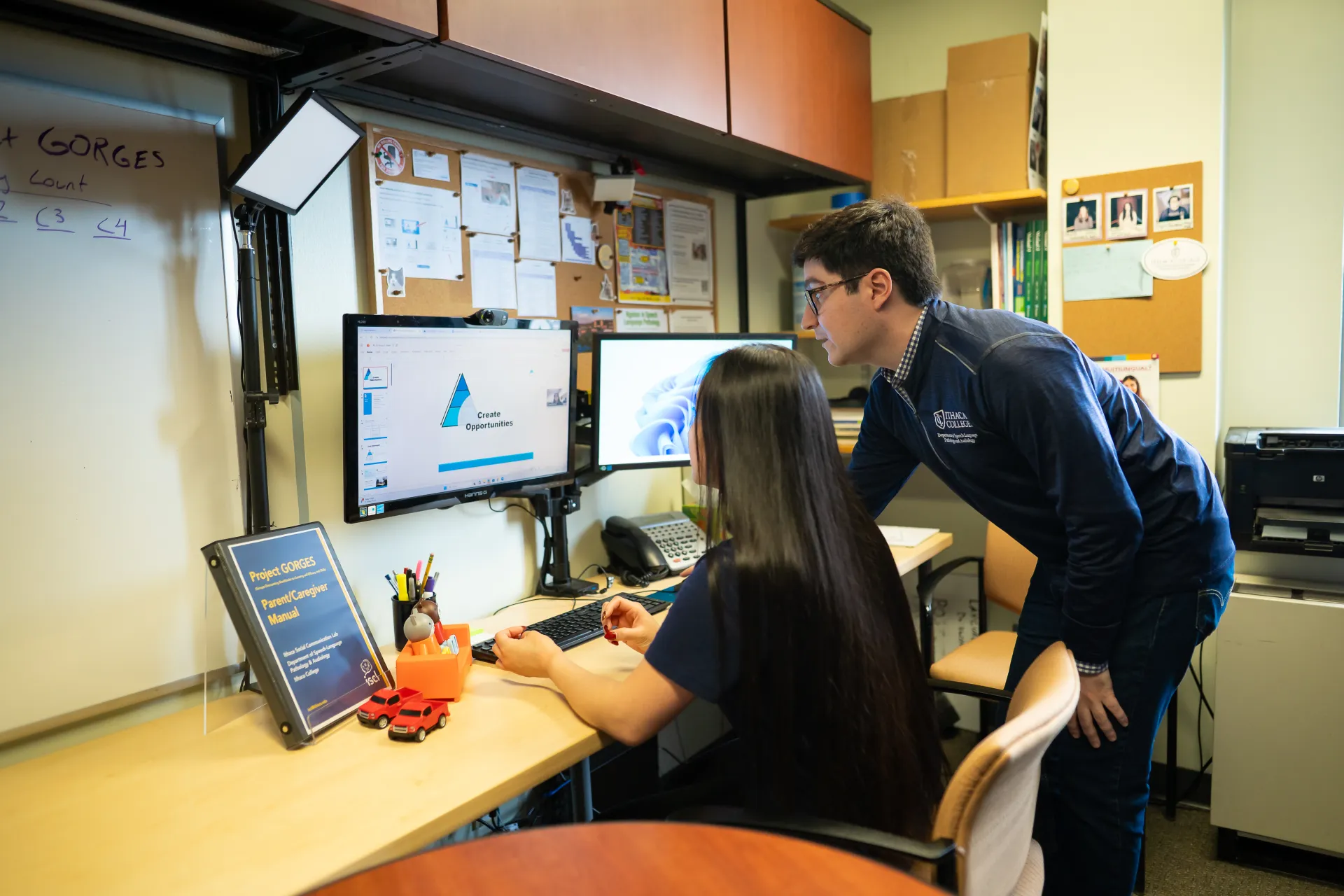
The ISCL focuses on improving access to social communication interventions for individuals with developmental disabilities and differences across the lifespan. Current projects include examining differences in early intervention access between rural and urban communities using GIS software, evaluating an adaptation of the Project ImPACT parent coaching program (Project GORGES), and developing a communication skills improv program for adults with developmental disabilities (Project RIPPLE).

Learn more: To learn more about the lab and about what we're working on right now, visit the ISCL website.

Get involved: 

  • Students: Opportunities are available for undergraduate and graduate students to participate in research as assistants, through independent study, or thesis work. Email Dr. Zellner for more information.
  • Community members: The ISCL is currently recruiting participants for telehealth and in-person clinical studies. Follow our Instagram (@icsocialcomm) for more information or send an email to iscl@ithaca.edu.

Featured Student Research

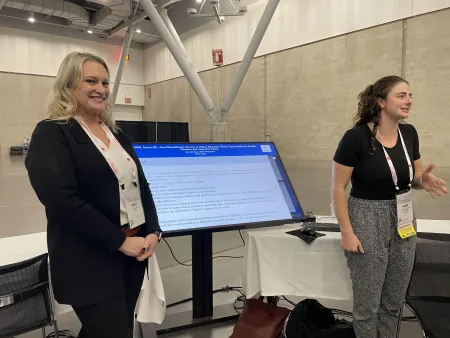
Dr. Rominger & Abby Marracino, M.S. '24, presenting poster at ASHA 2023

Dr. Rominger and Abby in front of their poster at ASHA 2023.

Dr. Amy Rominger and SLPA master's student (now alumna) Abby Marraccino ('24) presented at the 2023 ASHA Convention in Boston, MA, on aural rehabilitation (AR) services in higher-ed clinics: Aural Rehabilitation Services in Higher Education Clinics: Opportunities for Student Clinicians and Access for Clients. 

Taking information submitted by clinic directors, they discussed the current landscape of AR services offered as a clinical opportunity for student clinicians and the potential barriers and future avenues for allowing more of these clinical opportunities.

Recent SLPA Presentations & Publications

Presentations

Zellner, M.A., Levin, L.*, Reyes, I.*,& Blada, K.* (2026, October). Leveraging groups to improve outcomes in a brief caregiver coaching program. Division for Early Childhood Conference.

Bayne, D. & Guarneri, L.* (2025, November). Compassionate Companions: Examining Animal-Assisted Therapy Across Diverse SLP Settings, Populations, and Clinical Domains. American Speech-Language-Hearing Association Annual Convention.

Hajjar, D. & Cass, R.* (2025, November). Using a Participatory Action Framework for Collaborative Development and Use of Visual Scene Displays. American Speech-Language-Hearing Association Annual Convention.

Richie, C., Hosbach-Cannon, C., & House, E. (2025, November). Post-Pandemic Academic Search Strategies from a Job Seeker, Search Committee Chair, and Search Firm Executive. American Speech-Language-Hearing Association Annual Convention.

Rominger, A. & Webster Ben-David, M.* (2025, November). From Classroom to Community Schools: Outcomes of a Collaborative Hearing Screening Program. American Speech-Language-Hearing Association Annual Convention.

Publications

NoorAli, S. , De Anda, S., Cycyk, L.M., & Starlin, S. (2025). Barriers and facilitators to assessment practices in linguistically diverse children: A preliminary application of theoretical domains framework. American Journal of Speech-Language Pathology .

Zellner, M.A. , Kaat, A.J., & Roberts, M.Y. (2025). The Impact of COVID-19 on Early Intervention Referrals and Enrollments: An Interrupted Time Series Analysis. American Journal of Speech-Language Pathology .

Bayne, D.F., Keefe, W., & Shune, S.E. (2024). Exploring Caregiver Quality of Life in Dementia: The Role of Mealtime and Care Recipient Factors. OBM Geriatrics.

Hajjar, D.J. & Mulkerin, K.* (2023). Visual scene displays for children and adults: Using case studies to bridge research and clinical practice. Perspectives of the ASHA Special Interest Groups.

*Current IC student or alumnus.