“It Was Just a Joke”

By Kim Wunner, April 22, 2026
Are we really oversensitive about misogyny? H&S Distinguished Speaker and Guggenheim Fellow Kate Manne helps us answer that question.
chool of the Humanities and the Sciences (H&S) Distinguished Speaker, Kate Manne

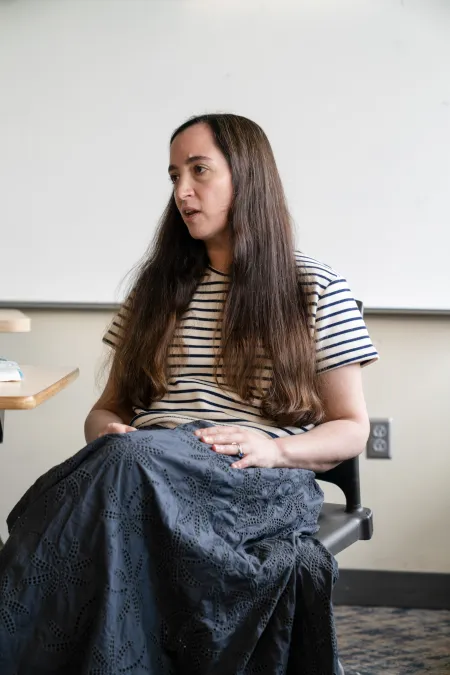
The School of the Humanities and the Sciences (H&S) Distinguished Speaker in the Humanities Series invites an expert with interesting perspectives to campus. The 2026 Speaker is Kate Manne, moral philosopher and intersectional feminist. Photo Credit: Kendell Moats '27

There are moments when the way forward is to pause and assess deeper reasons to why the world is the way it is. We turn to each other and experts in fields for insight and understanding. In higher education, we often look to experts in their field to help us reframe and better understand the complexity of our own cultural and political moment.

It is with that intention that the School of the Humanities and the Sciences (H&S) Distinguished Speaker in the Humanities Series exists. Over the last 26 years, H&S annually invites an expert with interesting perspectives to campus to meet us in the cultural moment we are living through. That individual engages our students, faculty, and broader community in a (hopefully) provocative exploration of areas that are often controversial, complex, emotional, and deeply nuanced. The speaker’s perspective and depth of thought in a culturally relevant field are precisely why they are chosen to join us in this moment.

Claire Gleitman, dean of the School of the Humanities and the Sciences, explains that the series “brings recognition to the critical role of the humanities in illuminating the urgent moral, ethical, environmental, and political questions of our time—and all times. Now more than ever, we need the humanities to help us imagine a better world, and to give us the language, the empathy, and the critical insight to begin building it.”

Enter Kate Manne, the 2026 Distinguished Speaker. Manne is a moral philosopher and intersectional feminist whose work focuses on misogyny, sexism, and gender-based violence. These weighty topics have been and continue to be front and center of every news cycle in the last couple of years. They leave many of us with feelings that are unruly and rather overwhelming.

Manne was the first scholar to complete a book-length study of misogyny, Down Girl: The Logic of Misogyny, published in 2017. She is also the author of Entitled: How Male Privilege Hurts Women and Unshrinking: How to Face Fatphobia. Her essays and opinion pieces have appeared in The New York Times, The Atlantic, The Boston Review, HuffPost, The Times Literary Supplement, and elsewhere. She is also a professor of philosophy at Cornell University. Last week, she was awarded the prestigious and highly coveted Guggenheim Fellowship.

In these times of uncharted and murky waters, Manne is here to help.
Pervasive, Just the Way We Like It

Since 2000, H&S has invited an individual whose work “illuminates the relationship between humanistic forms of knowledge and the texts and institutions that give shape to our worlds” to campus. Manne joins a distinguished roster of intellectuals, including Salman Rushdie, Peter Singer, Tony Kushner, and Martha Nussbaum.

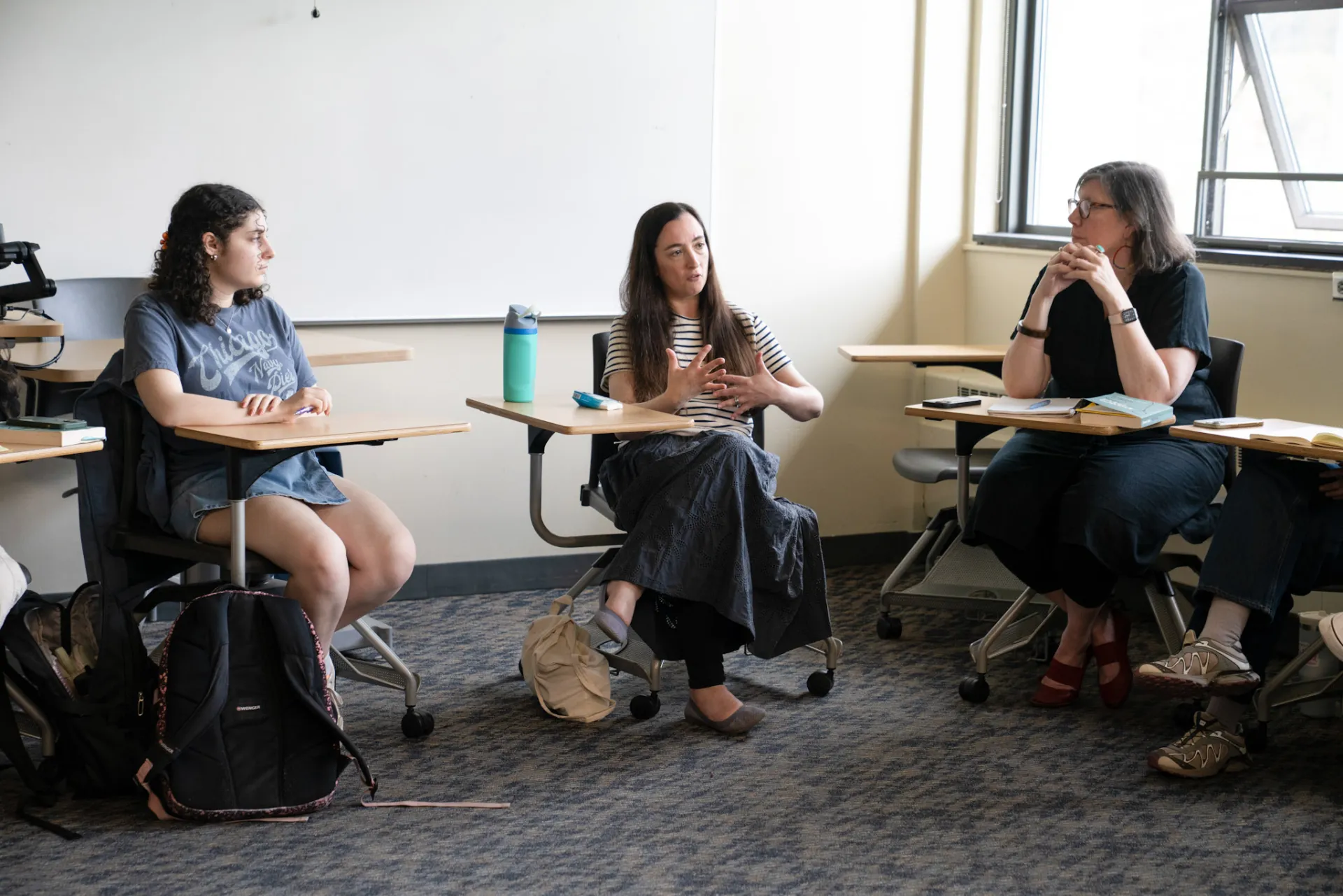
There are two components to the honor. First, the speaker visits classes, spending time with students and faculty in an intimate, academic setting. Manne joined two: Rebecca Plante’s Sociology of Sexualities and a “slow read” of her own book, Down Girl: The Logic of Misogyny.

Associate Professor and Chair of Literatures in English Jennifer Spitzer, who co-leads the slow read, explains, “While the book was published seven years ago, so much of the material feels urgent and relevant to the current cultural and political moment.”

The second component is a public lecture, free and open to the community. Manne’s lecture, titled “Sensitivity and Survival,” extended these conversations outward, inviting broader reflection.

Spitzer explains, “She asks us to take misogyny seriously—not as a marginal phenomenon or one located in bad actors—but as a property of environments and a set of mechanisms that police and enforce gender norms.”

If misogyny is systemic, we live within that system with embedded behaviors and norms to sustain it.

These “sets of mechanisms” are powerful precisely because of how embedded they are. Often, they go unrecognized, accepted instead as “just the way it is,” without questioning why or how they persist.

To confront misogyny at this level requires examining these mechanisms individually—asking fundamental questions: Why is it this way? Can it be better? Is there another way of doing this?

In her talk, Manne guided us through one such mechanism: the accusation of oversensitivity.

“YOU DON’T KNOW WHAT YOU ARE TALKING ABOUT”

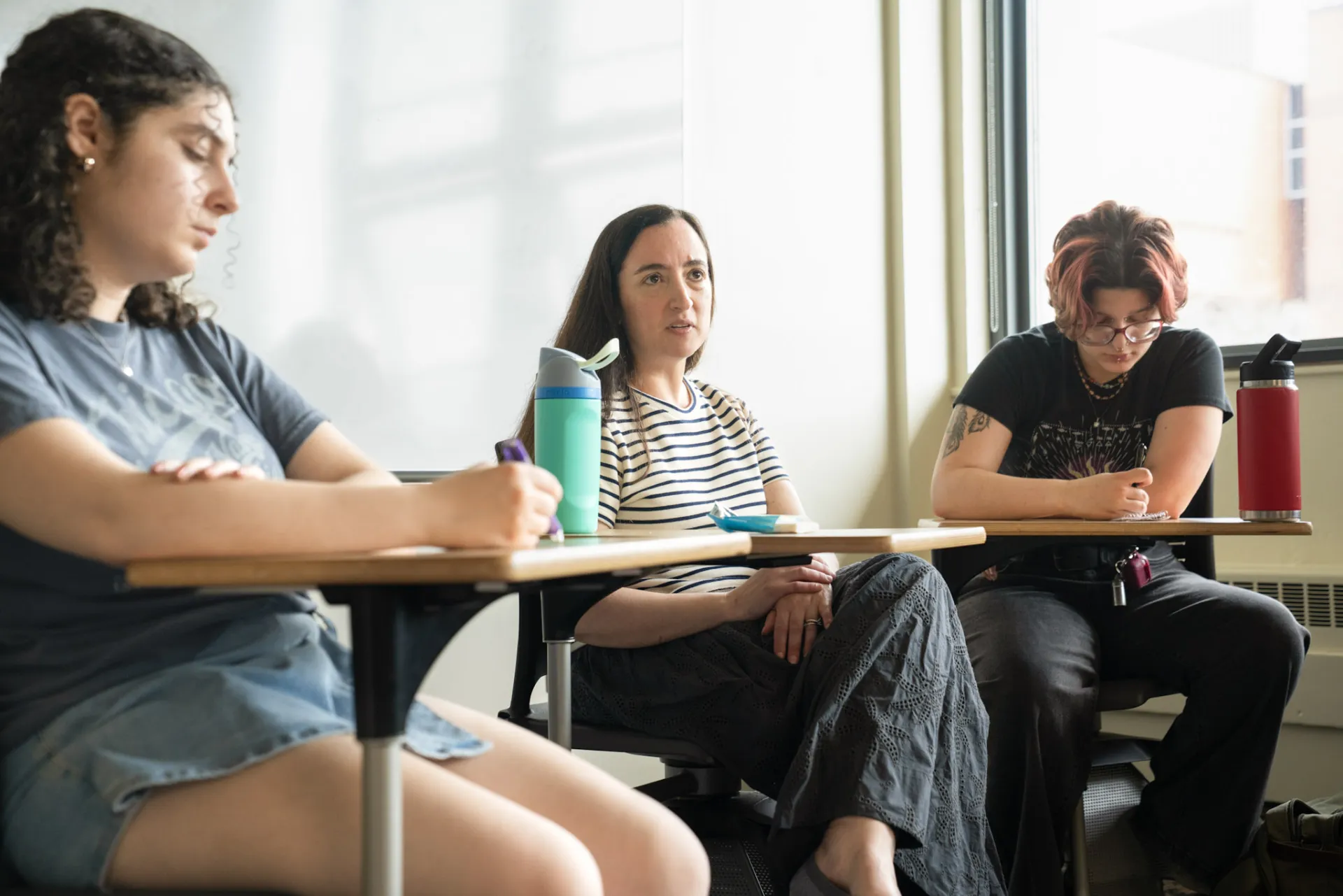
Student attentively listening to the conversation.

IC students in two classes, the Sociology of Sexualities and the Slow Read of Down Girl: The Logic of Misogyny had the opportunity to interact with Kate Manne, discussing her work and the questions it brought up for them. Photo Credit: Kendell Moats '27

Manne defines “sensitivity” as “a justified, valuable capacity to detect, identify, and respond to injustices like sexism, racism, and misogyny.” This is, arguably, a trait we would want individuals—and societies—to cultivate. The term itself implies a necessary balance.

Oversensitivity, by contrast, is framed as a misalignment between detection, identification, and response. But who determines when someone is being “oversensitive”? Often, it is an external voice—an individual or broader societal perspective—asserting that the response is invalid.

This accusation tends to take two forms.

The first is what Manne calls “over-identifying.” Imagine the only woman at a conference table full of men being asked to get coffee. Later, recounting the moment, she says, “I swear, it’s because I’m a woman.” Her husband responds, “I’m sure that’s not it. They could have asked anyone.”

In this instance, she is criticized for attributing misogyny to the interaction.

The second form is “overreacting,” in which a person’s response is judged as disproportionate to the action. For example, a woman reports to HR that her boss commented on the length of her skirt during a meeting. He dismisses her response as “overreacting,” insisting it was “just a joke” or “nothing.”

Manne suggests that the accusation of oversensitivity often shifts the burden of appropriate response onto the individual experiencing the injustice.

Labeling women as overreactive can lead to gaslighting. Manne points to the popular subreddit “Am I Overreacting?” as evidence of this dynamic. “There is no shortage of examples,” she notes. “The fact that these posters turn to Reddit suggests that, at some level, they know they’re not overreacting—that they have a right to feel this upset.” Yet they struggle to trust their own perceptions and experiences.

The cumulative effect of persistent invalidation is a kind of numbness. Under-sensitivity emerges when individuals learn to see injustice as normal—no longer something to question or resist.

At a moment when public discourse frequently warns against being “too sensitive,” Manne asks us to reconsider whether sensitivity is, in fact, a liability—or an essential means of recognizing and surviving injustice.

“I’M NOT OVERSENSITIVE, YOU ARE”

Examining the accusation of oversensitivity reveals something more profound: the claim itself is produced by the structure of misogyny. For that structure to remain intact, it cannot tolerate disruption. As a result, it develops mechanisms to push back against those who challenge it.

An alternative approach would be to listen—to affirm women’s experiences, to engage with curiosity rather than dismissal. Moreover, those labeled as “oversensitive” play a crucial role in holding systems accountable.

Each act of questioning, each refusal to accept “the way things are,” begins to destabilize entrenched structures—making space for something more just, more responsive, and more humane.

Spitzer elaborates, “Professor Manne’s work inspired rich discussions in our class, including why certain powerful men remain untouchable despite prolific harm; how women in public life are judged through gendered and racialized lenses and held to impossible standards; how cancel culture often adheres more readily to women than men; and how perpetrators of sexual violence are frequently afforded more sympathy—or ‘himpathy’—than their victims.”

If accusations of “oversensitivity” is a mechanism that keeps injustice in place, then the work of the humanities is to interrupt it. Through conversations like these, the Distinguished Speaker Series does more than bring leading thinkers to campus—it demonstrates, in real time, how the humanities equip us to name, question, and ultimately reshape the structures that govern our lives. It affirms what the humanities have always insisted: that language matters, that interpretation matters, and that the courage to question what feels “normal” is where change begins. In that sense, the work happening here is both intellectual and deeply human—an insistence that a more just world must first be imagined before it can be built. 

Ready To Ask Questions?

The School of the Humanities and the Sciences invites students to ask questions and explore the answers, fostering unique thinking to solve problems and inspire change.