
Pathways to Access

By Sloan MacRae, March 9, 2026
Two MBA students apply business strategy to very different missions: making theatre more accessible and helping veterans navigate the benefits they’ve earned.

On the surface, Mia Jumbo MBA ’26 and Brendan Holmes MBA ’26 don’t appear to share much professional terrain.

Jumbo serves as Production, Events, and Facilities Manager for Ithaca College’s School of Music, Theatre, and Dance, working across the production and operations side of performance—overseeing the planning, logistics, and execution that bring shows to life. Holmes spends time in coffee shops and veterans’ circles, meeting former service members where they are and helping them navigate federal benefits, interpret disability ratings, and build financial literacy for long-term stability and everyday life.

Both are pursuing graduate degrees in entertainment and media management in the School of Business. Each arrived with experience already shaping their work. And through their coursework they are deepening a shared commitment to access—whether that means designing inclusive theatre environments or helping veterans secure the benefits and stability they have earned.

Making Access Part of the Show

Jumbo came to Ithaca College after working in higher education at Binghamton University, where she taught practicum theatre students. When a production management role opened at IC, she applied, and once on campus, she recognized an opportunity.

Enrolling in IC’s MBA in Entertainment and Media Management felt like a natural fit. “This is the most perfect opportunity for me to further my education and also expand a little bit more on my production management side,” she said.

Production management in professional theatre touches nearly every operational facet of an organization. In a role that spans budgets, logistics, facilities, and creative coordination, the MBA program sharpened the business foundation behind the work she was already doing. It also gave her clearer language and strategy for advancing accessibility.

Her awareness began years earlier at Boynton Middle School, where she worked as a library clerk and managed the school’s Chromebook loan program. There, she observed digital accessibility gaps, including students who needed audio tools, students navigating dyslexia, and students whose needs weren’t yet formally identified.

The MBA in Entertainment and Media Management may read as industry-specific. In practice, it equips students to operate within complex organizations—whether those organizations produce theatre, launch media ventures, or navigate systems that affect people’s lives.

A woman dressed as Indiana Jones sits on a motorcycle.

Jumbo MBA '26 attends an Indiana-Jones themed product activation at South by Southwest with the School of Business. 

Later, in higher education, she began recognizing her own accessibility needs—hearing challenges and cognitive impacts linked to concussions she incurred during adolescence. That personal clarity sharpened her professional lens.

Now at IC, Jumbo leads a committee focused on patron-facing accessibility in performance spaces at the Dillingham Center on campus. The work includes expanding open captioning, improving the complement of assisted listening devices, exploring ASL interpretation for select performances, adding a bariatric chair to the seating inventory, and formalizing processes so accommodations aren’t improvised in the moment.

“I’m really trying to approach accessibility being part of the production process, not an afterthought,” she said.

She describes what audiences feel when accessibility is reactive—when there’s scrambling to provide an accommodation, or when a patron must advocate repeatedly for something others receive automatically. The goal instead is integration from the earliest design conversations through technical execution.

Students are contributing to the effort as well. The department has begun involving theatre administration students in accessibility planning, giving them hands-on experience in work that is increasingly in demand across performing arts organizations.

“We’re starting to create an accessibility coordinator position who actually handles all of this and will be able to be marketable out in the world,” she said.

The spark for expanding that work came during a School of Business trip to South by Southwest, where Jumbo attended a session that opened her eyes to new possibilities for embedding access into creative design.

The vision she carries forward is incremental and durable. “Slow progress is going to be long-term progress,” she said. Her MBA coursework provides structure—budgeting, planning, long-range strategy—for work that is creative, operational, and ethical all at once.

Cutting through Red Tape

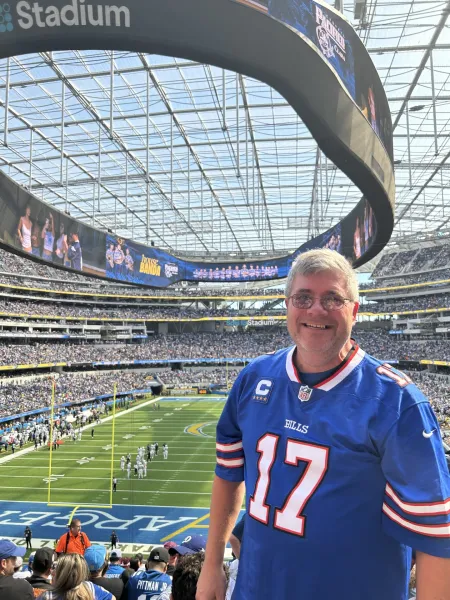
A man in a football stadium wears a Buffalo Bills jersey.

Holmes MBA '26 on a School of Business trip to Los Angeles. 

Holmes’ path to Ithaca College began decades earlier.

He enlisted in the U.S. Navy in 1988 and completed his service as an Operations Specialist 2nd Class (OS2/E-5). During Operations Desert Shield and Desert Storm, he transferred from radar and navigation into the Tomahawk Weapons Control System aboard the USS Wisconsin (BB-64) , a World War II–era Iowa Class battleship deployed in a modern war. His responsibilities included coordinating real-time information between U.S. and coalition command centers and even sending the official notification to allied forces that the first strikes of Desert Storm had begun.

After his enlistment ended, Holmes earned an undergraduate degree in pre-medical biology and rhetoric with a minor in computer science from Hofstra University. He later studied Mandarin Chinese for eight years while working in information technology and as an anti-piracy consultant with Microsoft.

A battleship in a warzone.

The USS Wisconsin (BB-64), a World War II–era Iowa Class battleship, sees action during Operation Desert Storm.

He and his family relocated to the Finger Lakes in 2007, where he owned and operated a restaurant for 12 years.

Through all of that, Holmes was experiencing serious health problems.

After serving in the Persian Gulf, where retreating Iraqi forces set hundreds of oil wells ablaze, Holmes began suffering chronic pulmonary issues. 

For decades, he challenged the Veterans Administration to recognize the long-term effects of that exposure. The answer came in 2021, when he learned that his ship—along with others in the area—had been exposed to a neurotoxin: sarin gas.

After more than 32 years of navigating denials, Holmes secured confirmation of his exposure and was awarded a Total & Permanent Disability designation. That determination opened the door to continue his education through Chapter 31 Veterans Readiness & Employment at Ithaca College.

By then, Holmes was already helping other veterans navigate the same system he had struggled through. Through his initiative, Brass Tacks for Veterans—an entirely volunteer, one-person operation—he helps fellow veterans untangle VA paperwork, understand benefit structures, and make informed decisions about their finances. The work is intentionally personal: there’s no website, no formal intake. Some veterans reach him through referrals, others through conversations he initiates himself—often over coffee after noticing a cap or patch that signals service.

“I’m giving them the financial literacy that a financial planner would charge them for,” he said.

His coursework strengthens those efforts. With a sharper understanding of finance, taxation, and long-term planning, he can help veterans make informed decisions about disability back payments, income thresholds, and long-term security.

“So my goal is to educate people now because I have the finance background,” he said.

A Degree with Range

The MBA in entertainment and media management may read as industry-specific. In practice, it equips students to operate within complex organizations—whether those organizations produce theatre, launch media ventures, or navigate systems that affect people’s lives.

In a fast-tracked, nine-month program, students study core business disciplines such as accounting, negotiation, leadership, marketing, and organizational structure while gaining hands-on experience through projects and practicums tied to real media and entertainment ventures.

For many graduates, that preparation leads to careers in fields like digital marketing, live event production, sports and entertainment management, media production, or public relations.

Jumbo uses the program’s business foundation to embed accessibility into production planning—integrating accommodations, budgeting, and audience experience into the earliest stages of theatrical design and management.

Holmes draws on the same financial and organizational training to help veterans understand disability benefits, navigate federal systems, and make informed decisions about their financial futures.

For both, the degree strengthens work already central to their lives: using business knowledge to remove barriers so others can participate fully.

Turn your passions into impact.

At Ithaca College, graduate programs like the MBA in Entertainment and Media Management help students combine business skills with creative and professional ambitions—from producing live events and media ventures to leading organizations and advocating for their communities.

Learn more about the MBA in Entertainment and Media Management at the School of Business.