Pakistan, 2022–2023
Promised Land and Tilism-e-Hoshruba.exe
Pakistan, 2022–2023 and Pakistan, 2025
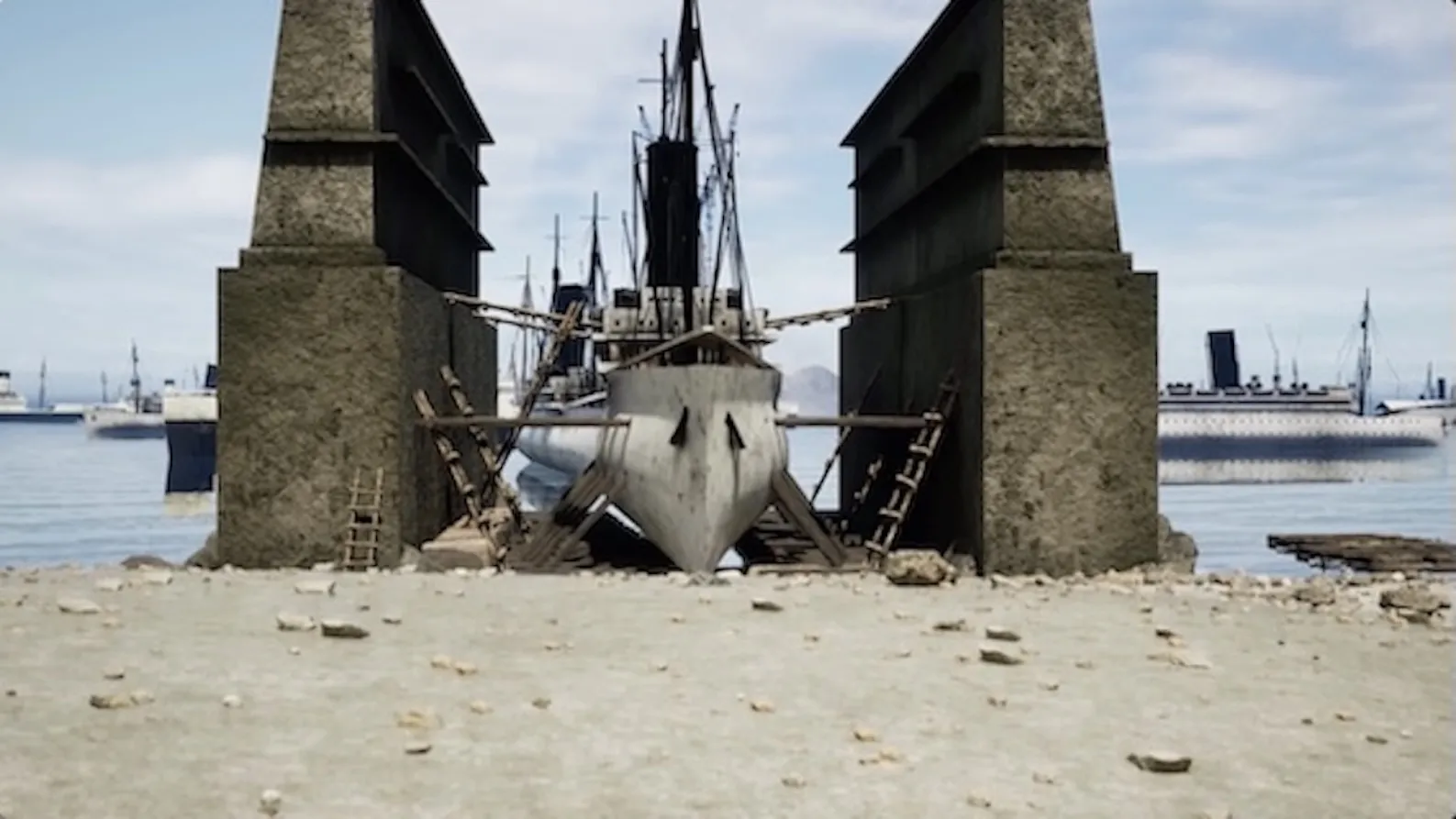
Promised Land
Promised Land
Imran Channa's Promised Land is a large-scale interactive video installation that allows visitors to move through a game engine across three different states of a so-called promised land. The images inside the game engine interpret images by migrant filmmakers, such as J. C. Lamster, who worked for the Dutch East Indies Company (VOC). His films and others like them are now housed in the VOC archives and the EYE Filmmuseum. Each screen depicts a "state," playing with the word's meaning as temporal condition and political entity. The states describe how natural conditions (Savage State) change as land is reworked into landscape defined as geopolitical territory (Pastoral State) or fantasy (Desolation State). The visitor moves without an avatar, a disembodied presence that mirrors the absence of humans in the three states. In Channa's words, humans have been "deleted" or "erased": there are "no humans left" due to the "broken promises" of colonialism, religion, and technology that prompted Europeans to migrate to Southeast Asia.
Tilism-e-Hoshruba.exe places fantasy from the epic poem (dastan), compiled at the Mughal Empire's end, about a hero who protects his community from an invader and in dialogue with the violence of forced migration due to the Partition of India and Pakistan in 1947. The paintings in Enchanted Land evoke the magical land of Hoshruba, yet they are mediated by AI, which Channa prompted to visualize it. He paints the images, which are displayed inside frames inscribed with AI-generated interpretation of promises made by Pakistan's first president Mohammad Ali Jinnah, which are dated and translated into Morse Code. As a counterpoint, the work in Tangible Fiction consists of 3D-printed objects carried by migrants, based on oral accounts of forced migration and on images taken by a foreign photographer, Margaret Bourke White, and published in a 1958 issue of a foreign magazine, Life. The work challenges AI's capacity to imagine such places and interpret the promises due to its training on LLMs (Large Language Models) from an entirely different historical and political context.