Choose Your Own Adventure

By Sloan MacRae, April 17, 2026
Inside career development in Ithaca College’s School of Humanities and Sciences.

When a parent asked Associate Professor of Physics and Astronomy Kelley Sullivan what their student could possibly do with a physics degree, her answer was simple:

“What can’t they do with a physics degree?”

It’s a response that gets at a persistent misconception, one that faculty and students in the School of Humanities and Sciences (H&S) encounter often: that their fields are too broad, too abstract, or too impractical to lead directly to a career.

At Ithaca College, career development is anything but one-size-fits-all. Each of the college’s five schools has a dedicated career engagement specialist with expertise in the unique opportunities, industries, and pathways connected to that school.

That model is relatively new. When Dave Curry arrived to lead the Center for Career Exploration and Development (CCED), the team operated largely as generalists, supporting students across all disciplines. As staffing and resources grew, the office shifted to a school-based approach, assigning specialists to individual schools so they could build deeper expertise, strengthen faculty partnerships, and provide more targeted support.

For Curry, the goal is straightforward: “I’m not satisfied until we’re helping absolutely every student.”

In the School of Humanities and Sciences, that work has to account for breadth. With dozens of majors spanning nearly the full range of academic inquiry, students are often navigating a wider range of possible directions rather than working toward a more clearly defined set of roles.
Starting with interests

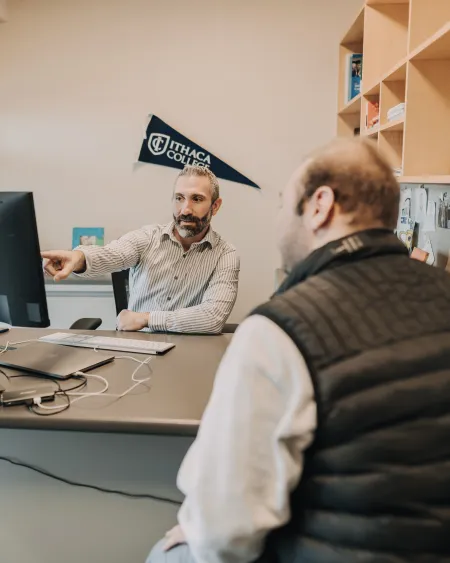
A student and a career counselor sit at a desk.

Dave Curry, director of career services, with a student. (Photo by Forest Floor Creatives)

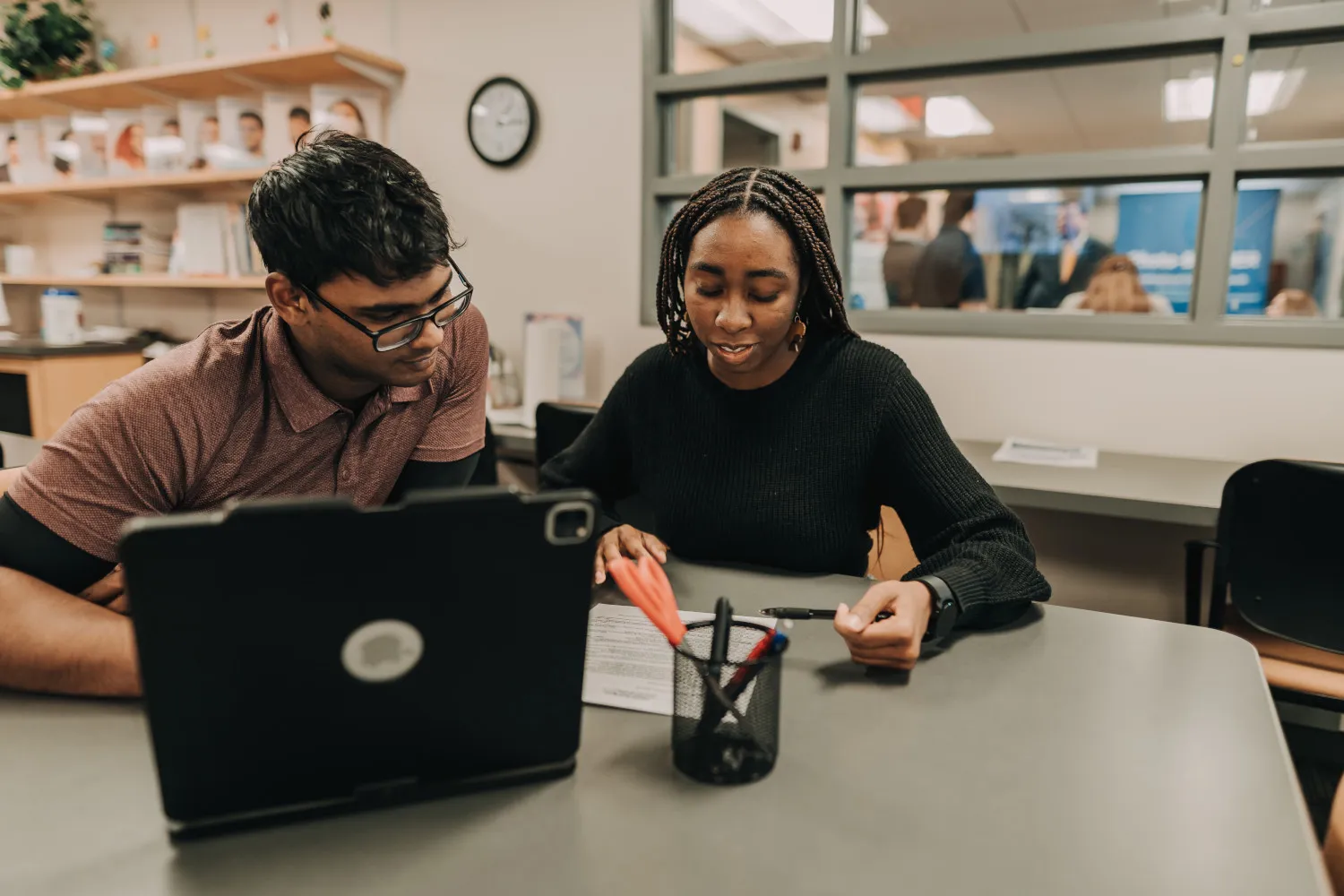
“There’s way more options in H&S,” said Amy Huang, the school’s career engagement specialist in CCED. “And a lot of students are more passion-coded than career-coded.”

In a school defined by that range of options, students often begin with interests rather than fixed destinations. That distinction shapes how career development happens. Instead of pointing students toward a single outcome, Huang’s role often begins with helping them translate those interests into possibilities—and then into action.

She regularly visits classes, leads workshops, and hosts resume reviews, often bringing students into the center itself to make sure they know the resources are there for them.

“We have to find your Rome first, then decide what road to take to get there,” she said.

That process is supported by a range of tools and experiences available to students across Ithaca College. Students use platforms like Handshake, a job and internship platform for college students and recent graduates, where “employers and jobs that are posted on the platform get vetted by our office first ... There’s no scams. These are quality jobs.”

In H&S, those experiences often take the form of external internships—often made possible by donor-funded internship support when opportunities are unpaid or underpaid—alongside research, community-based projects, and presentations like the Whalen Symposium, where early work can evolve into conference presentations or graduate study.

“How do you negotiate a job offer ... how do you do well in an interview,” Huang said, describing workshops she brings directly into classes and student organizations.

Underlying all of it is a focus on what employers consistently value—skills like communication, critical thinking, and collaboration, developed across coursework, research, and internships.

“Out of the top eight skills that employers want from recent grads, seven of them are so-called soft skills,” she said.

“It widened my view of what I could do with this physics major.”

Xander MacKenzie '28, physics and mathematics double major, astronomy minor

Forking paths, not fixed outcomes

For Sullivan, the question of what students can do with a physics degree shapes how she teaches.

Recently recognized as the Career Champion for H&S—an honor for faculty who actively integrate career development into their teaching—she builds that perspective directly into her courses, framing a physics degree not as a path to a single role, but as a set of skills that can be applied in many directions.

“It’s about learning how to problem solve,” she said. “That’s the main thing … So our students are problem solvers. They’re collaborators ... They are writers.”

Those skills translate across fields, often in ways students don’t initially expect.

“We have lots of physics majors who end up in computer engineering and computer science … or she could go into medicine, or she could go into science journalism, or she could go into finance,” Sullivan said.

That range is something students often discover gradually.

“They enter thinking they’re going to have to work in a lab or be a teacher,” she said. “And then slowly we get to all the rest of the possibilities, and you see this collective sigh of relief.”

The work is helping students connect what they’re learning to their passions and the kinds of problems they want to solve—and the roles where they can do that.

Career development on the syllabus

In Sullivan’s physics classes, career development isn’t a separate track, but part of the academic experience.

She teaches a series of professional development seminars taken in the first year, sophomore year, and senior year. Across the department, faculty take their own approaches to connecting coursework to career development. In Sullivan’s classes, early sessions focus on navigating college and exploring options, while later ones emphasize resumes, cover letters, and interview skills.

“As a sophomore, they’re building a LinkedIn page,” she said. “How do you write a resume? How do you write a cover letter?”

Those lessons are reinforced through collaboration with CCED.

“Let’s get these sophomores setting foot in the career center so that they know where it is, they’re comfortable with it, and they’ll come back,” Sullivan said.

Across H&S: Career Development in Practice

Career development in the School of Humanities and Sciences extends well beyond any single classroom or discipline. Across departments, faculty are building professional experience directly into coursework, giving students opportunities to apply what they’re learning in real-world contexts.

In ENVS 351: Farming the Forest, students produce and market goods such as maple syrup and honey, gaining experience in both environmental systems and small-scale enterprise.

In ENGL 295: New Voices Seminar, students organize and program a live literary event in partnership with local business Buffalo Street Books, working with emerging writers and managing all aspects of the event.

Courses like SOC 305: Practicum in Social Change and SOC 401: Community Organizing pair classroom learning with field-based work, connecting students with community partners and applying theory to real challenges.

Other offerings, including international and policy-focused practicums, provide additional pathways for students to engage with professional environments before they graduate.

Together, these experiences reflect a broader approach within H&S: integrating career development into the curriculum itself, rather than treating it as something separate from academic work.

A student's view

When Xander MacKenzie ’28, a double major in physics and mathematics with a minor in astronomy, arrived at Ithaca College, he had a clear picture of what a physics degree would lead to.

“I was hoping to be able to do physics for the rest of my life,” he said, describing a future in a lab or a similarly focused role.

That perspective began to shift during his sophomore year, through coursework and interactions with the Center for Career Exploration and Development.

“It widened my view of what I could do with this physics major,” he said, noting he’d still love to work in a lab publishing discoveries.

Along the way, he also began to think differently about the skills that matter.

“I didn’t realize how important soft skills were,” he said, pointing to communication, teamwork, and problem-solving as areas he’s now working to develop. “It turns out I’m pretty good at teamwork.”

That shift has brought a new kind of challenge.

“When you have one path to walk, it’s kind of an easy decision on what you’re going to do,” MacKenzie said. “But now that I have a few paths to walk, I now have to make a decision … it’s a good problem to have.”

Skills that hold up in an AI world

That integration also reflects how careers themselves are changing, particularly as artificial intelligence reshapes how tasks are done and what skills matter.

Sullivan points to the importance of skills that can’t be easily outsourced or automated: collaboration, creativity, and applied problem-solving.

“You can’t AI a lab,” she said.

At the same time, students are learning how to use emerging tools responsibly and effectively, understanding both their potential and their limits.

Across H&S, that balance—between exploration and application, between passion and practicality—is the throughline. Students arrive with interests that may not map neatly onto a single career. Through coursework, advising, and hands-on experience, they begin to see how those interests translate … and how many directions they can take.

Choose your own adventure—and pathways.

Explore the possibilities in Ithaca College’s School of Humanities and Sciences.

Support at every step

See how Ithaca College’s Center for Career Exploration and Development helps students navigate what’s next.