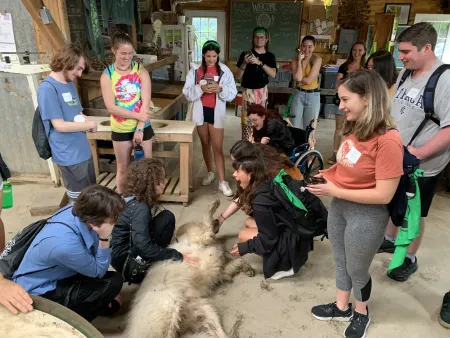
Of the over 2,500 courses offered at Ithaca College, about 80% of them offer sustainability focused offerings across each school and engage students from a variety of disciplines. Below is a sampling of some of those offerings most of which are open to all students and listed by Schools they are located in.
School of Business
- Sport Sustainability (SMGT 260) – Lance Warwick, 2 credits, Offered Fall Blocks I and II - Covers topics such as organizational capacity, corporate social responsibility, and the Triple Bottom Line. Students work on projects where they developed ideas for a pro-environmental initiative run by a sport organization. Student ideas ranged from waste diversion programs in stadiums to schedule realignment to reduce team air travel.
Park School of Communication
- Leadership Communication – Diane Gayeski, 300-level course - 300-level course in Communication Strategy and Design which has been redesigned to focus more broadly on different types of sustainability leaders. Utilizes the text Moscato, D. (2023). Environmental strategic communication : Advocacy, persuasion, and public relations . Rowman & Littlefield Publishers and highlights effective communication and leadership techniques related to promoting sustainability. OPEN TO ALL MAJORS.
School of Music, Theater and Dance
- Sustainability - Course Integration with Playwriting I - Saviana Stanescu - Course introduce sustainability topics to students in intro playwriting class including 1. Climate change; 2. Biodiversity loss, 3. Water scarcity and pollution; 4. Waste generation and plastic pollution; 5. Food insecurity and sustainable agriculture; 6. Social inequity and poverty; 7. Unsustainable consumption and production; 8. Deforestation; 9. Air pollution; 10. E-waste. Students write a monologue on a sustainability topic, as well as a short play on a sustainability topic. OPEN TO ALL MAJORS.
School of Health Science and Human Performance
- Sustainability within Healthcare and the Human Body in Anatomy and Physiology – Tim Reynolds - Features within the Anatomy and Physiology course that discusses how we can reframe sustainability within healthcare through a multi-disciplinary lens. OPEN TO ALL MAJORS.
School of Humanities & Sciences
- Proposal and Grant Writing – Priya Sirohi - Each Fall semester, a Writing Department faculty member teaches a class on Proposal and Grant Writing. It’s the only grant writing class open to all students on campus, regardless of major, so it attracts diverse students. Students work in teams all semester, and teams are formed around their budding expertise. Each team works with a real local environmentally focused nonprofit to create grant application materials that we give to those nonprofits to use in their actual work. OPEN TO ALL MAJORS.
- Farming the Forest: Non-Timber Forest Products - Non-Timber Forest Products is a hands-on, interdisciplinary class where students are given the opportunity to be in charge of their own business by sustainably producing material from undeveloped forest land- including the production of maple syrup and honey, wood carvings, tree bark baskets, etc. This class emphasizes the role of forests in providing a range of services to people around the globe while allowing students to learn the different aspects of running a business. OPEN TO ALL MAJORS.
- Introduction to Environmental Science and Technology - This is an introductory course for environmental studies and science students that focuses on the impact humans and technology have on our environment. Students learn about how technology contributes to environmental issues as well as how technology can reduce human impact and have practice using this technology.
- Quantifying Sustainability - Students will learn how to describe quantitatively the many processes that affect the sustainable production and consumption of natural resources. They will use quantitative tools to create, analyze, and critique mathematical models relating to sustainability and learn how to communicate these results effectively. Topics vary based on student interest but may include climate change, epidemiology, population growth, energy, and agriculture. OPEN TO ALL MAJORS.