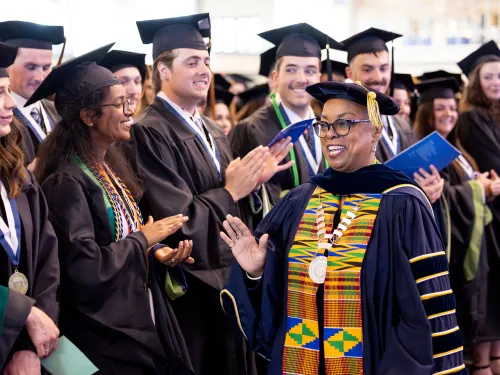
Photos from the 2025 IC Graduate Hooding and Commencement ceremony.
Ceremony Speeches
-
Good afternoon, and congratulations graduate students!
Although we gather today on South Hill, you have climbed a mountain. Yes? But you did not climb alone. On this, the most triumphant leg of your educational journey to date, I am honored to join your families, loved ones, friends, faculty, and mentors. I welcome them and thank them for their wisdom, their sacrifice, and their support of you.
Graduates let’s take a moment to celebrate those who helped you reach this moment.
For many college students, attaining an undergraduate degree offers a natural stopping point, but for you, that last chapter was yet to be written. You still had questions, aspirations, and an unquenched yearning to learn. We are honored that you chose Ithaca College as the intellectual grounds for your pursuits, and we hope we have fulfilled those needs, for the most part, but not completely. You see, it is our hope that the same drive that brought you here will lead you to ask even BIGGER questions and to continue your pursuit of not just knowledge but of justice and compassion.
In total, 162 students are receiving graduate degrees today. Some of you will teach; some will heal. Some will launch a business. Some will explore solutions to problems we are not even aware we have and others of you will discover new ways to think about what we take for granted.
In addition to our students, I also wish to honor the 28 faculty who earned promotion and/or tenure this year, and the 8 faculty who joined our professors’ emeriti community. Thank you for your commitment to our students and to our institution. Can we please give them a round of applause?
Following a tradition begun in 1992, the college’s centennial year, each graduate has received a medallion inscribed with a quotation chosen by the college’s president. This year the quotation comes from academic, author, and podcaster Brene Brown: “Faith is a place of mystery, where we find the courage to believe in what we cannot see, and the strength to let go of our fear of uncertainty.”
If faith is the substance of things hoped for and the evidence of things unseen, whatever it is you are hoping for, have the courage to believe you will achieve it, even if you cannot see it. Even when it looks like the odds are stacked against you, believe in something greater than yourself. Find the courage to look beyond what you see and believe in the possibility that lies in what you do not see. Embrace uncertainty. Fear not. Easy to say. Hard to do. Imagine for one moment that you have been equipped with everything you need to meet with success or to overcome failure as a direct result of your time here at IC.
Now more than ever, we must view the world deeply through multiple perspectives which is reflective of an education grounded in the liberal arts and professional studies. Imagine for a moment that we are each other’s keepers and our ability to survive let alone thrive is directly tied to our ability to listen, to question, and to seek understanding.
As your president, my charge to you today is to always speak truth and treat everyone with respect. When you tell the truth, you don’t ever have to remember what you said and when you treat everyone with respect, more often than not, you will receive what you give. I pray you always choose to do the right thing for the right reason, at the right time, even when no one is watching.We sincerely hope that during your time with us you have strengthened your courage to act in the face of the unknown, the courage to live your life, because you have already lived through a pandemic!
In closing, I say that to those whom much is given, much will be required. You have been given much. You have received an outstanding education from some of the best teachers, scholars, clinicians, and practitioners in the world. You leave here knowing how to think, speak, write, and act critically, creatively, and analytically. Your professional training has prepared you for success in your chosen field.
The time has come for you to go forth into the world, but remember as you go, you are not leaving from here, you are launching from here. Wherever you go, please think of us often and know we will leave a light on for you.
I wish you all good things, incredible success, and fulfillment. From my heart to yours, congratulations on this outstanding achievement. -
It is an honor to address you all today, on this wonderful occasion. It brings me back to when I started my career, many years ago. I’ve been trying to think of what advice I could give from that experience: When I went to graduate school I studied octopus suckers, then switched to snails and slugs and became one of the leading experts in the analysis of mucus and weird gels. So… I’m guessing that’s not directly relevant.
In fact, when I chose my research area, I never considered what every dinner party for the rest of my life would be like…. “So what do you do for a living?”, “I’m a biologist, I study animal physiology, biomechanics and biological materials.” “That’s so cool, what area?” “sticky goo – from slugs." I’m used to awkward pauses in conversation. BUT, and this is my main point, don’t be afraid of doing things differently. Follow your instincts. Trust your intuition. Even if you don’t plan on doing something as unusual as studying slug glue, you should not be afraid to take chances.When I started my career and chose the field of biological adhesives, I could see that it was a huge, open area with major practical applications. The glues that I study have the kind of properties that doctors look for in a medical adhesive. They set quickly into sticky, flexible and unusually tough materials. Kind of like rubber cement. They are unlike the mucus that most snails and slugs produce. I knew that if we could figure out how these particular slugs make tough, sticky glues, it could help guide the development of some very useful materials.
The fact that everyone thought studying slug glue was weird didn’t bother me. At some point you have to trust your training and qualifications, and your ability to learn. When I was starting out in this field, the biologists who studied glue didn’t understand engineering or materials science. There was an entire field of adhesion science, but the papers published by biologists on biological glues seemed oblivious to it. It was as if they were afraid of venturing there. I did venture into it, but it was scary. It is scary to do something that other people avoid.
I say this because you are now about to embark on a big and scary adventure. You’ve been a student for a long time, and now you are going to go out and do something and create your professional life. What a great time! You get to write your own story! So much is going to happen in the next few years.
You will have to make big decisions that will impact your life profoundly. Don’t make those decisions lightly, but don’t let fear guide you. If you know the best way for you – go with it. Trust in your training and your ability. It is scary, but a little fear is just something we all deal with. How you deal with it will determine a lot about your story.
I had a decision like this when I was in my early thirties. I had just received tenure at Butler University. It was a very good job, but my wife and I weren’t happy in Indianapolis, so I started a new job search. I was fortunate to get an offer from Ithaca College, which meant packing up and moving, starting all over again… one week after having our third child. I had to go through the entire tenure process again. There were a lot of people that said that it was crazy. Crazy? To trust in my ability and go to a job where I knew I could succeed and would be much happier? Just because of fear? It was the best move I ever made.
Ithaca College is wonderful. I get to live in a beautiful place. I get to work with great students. I work with students in the classroom, and I work with them on cutting edge, interdisciplinary research. At IC we talk about blending theory, practice and performance. This is the right way to train students to succeed in the modern world. This is why you are now prepared to succeed.
I think you all know by now that doing well in the classroom is not enough. You are finishing up advanced post-graduate study. You probably learned how to succeed in classwork in high school or at least your first few years of college. But here you learned to do more. You learned how to apply all that textbook stuff to real situations. I can tell you as a scientist, experiments usually don’t come out as clean as textbooks suggest. Weird, inexplicable results are the norm. We need people who can figure these things out. When you run into a challenge that doesn’t have a clear answer, embrace it and dig in; this uncertainty is not a time for fear, it is an opportunity for creativity.This brings me to my second point. You’ve learned so much pursuing advanced study. You have the technical skills to succeed in your career. But you have learned a lot more. One thing I hope you’ve learned is not to be afraid to get help from others.
To get this far, you have had to overcome challenges. At some point, you probably ran into something that you couldn’t tackle on your own. That’s normal. You should always be pushing yourself to this point. The key thing is what you do then.
For example, my work is very interdisciplinary, which means that I often must learn new and different fields, with different methods and different views. At times I’ve had to be a biochemist, a molecular biologist, a mechanical engineer, an applied physicist. I could not have done this on my own. I always needed someone to get me started, show me the basics of their field, teach me enough that I could build on and then do the work.
I am not naturally inclined to seek help. I am very independent and very introverted. The introverted part surprises most of my students, but I’m introverted. When I was a kid, all my parents had to do to keep me occupied all summer long was to dump a big pile of sand in our backyard. Who needs anything else when you’ve got a big pile of sand and some toy trucks? But that ingrained self-sufficiency made it hard for me to seek help when I needed it. I had to learn how to be more outgoing.
Surprisingly this is possible. Just because you interact with the world a certain way now, doesn’t mean that you have to be that way forever. Social skills are skills, like many other things, and they are learnable. When I wanted help, I had to figure out how to get it. I figured out how to network, I’m still bad at it, but I figured out enough to succeed and build professional connections. I may be a bad networker, but I’m a good listener, and that is probably much more important. When I stepped out of my comfort zone to seek help, listened, trusted others and let them help me, I went a lot farther.
Pushing myself out of my comfort zone and learning from others has been wonderful. It has opened up so many fascinating areas. Other people have so much to offer, and they are often excited to find that someone is interested in what they do and how they do it. And when you find someone who is helpful, you should appreciate and respect them.
This brings me to one final thought: Enjoy what you do. You don’t have to love every minute of your job. If you love your job, that’s great. If you think your work is the best part of your life, you should rethink what you are doing on vacation. But, I do love what I do. Do something where you can make a difference. Don’t be afraid to try. Do something with colleagues who feel the same sense of mission. Don’t be afraid to seek help from those colleagues and learn from them. In my experience here at IC, that is what has led to true satisfaction. That is my greatest wish for you.