Ithaca College Musicians Take Manhattan

By Sloan MacRae, November 17, 2026
The Jazz Ensemble, Wind Ensemble, Choir, and Symphony Orchestra played to a sold-out crowd at Lincoln Center’s Alice Tully Hall.

The Ithaca College Jazz Ensemble opened the November 13 concert at Alice Tully Hall with the ease of a band that knew how to listen to one another. Each solo grew naturally out of what the band was playing and also took it somewhere unexpected. On the original 78, listeners had to turn the record over to hear the second half of Duke Ellington’s “Diminuendo and Crescendo in Blue.” At Alice Tully Hall, tenor saxophonist Colin Leary ’27 carried the band from one half to the other, doing justice to the solo Paul Gonsalves made famous.

That was just the opening set. By the end of “Legacy in Sound,” a sold-out concert at Lincoln Center’s Alice Tully Hall on Friday, November 13, four Ithaca College ensembles had taken the stage. The Jazz Ensemble and Wind Ensemble joined forces for a world premiere, and the Ithaca College Choir and Symphony Orchestra brought the audience to its feet with the finale of Beethoven’s Ninth.

That morning, the bus had pulled out of Ithaca College at 6:27 a.m. Before the 7 p.m. curtain, the students had workshops at LaGuardia High School across the street from Lincoln Center, then load-ins and quick run-throughs. French horn players Finny Keefe ’27 and Sarah Griffin ’28 took over the college’s Instagram account to document the day as it unfolded. Both major in music education, and Griffin also majors in performance.

Ithaca College has been bringing student musicians to Alice Tully Hall for nearly 50 years. This year’s concert was made possible by two alumni, Charles Hack ’69, a music education graduate who began his career as a teacher, and John Neeson ’84, an economics graduate and chair of Ithaca College’s Board of Trustees.
From the Archive to the Bandstand

A college student jazz ensemble and vocalist perform.

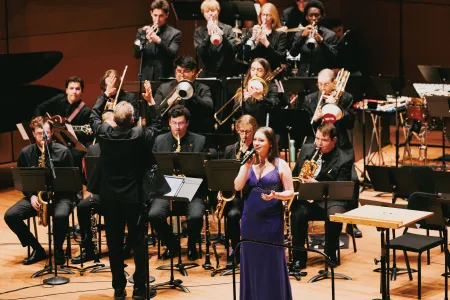
Mike Titlebaum conducts the Jazz Ensemble while Sofia Santoro ’27 sings. (Photo by Roshard Hercules '21.)

The students opened the concert with “Amblin’,” written and conducted by Mike Titlebaum, Ithaca’s director of jazz studies. The title tips its hat to Miles Davis. Alto saxophonists Isaac Hophan ’28 and James Baker ’28, guitarist Michael Scamacca ’28, and bass trombonist David Miller ’26 all took solos.

Jazz studies major Sofia Santoro ’27 sang “Robins and Roses” with such assurance that for a few minutes, Alice Tully Hall was a nightclub in 1936.

Gil Evans’s arrangement of “Robins and Roses” turned up among boxes of music donated to Ithaca College by the estate of bandleader Les Brown. Before he led his Band of Renown, Brown studied at Patrick Conway’s Military Band School, where Ithaca College’s band program has its roots. According to the concert program, no recording of the arrangement has surfaced.

Then came Ellington. Cahaya Cramer ’29 played the Duke’s own part at the piano, and Leary took the tenor solo made famous by Paul Gonsalves at the 1956 Newport Jazz Festival.

And this concert was only getting started.

A Piece for Two Bands

A college student ensemble stands for applause.

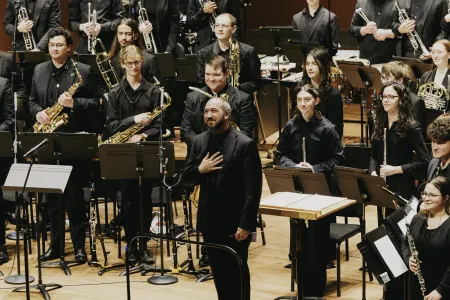
Director of bands Daniel Cook conducted the Wind Ensemble. (Photo by Roshard Hercules '21.)

The jazz musicians had one more piece to play before handing over the stage. They joined the Ithaca College Wind Ensemble for the world premiere of Synergy for Wind Ensemble and Jazz Ensemble, commissioned by the college from professor emeritus Dana Wilson.

Wilson, who taught at Ithaca for more than 20 years, traced the two ensembles’ roots in his program note. The modern wind ensemble grew out of a school band tradition shaped by European and American music. Early jazz took shape in places like New Orleans, where street bands drew on African and European traditions, blues, and ragtime. Both traditions grew as musicians took what they heard from others and made something new with it. In Synergy, Wilson put the two bands in conversation to hear what they could make together.

The Wind Ensemble, led by director of bands Daniel Cook, went on to play Dmitri Shostakovich’s Festive Overture and Paul Hindemith’s Symphony in B-flat. Hindemith’s three-movement symphony, which premiered 75 years ago, helped establish what composers could do with a wind band in the concert hall. At Alice Tully Hall, the same students who had just given Dana Wilson’s newest work its first hearing played one of the pieces that helped pave the way for it.

Toag Wolf ’27, a clarinet performance and music education major, switched between tenor saxophone and clarinet with the Jazz Ensemble and bass clarinet with the Wind Ensemble. “I think it’s really worth it to just be able to play more music,” Wolf said. “Play music with different people who I usually wouldn’t play with.”

For Keefe, who played French horn in both the Wind Ensemble and the Symphony Orchestra, the company was part of what made the evening.

“Sharing a stage at Lincoln Center with my friends means doing the thing I love with the people I love,” Keefe said.

When the Voices Came In

A man conducts college musicians.

Khyle Wooten, the college’s director of choral activities, conducts the Ithaca College Choir, accompanied by student musicians. (Photo by Roshard Hercules '21.)

After intermission, the Ithaca College Choir sang Adolphus Hailstork’s Shout for Joy, conducted by Khyle Wooten, the college’s director of choral activities. Hailstork drew on his experience as a choirboy in an Episcopal cathedral when he set verses from Psalm 33 to music. It premiered in 1990 for the 150th anniversary of Bank Street Baptist Church in Norfolk, Virginia.

The piece opened with an instrumental fanfare. The most haunting moment of the evening came when the instruments fell away and the singers carried the psalm on their own. It had the intimacy of a private prayer and the spine-tingling force of all those voices raised together.

Griffin, who had brought viewers behind the scenes through the Instagram takeover, performed with both the Wind Ensemble and the Symphony Orchestra on the horn she has played since sixth grade. “It’s been with me since as long as I can remember, so it’s nice to kind of bring that piece of home with me here,” she said.

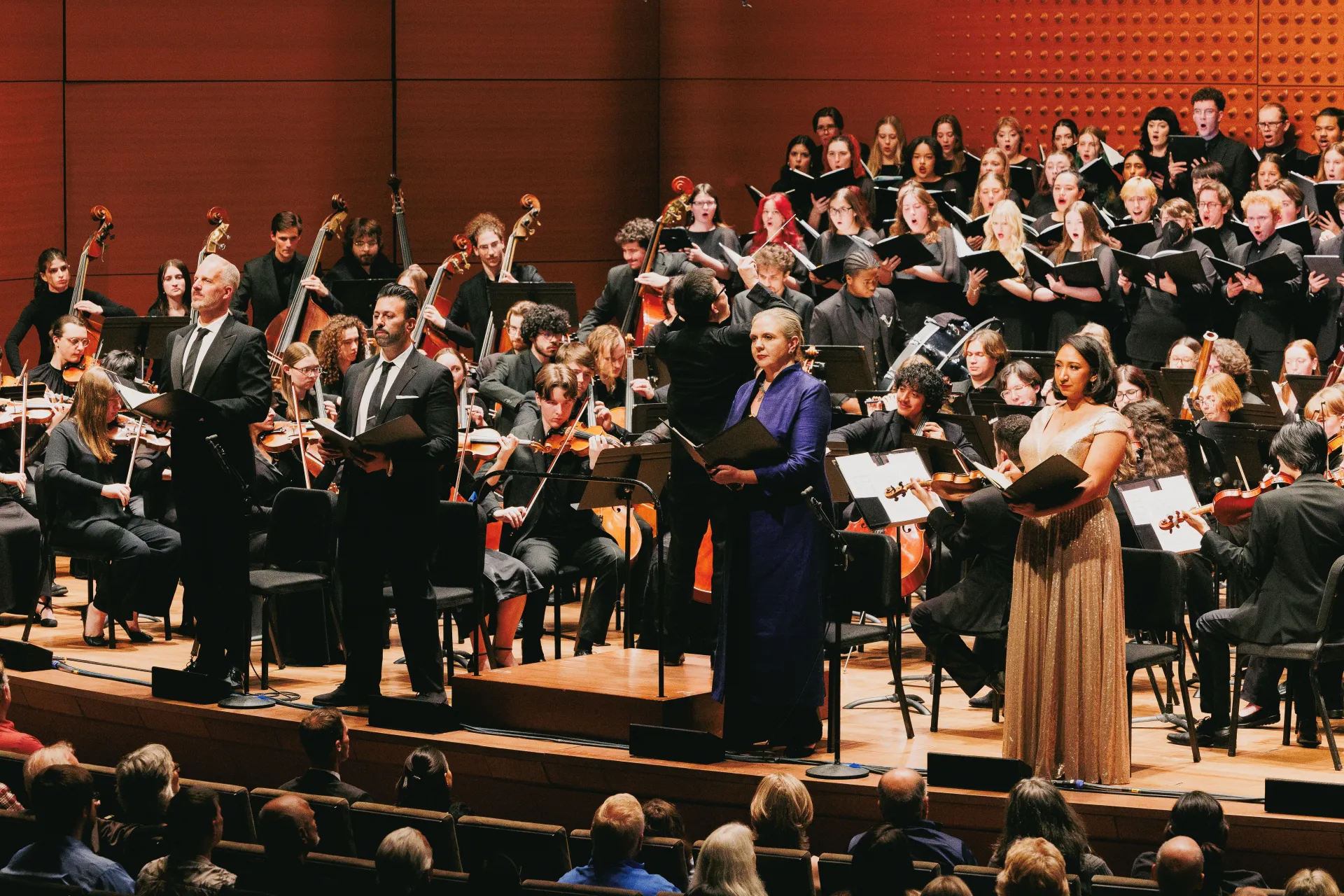
For the finale, director of orchestras Ho-Yin Kwok led the Ithaca College Symphony Orchestra and Choir in the fourth movement of Beethoven’s Symphony No. 9. Four soloists joined them, each with an Ithaca connection. Soprano Lisa Williamson and mezzo-soprano Tamara Acosta teach voice at the college. Bass Marc Webster ’02 is an alumnus and longtime voice faculty member. Tenor Dinyar Vania, who studied at Ithaca College, made his Carnegie Hall debut singing this same symphony.

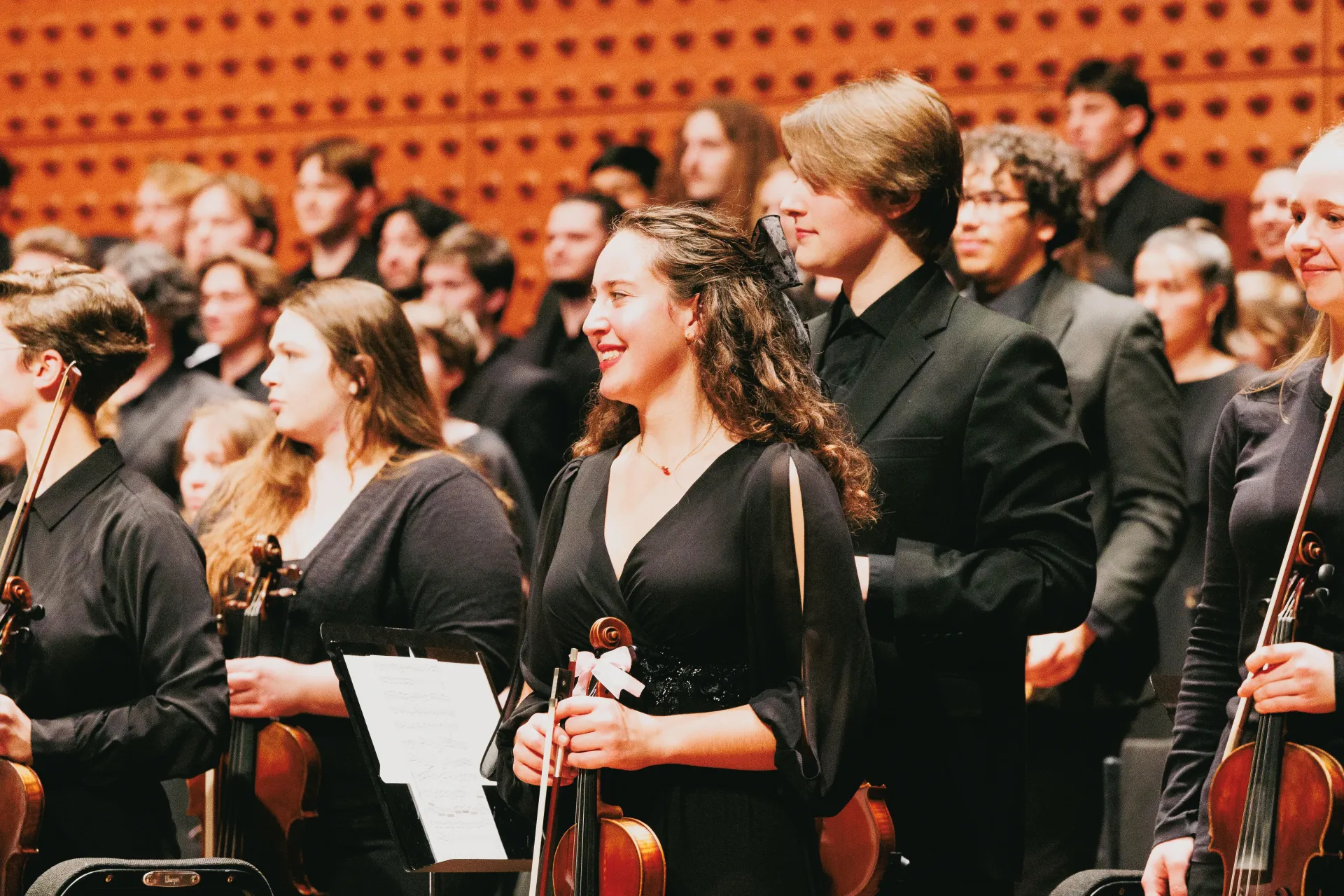
The stage at Alice Tully Hall barely held them all. When the orchestra, choir, and soloists were in full voice, the whole hall rang. Applause broke out more than once before the movement was over, even though the custom is to wait for the last note. When that note came, the audience sprang to its feet.

Could Ithaca College be your next stage?

Explore music programs at Ithaca College.