Speed of Sound

By Sloan MacRae, September 23, 2026
For more than a century, Ithaca College bands have shaped the musicians who shaped the profession.

The night before Grace Gonoud ’26 graduated from Ithaca College, she stood center stage in Glazer Arena. Accompanied by the Ithaca College Symphony Orchestra, she delivered a dazzling performance that made her single clarinet sound like an entire ensemble unto itself. 

The piece, titled Clarinet Concerto No. 1, “A Fourth Place,” demanded speed, agility, and constant stylistic shifts. Written specifically for Gonoud by composer John Oliver ’25—one of her closest friends—the concerto blurs the line between composition and improvisation, drawing on both classical and jazz traditions while reflecting the breadth of Gonoud’s musical interests. It was the kind of performance that leaves audience members reconsidering what a clarinet is capable of.

The performance took place during the annual Commencement Eve Concert, one of Ithaca College’s signature traditions. Directed by Mike Titlebaum, IC’s professor of music performance and director of jazz studies, the production annually transforms the arena into a three-stage showcase of musical and technical artistry, with the Ithaca College Symphony Orchestra at center, flanked by the Ithaca College Jazz Ensemble and the Ithaca College Choir. Every year, through seamless transitions of music, lighting, and staging, the ensembles move fluidly from performance to performance—sometimes independently, sometimes together—as lights fade on one ensemble to rise immediately on the next. 

Gonoud had performed in every Commencement Eve Concert since arriving at Ithaca College. Each year, she watched fellow students step into featured roles during this event, one of her favorites of the academic year. “I’m always in awe of the soloists every year,” she said. This year, she was one of them.
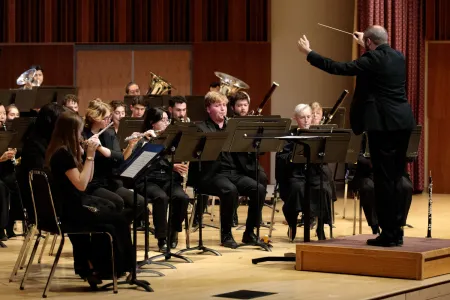
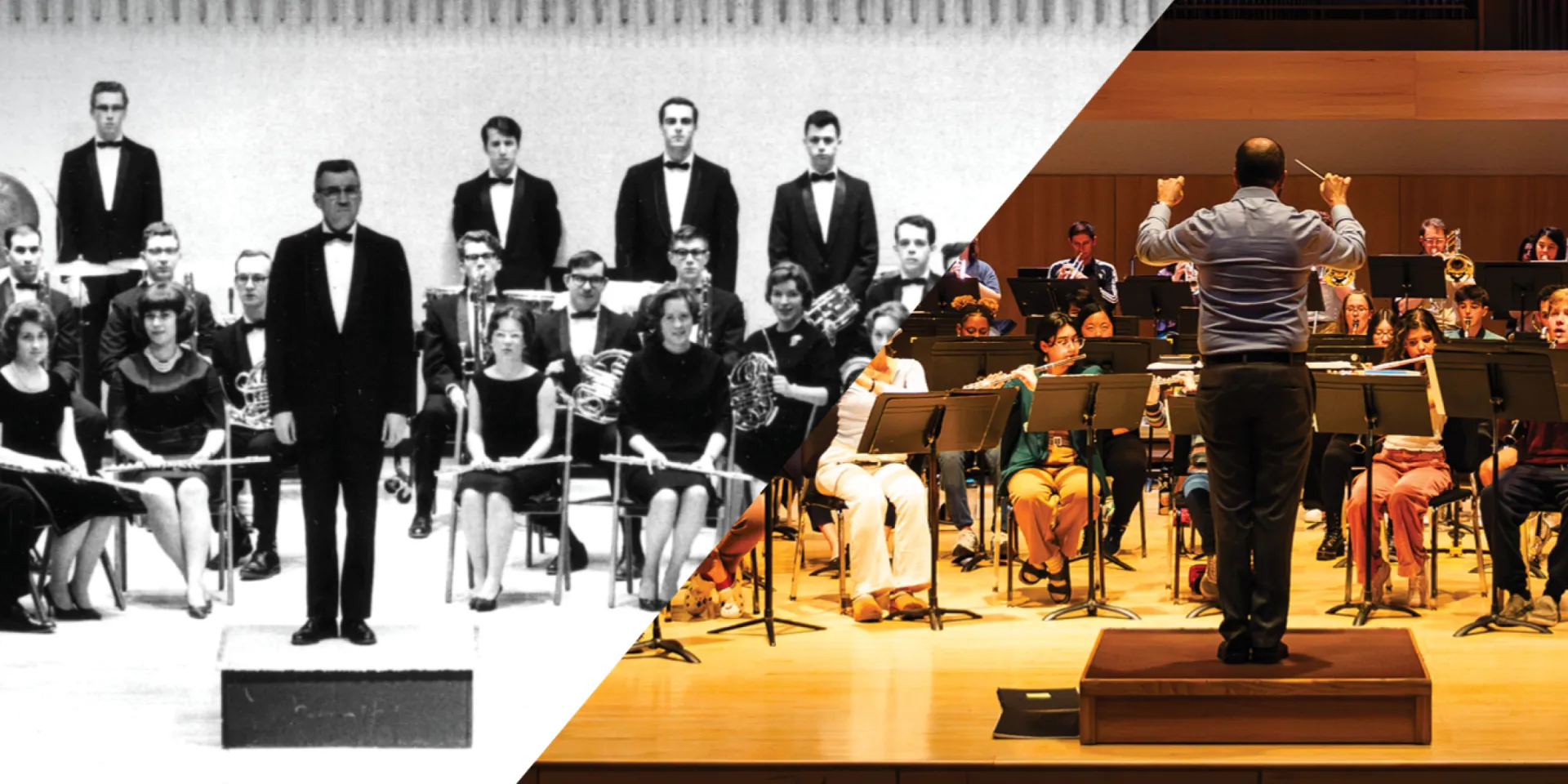
A conductor leads a college wind ensemble.

The Wind Ensemble performs in Ford Hall in 2024. (Photo by Connor Lange '19)

The moment also reflected much of what had defined Gonoud’s four years on South Hill. A music education major specializing in clarinet, she performed in the wind ensemble, orchestra, jazz ensemble, jazz combos, and theatrical pit orchestras while pursuing interests that stretched across genres—all of which will benefit her in a career teaching music. The concerto Oliver wrote for her drew from many of those same influences, incorporating classical traditions, jazz language, and improvisation. At one point, it even quoted a short musical phrase frequently played by Titlebaum during his improvised solos—a musical inside joke and tribute orchestrated by Oliver and Gonoud for their mentor. 

The performance felt distinctly IC: a music education major performing a concerto written by a student composer, blending multiple musical traditions and paying tribute to a jazz professor. It was accompanied by an orchestra conducted by Daniel Cook, the college’s director of bands. 

While the concerto was new, the ideas behind it were not. For generations, they have shaped the musicians, educators, and leaders who emerged from Ithaca College bands. The roots of that tradition stretch back more than a century and can be traced through military ceremonies, Broadway productions, classrooms, concert halls, and some of the most familiar sounds in American life.

An Ecosystem That Feeds Itself

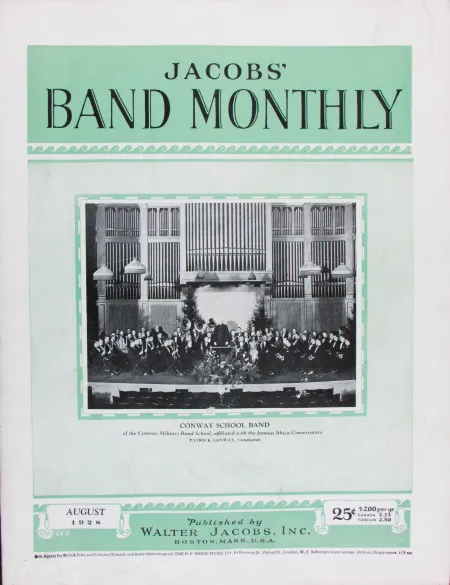
An archival advertisement for Conway School Band

From Ithaca College Archives.

In 1922, Patrick Conway founded his Military Band School in Ithaca through a partnership with the Ithaca Conservatory of Music. The move gave Ithaca something rare for the era: one of the nation’s earliest institutions dedicated specifically to educating band musicians, conductors, and music teachers. According to professor emeritus Mark Fonder, Conway’s stature in the band world rivaled that of John Philip Sousa, whose name remains synonymous with American band music more than a century later. 

Conway’s ambitions extended well beyond educating skilled performers. He envisioned musicians who understood every aspect of band music, from conducting and composition to teaching and administration. In a 1928 article, Conway wrote that students should graduate with “a thorough musical training” that included knowledge of all band instruments, directing and organizing a band, composing, and familiarity with both band literature and the broader musical canon. The approach helped distinguish Ithaca from many of its peers. Students were not simply learning to play in bands; they were preparing to lead them. 

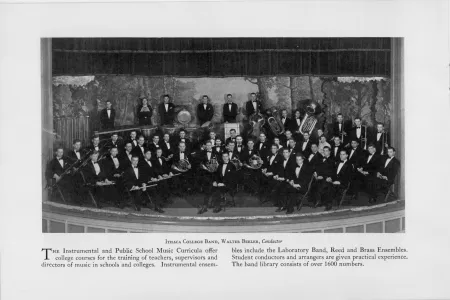
The Conway school attracted students who went on to lead military bands, perform with major orchestras, teach generations of young musicians, and help establish the modern profession of band directing. Among them was a young baritone player named Walter Beeler.

An archival news clipping featuring a band photo with the caption “Ithaca College Band, Walter Beeler, Conductor.”

From the Ithaca College Archives. 

If Conway laid the foundation, Beeler built the institution that would earn national recognition. Beeler became conductor of the Ithaca College Concert Band in the early 1930s and remained one of the defining figures in the program’s history for decades. His standing within the wind-band profession was such that Frank Battisti, one of its most respected conductors and educators, later observed, “No one knew how to improve a band’s tone and ensemble technique better than Beeler.” 

Under Beeler and the generations of faculty who followed, Ithaca College bands produced conductors, educators, military band leaders, and performers whose influence extended far beyond the confines of the city. As their careers spread across the country, so did the program’s reputation. It was reinforced not only by its musicians but also by its faculty composers. Major works such as Karel Husa’s Music for Prague 1968 and Dana Wilson’s Piece of Mind helped establish Ithaca College as an important center for wind-band music during the second half of the 20th century. 

When Kim Dunnick—now professor emeritus of music performance—accepted a position and arrived in Ithaca in 1981, he was already familiar with the college’s reputation. After earning degrees from Indiana University and teaching in Tennessee, he chose Ithaca because of the strength of its music program and the standing it had earned among musicians and educators across the country. 

Over time, Dunnick came to see that reputation as something self-sustaining. Graduates became teachers, conductors, administrators, and performers who hired, mentored, and recommended the next generation of Ithaca musicians. “It’s almost an ecosystem that feeds itself,” he said. 

Art Ostrander, who joined the Ithaca College faculty in 1971 and served as dean of the School of Music from 1985 to 2008—the longest tenure of any dean in the school’s history—spent decades helping sustain that tradition. A nationally respected music theorist and educator, he believed music education should expand students’ opportunities and aspirations. Under his leadership, generations of students prepared for careers as performers, educators, and arts leaders while continuing the broad-based approach that had distinguished the program since Conway’s era. 

The legacy of Ithaca College bands has never belonged solely to its most visible performers. While some graduates built careers on Broadway, in military ensembles, and on concert stages, many more became music educators whose influence multiplied through generations of students—many of whom eventually enrolled at IC. Mark Fonder, professor emeritus of music and a historian of the program, describes those teachers as “the backbone of the legacy.” 

Today, Ithaca alumni teach in schools and communities across the country. Among them are Robert Van Wyk ’97, a Rahway High School music educator who received the New Jersey Music Educators Association’s Master Music Teacher Award in 2026, and Christina M. Carnevale-Helbock ’99, whose ensembles at Brentwood High School have repeatedly earned New York State School Music Association Gold with Distinction ratings.

The collective impact of the college’s faculty, alumni, and students is difficult to measure. No single story can fully capture it. Individual careers, however, offer a glimpse of the program’s reach.

Soundtrack to a Nation

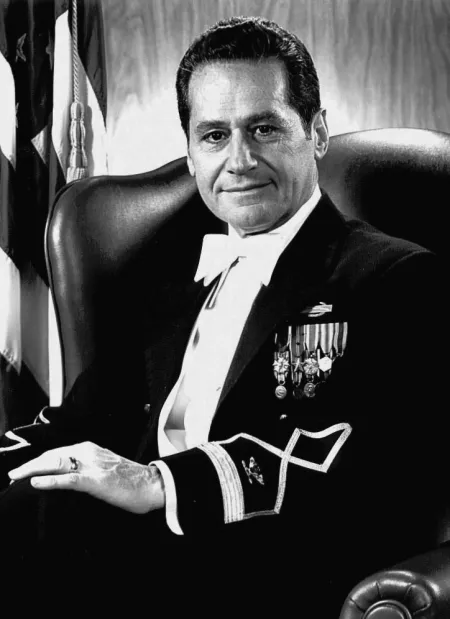
A black and white photo of a man in a military uniform.

Arnald Gabriel ’50, HDRMU ’89.

For much of its history, Ithaca College has occupied an unusual place in music education. Neither a massive state university nor a major metropolitan conservatory, it nonetheless became home to one of the country’s most influential collegiate bands programs. From the Finger Lakes of New York, its reach extended far beyond campus. And for generations, Ithaca College graduates have carried the influence of the bands program even farther. 

One of the clearest examples is found in military music. For many Americans, military bands are largely invisible until moments of national significance like a presidential inauguration, a state funeral, a ceremony at Arlington National Cemetery, or the arrival of a visiting head of state. Despite their relatively low public profile, military bands remain among the nation’s most prestigious professional musical organizations. Drawing on his experience as a member of the United States Army Band in Washington, D.C., Dunnick noted that the U.S. Armed Forces are also among the nation’s largest employers of musicians, supporting thousands of performers across more than 100 ensembles worldwide. Their responsibilities extend well beyond ceremonial duties, encompassing public concerts, diplomatic events, recruitment efforts, recordings, and performances that serve both military and civilian audiences. 

The connection between Ithaca College and military bands reaches back almost to the beginning of the program itself. The Patrick Conway Military Band School attracted students who went on to shape military music nationwide. Among its alumni was George Howard, HDRMU ’84, who later became the first conductor of the United States Air Force Band.

Few figures, however, embody that connection more fully than Arnald Gabriel ’50, HDRMU ’89. After enrolling at Ithaca College in 1946, Gabriel earned his bachelor’s and master’s degrees in music education before joining the U.S. Air Force as a musician. He eventually rose to become conductor and commander of the United States Air Force Band, a position he held from 1964 to 1985. Following his retirement, he became the first conductor to be named conductor emeritus of the ensemble. 

Gabriel’s career illustrates something that has long distinguished Ithaca’s bands tradition. The program did not simply produce performers. It produced leaders: educators, conductors, organizers, and musicians prepared to guide institutions as well as ensembles. And that influence continues today. Dunnick points to generations of Ithaca College alumni who have served throughout the military-band system, from premier ensembles in Washington, D.C., to specialty bands stationed across the country and around the world.

Military bands represent just one branch of the Ithaca family tree. Another can be heard in Broadway theatres, television studios, recording sessions, and on concert stages across the country.

“When that door opens for you, you’ve got to walk in the door and just nail it.”

Jim Hynes '78
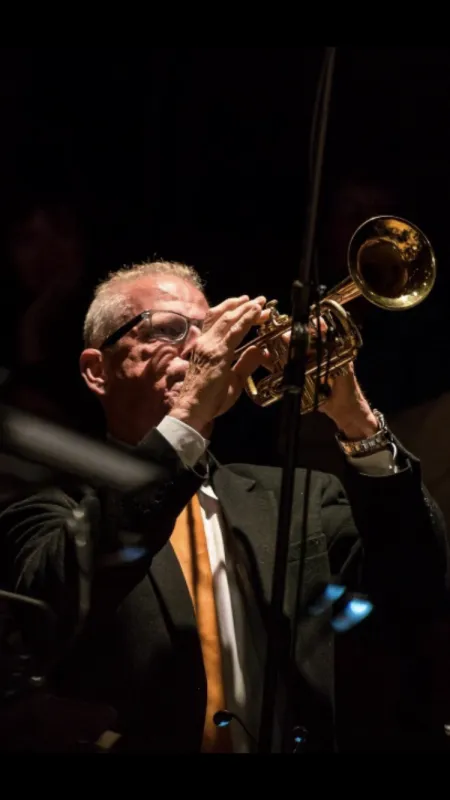
A man plays a trumpet.

Acclaimed musician Jim Hynes '78 playing the trumpet. (Photo submitted.)

Jim Hynes ’78 arrived at Ithaca College under circumstances few would have predicted would lead to one of the most accomplished performing careers of any alumnus of the School of Music. Unlike many aspiring professional musicians, Hynes did not begin playing his instrument as a young child. He picked up the trumpet at age 17 after a friend encouraged him to join his high school band. As a would-be first-generation college student, he had given little thought to pursuing higher education until a teacher suggested he consider studying music. That recommendation eventually brought him to Ithaca. 

By his own account, Hynes arrived feeling far behind many of his peers. Rather than discouraging him, the experience became motivation. He immersed himself in ensembles, studied with trumpet professor Herbert Mueller, and spent much of his college career trying to catch up to musicians he viewed as more advanced. By his senior year, he had won the college’s concerto competition and was chosen to fill Mueller’s spot in the faculty brass quintet during the professor’s sabbatical, performing alongside faculty musicians while still an undergraduate. The trajectory his career followed was remarkable. After graduate study at the Eastman School of Music and a stint with the Rochester Philharmonic Orchestra, Hynes moved to New York City. Within weeks, he landed his first Broadway substitute engagement. Six months later, he was performing in an orchestra for a Broadway show. 

If the opportunities came quickly, the preparation had taken years. 

“When that door opens for you, you’ve got to walk in the door and just nail it,” Hynes said during an interview earlier this year. 

Over the next four decades, Hynes built a career that carried him to nearly every corner of the music industry. He performed on Broadway, toured with Paul Simon, recorded film scores and commercial jingles, and became one of the most sought-after trumpet players in the country. 

People may not have known Hynes’s name, but they almost certainly heard his trumpet. His credits included Broadway productions and cast recordings, as well as the iconic trumpet parts associated with The Price Is Right theme and NBC’s Sunday Night Football. Millions of listeners have heard those performances without realizing they were listening to an Ithaca College alumnus. 

Hynes’s career illustrates the breadth of the Ithaca bands tradition. Some graduates became educators. Others led military ensembles, community bands, and university programs. Still others carried their training into the highest levels of the performing arts and popular culture.

Editor’s note: Jim Hynes ’78, who was interviewed for this story, passed away in June 2026 before its publication.

On the Next Downbeat

A student ensemble performs at an outdoor concert.

IC's Founder’s Day Concert in the Park celebrates the institution’s longstanding partnership with the city of Ithaca and typically takes place in mid-September. (Photo by Tessa Dill '26)

When Patrick Conway described the kind of musician he hoped to educate, he envisioned graduates who could do more than perform. They would understand multiple instruments, teach, lead ensembles, organize musical associations, compose, and move comfortably across musical traditions. More than a century later, much of that philosophy remains intact.

Gonoud arrived at Ithaca College knowing she wanted to become a music educator. Over the next four years, she built an experience that might have felt familiar to Conway’s students. She performed in the wind ensemble, orchestra, jazz ensemble, jazz combos, and theatrical pit orchestras. She pursued both clarinet and saxophone. She taught. She performed professionally. And she learned from faculty members who encouraged students to pursue opportunities and gigs wherever they could find them.

Part of Ithaca’s reputation, she noted, comes from the sheer volume of experience students accumulate while they are at IC. “Students gain so much experience performing and teaching, literally from day one,” Gonoud said. While still an undergraduate, she performed with local theatre productions, supported ensembles at Cornell, accepted professional gigs, and worked with students in local schools. “There’s just so many opportunities here in both teaching and performing,” Gonoud said.

Those opportunities are reinforced by a network of alumni who continue to mentor and support the next generation. Gonoud points to Emily Pecoraro ’12, an Ithaca graduate whose Broadway and national touring career has earned increasing recognition, as one example. Like many Ithaca musicians, Pecoraro has remained connected to the program after graduation, offering advice and encouragement to students following similar paths. The pattern is a familiar one: Graduates leave Ithaca, build careers, and help open doors for those who follow. Over time, those individual connections become part of the larger story of the program itself.

The morning after the Commencement Eve Concert, Gonoud crossed the same stage to receive her diploma. She now teaches and performs professionally while beginning her career as a middle school band director in the Syracuse area. Along the way, she found another example of the program’s reach: several Ithaca College alumni served on the search committee that hired her. Now she begins her own chapter in the ongoing story of Ithaca College bands.

Help Us Tell the Story

The history of Ithaca College bands spans more than a century and includes thousands of alumni whose careers and contributions have shaped music education, performance, military music, and the arts. The individuals featured in this story represent only a small sample of that legacy. 

If there’s an alumnus, ensemble, tradition, or chapter of Ithaca bands history you feel deserves future coverage, please send your ideas to stories@ithaca.edu. While we can’t feature every submission, we welcome suggestions as we continue telling the stories of Ithaca College musicians, past and present.