Ithaca College’s financial outlook, student recruitment, and employee benefits were the focus of the Oct. 20 State of the College gathering, where administrators also outlined how faculty, staff, and students can take part in planning for the college’s academic future. President La Jerne Terry Cornish and other administrators shared updates and then took questions from the campus community.
State of the College Outlines Financial Path and Invites Campus into Academic Planning
By IC News, October 26, 2026
Administrators discuss the college’s finances, recruitment, and benefits, and outline how faculty, staff, and students can shape academic planning.
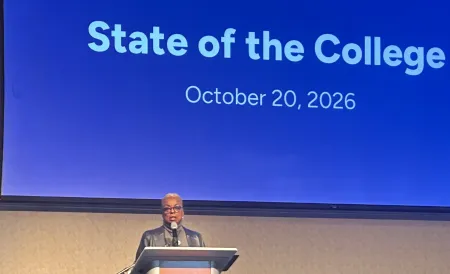
President La Jerne Terry Cornish speaks at the October 20 State of the College meeting.
Financial Outlook and Budget Decisions
Marc Israel, associate vice president for business and finance and interim chief financial officer, reported that undergraduate enrollment fell short of projections by slightly more than 100 students across the incoming and returning student populations.
The resulting loss of anticipated revenue, partially offset by gains in graduate and other revenues, increased the projected deficit from the budgeted $4 million to approximately $8 million.
Israel said the college is forecasting to hold approximately $70 million in cash and short-term investments as of FY 2027 yearend. While that amount remains within the college’s financial guidelines, operating losses and capital expenditures have reduced those reserves over time. He also noted declining debt and opportunities to strengthen the endowment through additional giving.
Cornish said the Board of Trustees has charged the administration with limiting the fiscal year 2027 deficit to $4 million and achieving budget neutrality in fiscal year 2028.
Changes to the college’s retirement contributions are expected to save at least $1 million, with another $1 million in reductions being sought from nonsalary operating expenses. Together, those measures would reduce the projected deficit to approximately $6 million. The college is also looking to reduce planned capital spending to preserve cash.
Cornish said the college will honor its commitment to January salary increases of 2.5%, with an additional 0.5% available for merit.
“We are reviewing staffing in relation to our enrollment and the work the college needs to accomplish,” Cornish said. “We are not currently looking to eliminate any faculty positions. We are examining staff positions and I will not pretend otherwise.”
She acknowledged the uncertainty for employees who have already taken on additional responsibilities. Cornish has asked the board to consider allowing a higher deficit this year while maintaining the goal of budget neutrality in fiscal year 2028. That request remains under consideration.
Cornish said expense reductions must accompany efforts to recruit students and provide the education and support that help them persist and graduate.
Student Recruitment
Rock Hall, vice president for enrollment management, discussed recruitment efforts for the fall 2027 entering class, including earlier outreach, admission decisions, and merit aid offers.
Hall said the college began its outreach in August and released admission decisions in October. Recruitment efforts also include the second year of the Presidential Scholarship and additional opportunities to engage prospective students and their families.
During the question-and-answer session, Hall said the college is returning merit aid to the levels used in the 2025 recruitment cycle after changes in the following cycle contributed to enrollment falling short of its target.
Employee Benefits
Tanya Brown, associate vice president and chief human resources officer, outlined changes to employee benefits for 2027, citing rising health care and prescription costs.
Medical premiums will increase, with the amount depending on employees’ plans, coverage levels, and pay bands. Some plans will also have changes to deductibles, coinsurance, or out-of-pocket maximums.
The college will move prescription coverage to Optum Rx through a coalition of higher education institutions. Brown said employees will receive information about how the change affects their medications and costs, with individual assistance for those affected by certain specialty medication changes.
The retirement plan will move from an 8% college contribution for eligible employees to a dollar-for-dollar match of employee contributions up to 7% of eligible pay. Employees will need to contribute 7% to receive the maximum college contribution.
Dental, vision, disability, and life insurance plans will remain unchanged, as will the college’s contributions to eligible employees’ health savings accounts.
Open enrollment runs from Oct. 26 through Nov. 6, with a benefits fair scheduled for Oct. 29.
Academic Planning and Campus Participation
At its October meeting, the Board of Trustees approved a resolution stating: “The board endorses the development of a new academic model anchored in our key strengths, responsive to our size, mission, vision, and values, and incorporating changes in the broader higher education landscape.”
Melanie Stein, provost and executive vice president for academic affairs, emphasized that the college is at the beginning of this work and that input from faculty, staff, and students will shape it throughout the academic year. No model has been adopted. Stein said the discussion concerns how the college’s schools and departments are organized and that all current degree programs remain in place.
“Likewise, this conversation is not about eliminating faculty and staff positions, and it is not an exercise to close this year’s budget deficit through program cuts,” Stein said.
A student town hall is scheduled for Nov. 3, with details to follow. By early November, Stein plans to establish the Organizing for Opportunity Transition Team to gather campus input, examine options, and share updates throughout the academic year.
“Throughout this process, we will be clear about what’s an idea under discussion and what’s a decision,” Stein said. “We will share what we’re hearing and how it’s shaping the work. When we ask for your participation, we owe you a real response, and you will get one.”
At the previous week’s all-faculty meeting, Stein outlined the case for change and shared a conceptual three-school model as a starting point for discussion about how the college could build on its strengths, connect liberal arts and professional study, and better serve students pursuing multiple interests.
She acknowledged that academic organization shapes professional identities, relationships, and the ways faculty and staff teach and support students, and she invited specific concerns, examples, and alternatives to help assess possible models.
Cornish thanked those who had offered thoughtful questions and alternatives and urged the community to approach disagreements respectfully.
Cornish also emphasized leadership’s responsibility to explain its reasoning, answer questions, and listen to feedback.
“If we ask you to engage, then we must be willing to engage with what you tell us,” she said.
Campus Questions and Concerns
Faculty, staff, and students raised questions about employee morale, workloads, student support, and opportunities to participate in academic planning.
Staff members described concerns about absorbing additional work if positions are eliminated, particularly as employees face higher benefit costs and reduced retirement contributions.
Brown said staffing reviews examine the work the institution needs to accomplish and its effect on students. Stein said departments will need to consider priorities and possible changes in how they provide services.
Students asked how they could participate in academic planning and raised concerns about school identities, retention, and resources for academic programs. Stein reiterated that no decisions about the college’s academic structure have been made and encouraged students to attend the Nov. 3 town hall and watch for further opportunities to contribute.
A webpage will serve as a central source of information about the academic planning process, including updates from the team, once the team is established.