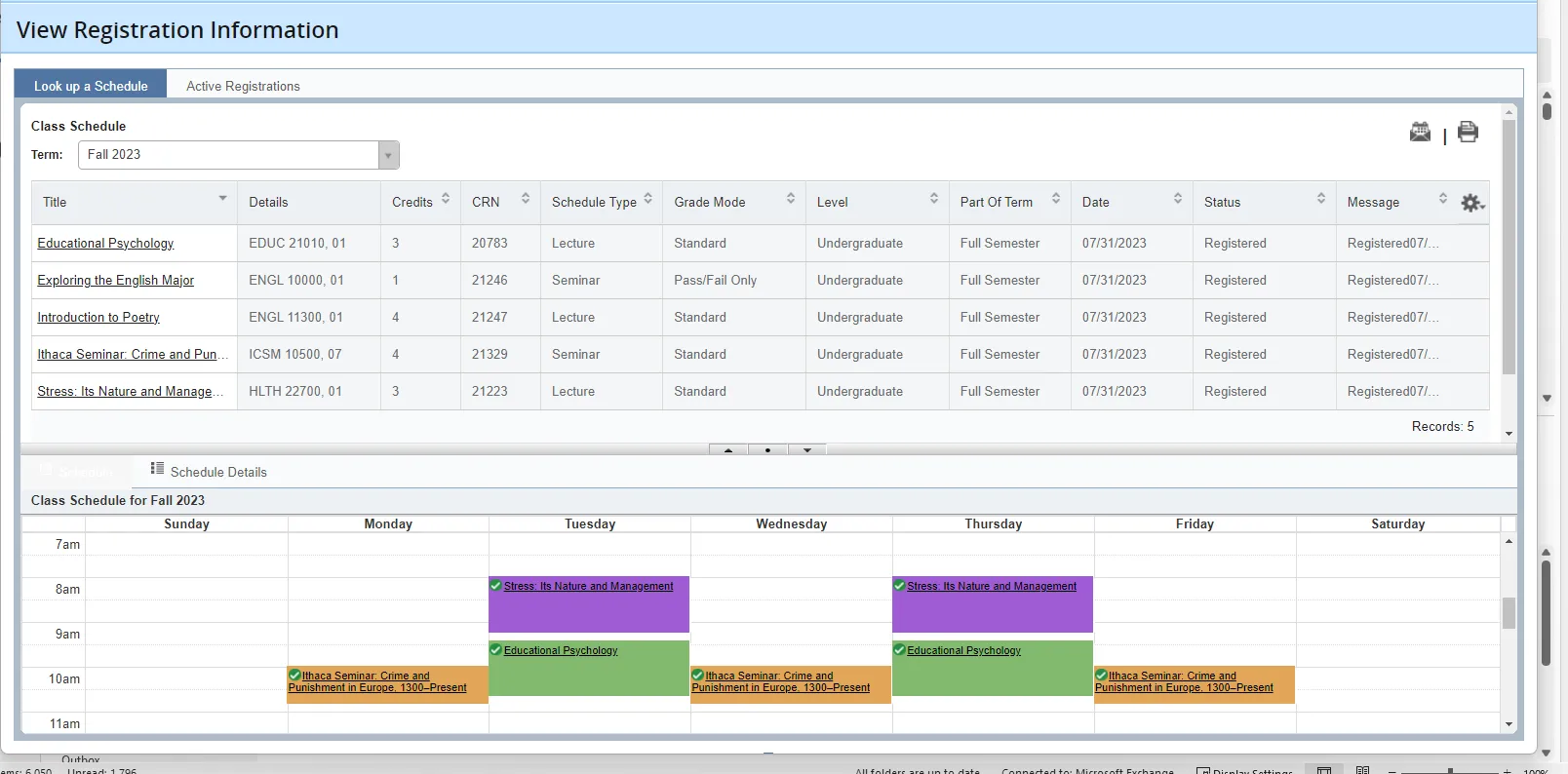
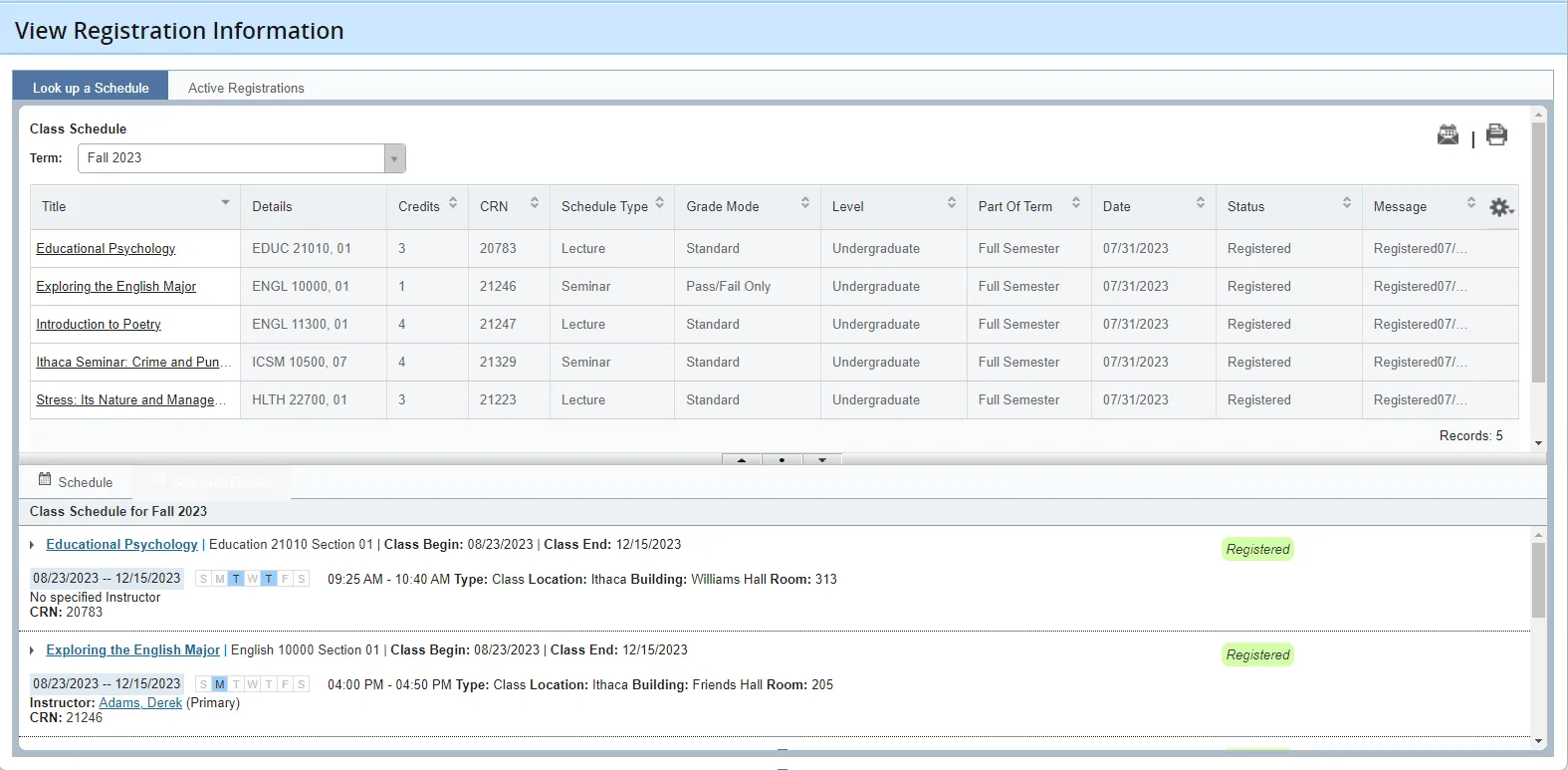
First-Year Students: Your final schedule will be available by July 31, when you will receive an email with step-by-step instructions for viewing your fall course schedule.
Transfer Students: You should reach out to the Academic Support Center (academicsupport@ithaca.edu) to schedule an individual appointment with an advisor. The Academic Support Center will partner with your school and you to identify and register in appropriate classes over the summer.
If you have a question or concern that is not addressed in our FAQs, please reach out to the Academic Support Center. By email at academicsupport@ithaca.edu or phone at 607-274-3381.
Academic Interests Survey FAQs
Everyfirst-year studentmust complete the survey to help us build your first semester schedule.
Transfer students(who earned college credits after graduating from high school) do not need to complete the survey; your fall schedule will be based on your college transcript(s) and created in partnership with the Academic Support Center team.
At Ithaca College, we prioritize your success. Your responses to the Academic Interests Survey help us build your fall schedule to include courses in your major or potential area of interest and a mix of core and elective courses to ensure that every one will count toward your degree. If you are enrolled in our Exploratory Pathways or Pre-Health Professions Program, the Academic Interests Survey is your critical first step in exploring areas of interest toward your eventual choice of major.
The survey is due June 2. We start building schedules in early June, so it is to your advantage to get your survey done as soon as you are able, as the information will help us to craft the best schedule for you.
And don’t forget to complete your math placement assessment as soon as you are able to do so. Some majors, minors, and even courses of general interest may require that students receive a minimum placement score to enroll. Without such a score, we may not be able to guarantee spots in classes or build schedules that include areas of interest.
Access the Academic Interests Survey via your New Student Checklist in IC Connect. To complete the survey, you'll need to first activate your new Ithaca College student account (if you haven’t already). More information about activating your new Ithaca College student account can be found on your New Student Checklist.
As a first-year student, you are guaranteed at least one class in your major or a potential major, but the rest of your classes may not match your interests as well as you—and we—would like without the survey completed.
We begin creating schedules in early June, so please complete your Academic Interest Survey and submit it ASAP! If you miss the deadline, still complete the survey as soon as you can. We will make every effort to get you classes that align with your interests, but that will be more challenging since we will have already started building students’ schedules in June.
Please contact New Student and Transition Programs at NSTP@ithaca.edu to ask whether you can resubmit your Academic Interest Survey.
Please contact New Student and Transition Programs at NSTP@ithaca.edu.
Math Placement Assessment FAQs
Even if your intended major does not require a math course, it is important for you to take the math placement assessment. We ask all students to take the math placement assessment because we know many students eventually discover that they want a major, minor, or even just a course that requires a math placement score. Best to do it now while your memory is fresh. It even comes with a prep guide to help you get ready, so it’s not scary! Get more information.
Your math placement score will appear immediately after you submit your exam. It will also be stored in Degree Works, the Ithaca College student information system.
Math, physics, some quantitative literacy (QL) core curriculum courses like statistics, and some quantitative research courses within majors are only open to students with a minimum math placement score. This is to ensure that you have the skills you need to complete that course successfully. If you do not have the minimum score, you can retake the placement exam four more times, but you are required to take time and complete review modules between retakes. IC also offers a Math Boost course to help students improve skills and scores. Since some majors have carefully sequenced courses, it is to your advantage to prep and do your best on the Math Placement Assessment from the outset.
If you do not take the Math Placement Assessment and the score is required for courses in your major (such as business, economics, natural sciences, and others), we cannot accurately build your fall schedule. If you are exploring different possible majors or minors, you also want to be prepared for classes that may require math. The assessment remains open, and you can even do it once you arrive on campus, but you will have many demands on your time once you arrive, so it is to your advantage to get it done by June 2 .
Fall Schedule for New Students - FAQs
First Year Students: At Ithaca College, we prioritize your success. After you complete your Academic Interests Survey, we use your responses to build your fall schedule to include courses in your major or potential area of interest and a mix of core and elective courses to ensure that every one will count toward your degree. If you are member of our Exploratory Pathways or Pre-health Professions programs, the Academic Interest Survey is a critical first step in exploring areas of interest toward an eventual major.
Transfer Students : You will receive an email from the Academic Support Center inviting you to be in touch and set up a virtual meeting with an academic advisor who will guide you through course selection to build an effective fall schedule, based on your previous coursework and on requirements for your major.
This varies by school and by major, but first-year students will have:
At least one course in your major or a potential major.
Your required first year seminar. Check out our Ithaca Seminar offerings here.
Depending on your major, you may have room for one or two elective or core curriculum courses that help you meet graduation requirements, learn transferable skills, and test drive some new subjects that align with your interests.
A total of 13-17 credits. Though tuition covers up to 18 credits we advise that you NOT exceed the credits in your fall schedule in order to be most successful in your first semester.
In high school, most classes meet every day, but in college, each course may meet only two or three times per week. As a result, you may have long periods during the week when you are not scheduled to be in class. It is important to understand that college courses expect you to spend about twice as much time on work outside of class as you spend in class on studying, reading, and completing assignments. This means that the open time in your schedule is not truly “free” time, but time you should create structure and rhythm for your work.
It is also an opportunity for productive activities related to your coursework, like participating in co-curricular events and personal growth opportunities. If you would like to work on your school-life balance, consider meeting with someone in the Academic Support Center before or during your first semester at Ithaca College.
The Ithaca Seminar (ICSM) is a four-credit course that combines an interdisciplinary topic with information and skills you will need to be successful in your transition to college. Every incoming student takes a seminar in their first semester at IC. First year students will take seminars that are aligned with the interests you will identify in the Academic Interests Survey. Students in most programs can even share up to five seminars that interest you most. It is helpful for you to review these before completing the Survey. Check out the seminar descriptions on our Ithaca Seminar webpage.
If you are a student in the H&S Pathways program or who has been accepted into the H&S Innovation Scholars program, you will be registered for one of the specific Ithaca Seminars, associated with that program, based on the interests you have identified your survey.
If you are a transfer student, you will have a specific Ithaca Seminar exclusively for transfer students. This seminar is meant to help you adjust to college life at IC and make connections with other transfer students, acknowledging that you already have college experience.
No, there is no language requirement at Ithaca College, but there are a few majors that require students to have proficiency in a second language. There are two paths to demonstrating proficiency in a major: 1) by taking the appropriate level language course(s) at Ithaca College, or 2) by taking a language proficiency examination once you have arrived on campus. You can get more information about proficiency exams from the World Languages, Literatures, and Cultures Department at wllc@ithaca.edu.
If you have studied French, German, Italian, or Spanish in high school, or if you grew up speaking one of these languages at home, and you are interested in continuing to study that language once you arrive at Ithaca College, you may need to take a language placement assessment to identify the right course/level for you.
First year students: If, when filling out your Academic Interest Survey, you indicate an interest in continuing to study one of these languages, the department will reach out to you with information about next steps.
Transfer students : If you’re interested in continuing language study, be sure to discuss that during your advising meeting this summer. You should also reach out to the World Languages, Literatures, and Cultures Department about next steps, via email at wllc@ithaca.edu.
The federal requirement for full-time status is 12 credits. Dropping below this number can affect your financial aid and housing. For international students, dropping below 12 credits can affect your visa status. For athletes, dropping below 12 credits can affect your eligibility to participate. Students at IC can take up to 18 credits per semester, though we only recommend that certain majors register for 18 credits in their first semester. Most students will be registered for 14-16 credits in their first semester.
In general, you should plan to complete 15 credits per semester to stay on track for a four-year graduation. However, you can take fewer credits during a spring or fall term and still be on track to graduate if you plan to take summer or winter courses (at additional cost) or are bringing in some credits with you.
To earn your minimum of 120 credits for your bachelor’s degree, you need to average 30 credits a year. Taking only 12 credits on a regular basis will not enable you to graduate on time. That said, if you have earned credits from AP, IB or dual enrollment courses, you may wish to use a few of these to make your transition to the first semester of college less demanding. If you have a registered accommodation (such as an IEP or a 504 plan in high school), and 15 or more credits will be extremely challenging for you, you may benefit from registering for only 12 and making up the other 3 credits in a summer session (at additional cost).
First Year Students: By July 31, you will receive information from the Academic Support Center about how to see your fall course schedule. Any information you see regarding fall classes before that date is not official, as changes will be made up until we release the information about fall schedules.
Transfer Students : You will receive an email from the Academic Support Center inviting you to be in touch and set up a virtual meeting with an academic advisor who will guide you through course selection to build an effective fall schedule, based on your previous coursework and on requirements for your major.
Once you arrive on campus for orientation, you will have the ability to make limited changes to your course schedule. Remember that your schedule represents the best academic advice from our advising experts, so while you can change your schedule, we recommend that you not do so without first consulting the Academic Support Center or your faculty advisor. At orientation, academic advising experts are available during the Academic Sessions if you want or need to make limited adjustments to your schedule. You will be able to make changes to your schedule until the last day of the first week of the semester.
Once you have registered with the Office of Student Accessibility Services, contact the Academic Support Center (academicsupport@ithaca.edu) and their team will work with you to ensure that your courses align with your documented accommodations.
Typically, faculty advisor assignments are made in August, prior to the start of orientation. You can find information about your advisor in HomerConnect or DegreeWorks. However, anytime you need support - this summer through graduation - you can always reach out to the Academic Support Center for help (academicsupport@ithaca.edu).
Please reach out to the Academic Support Center (academicsupport@ithaca.edu) to talk to an advisor about this.
You can review your student information at degreeworks.ithaca.edu to see if your transfer credit is reflected there. If you’re not sure how to do that, please contact the Academic Support Center (academicsupport@ithaca.edu).
If your college/transfer credit is not reflected, contact the institution where you took classes or College Board for Advanced Placement Exams and have an official transcript or official score report sent to the Office of the Registrar at Ithaca College as soon as possible. Note that transfer credit cannot be awarded from your high school transcript. We must receive an official transcript directly from the credit granting agency (e.g., the college or university that offered the course). (Students should not send themselves official documents to be forwarded to Ithaca College, they must be sent directly to Ithaca College.)
Computer recommendations vary by major and school. For example, some specialized programs in the Park School of Communications and MTD recommend Apple products. In general, however, Ithaca College does not require a specific computer brand. Students should plan to have a reliable laptop—either a Mac or a PC—that meets their program’s needs.
School-specific guidance:
Park School of Communications: Recommendations vary by major. Visit the Park School’s Equipment Needs Webpage for details.
School of Business: Macintosh or PC is acceptable (PCs are most common).
School of Health Sciences and Human Performance (HSHP): Macintosh or PC is acceptable.
School of Humanities and Sciences: Macintosh or PC is acceptable.
School of Music, Theatre, and Dance: Macintosh computers are most common. The Center for Music’s computer lab and computer classroom use Macintosh computers exclusively. Additionally, most faculty, staff, and administrative offices use Macintosh computers. While compatibility may be advantageous for students, it is not necessary for students to adopt a Macintosh platform in order to complete required assignments and other activities. Students in the Composition degree program however are advised to consult their faculty members regarding compatibility with the composition workroom computers. Lab and classroom computers in the School are fully equipped with software for word processing, spreadsheets, database, and music notation (Finale and Sibelius).
The college bookstore has an online site where you can explore required texts for classes offered at IC.
The office of the registrar has a glossary that you may find helpful. If there is a term, process, or direction that is confusing to you, please don't hesitate to reach out to the Academic Support Center (academicsupport@ithaca.edu) - their team is always happy to help!
IC Advantage and Summer Course FAQs
IC Advantage is a special benefit only for incoming students. It offers you the option of taking 1, 2 or 3 single-credit, online courses so you can earn college credits, connect to an IC professor and start making friends before you even set foot on campus. And the first course is FREE! Check it out here: https://www.ithaca.edu/academics/extended-studies/incoming-students
Summer enrollment is limited to IC Advantage courses for incoming students. This maximizes your ability to connect with other first year students.