
Leading the Charge

By Patrick Bohn, October 27, 2026
Brian Flinn ’96 Grows Flag Football for the NFL
Flynn at Podium

Brian Flinn '96, seen here at the 3rd Annual NFL FLAG Championships in Indianapolis, is currently the NFL's senior vice president for global flag football. (Photo courtesy of the NFL)

Brian Flinn ’96 isn’t one for maintaining the status quo. As he has carved out a career in the sports industry, he has been guided by a simple ethos.

“Disruption is positive,” he stated matter-of-factly. “Every good leader should be looking for ways to disrupt their field.”

Flinn has done just that for three decades by working in marketing and media roles that have taken him across the sports and entertainment landscape to his current role as the NFL’s senior vice president for global glag football.

When the NFL initially reached out to Flinn about the job in the spring of 2026, he was serving as the COO of the Pro Padel League, which was founded in 2022. Padel is a mix of tennis and squash, and the league was home to 10 franchises in the United States, Canada, and Mexico.

“Because it was a startup league, I was the commissioner and also the marketing intern,” he laughed. “I was working 90-hour weeks and wearing a lot of hats.”

Although he loved the job, Flinn admits that the allure of the most popular league in the United States was powerful. “There’s the NFL, and there’s everything else,” he says. “The power of the brand is undeniable, and, within that brand, flag football is a rocket ship.”

Aboard that rocket ship, Flinn spearheads the league’s efforts to grow the sport from the grassroots level through professional leagues, as well as international expansion.

“We run youth leagues and tournaments around the country featuring 2,000 leagues and nearly a million athletes,” he said. “We’re partnering with Boys & Girls Clubs and YMCAs and working with schools at all levels to introduce it into P.E. programs. We’re also working with high schools and the NCAA to ensure that the coaching, officiating, and health and wellness tentpoles within the sport are strong.”
“Football is an American institution, but it’s one that women haven’t always had access to. Flag is changing that. We’ve opened the doors, and women are kicking down the walls. There’s no ceiling to what they can accomplish.”

Brian Flinn ’96, senior vice president for global flag football for the National Football League

The results are measurable. Flag football is the fastest-growing youth team sport in the U.S. with nearly 100% growth among teenage girls over the past three years. Girls’ high school flag football in particular has skyrocketed in popularity, with participation increasing 551% in the past four years, according to the National Federation of State High School Associations’ annual Participation Report.

“Football is an American institution, but it’s one that women haven’t always had access to,” Flinn said. “Flag is changing that. We’ve opened the doors, and women are kicking down the walls. There’s no ceiling to what they can accomplish.”

The NCAA has named flag football an emerging sport, with a January 2027 vote scheduled to make it a championship sport. Earlier this month, Ithaca College announced that it was adding women’s flag football as a varsity sport.

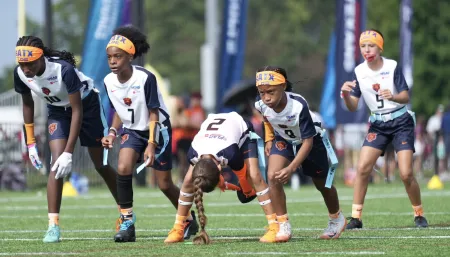
Girls playing flag

Flag football is the fastest-growing youth team sport in the United States. (Photo courtesy of the NFL.)

“I want to thank President La Jerne Terry Cornish and Ithaca College for their commitment to expanding opportunities for student-athletes through the addition of women’s flag football as a varsity sport,” Flinn said. “Every college that invests in flag football creates new opportunities for women to compete, pursue their academic goals, build unique leadership skills, and continue their athletic careers. As momentum behind the sport continues to build globally, with flag football set to debut at the 2028 Olympic Games and professional opportunities emerging, institutions like Ithaca are helping shape the future of the game and inspire the next generation of athletes.”

Flinn can speak to that from experience because, throughout his career, he’s worked with organizations as they’ve grown and shaped their futures.

He was working for the New York Knicks in 1996 when the WNBA was founded, and because the league was backed by the NBA, he got a front-row seat to the launch of the league’s New York-based team, the Liberty.

“I don’t think the enormity of it hit me at the time,” he said. “But it was still amazing working to support something so entrepreneurial.”

“Every college that invests in flag football creates new opportunities for women to compete, pursue their academic goals, build unique leadership skills, and continue their athletic careers.”

Brian Flinn '96

Flinn moved from the Knicks to the league office in 2000 and there was the director of communications on the team that launched the NBA Development League (now known as the G League). The G League is the NBA’s official developmental league, with rosters composed of players who aren’t quite ready for the NBA.

“Prior to that, there was no ecosystem for the countless talented college players who weren’t drafted into the NBA,” he said. “So, helping to create and grow that league through storytelling and brand building was fantastic.”

Flinn eventually rose to become the league’s senior vice president of marketing, overseeing marketing campaigns and brand positioning for the league. But after 17 years in the NBA, he realized he wanted to broaden his horizons, and he took a job with World Wrestling Entertainment in 2012.

“It was more of that same theme of working with something that was considered a bit of a challenger brand,” Flinn said. “As big of a brand as the WWE is, it’s misunderstood. Even though it tends to compete for the same eyeballs as sports leagues, it is an entertainment product. It doesn’t fit neatly into a bucket.”

At the time, the WWE model was built on consumers purchasing specific pay-per-view events, which generated about $90 million annually. As the senior vice president for marketing and communications, Flinn worked to completely change the business model, helping launch the direct-to-consumer streaming video app WWE Network, which he described as akin to Netflix. Before long, the app was pulling in $200 million, and it was eventually licensed to NBCU/Peacock for $1 billion.

“Ithaca fit the vision in my head of what a college should be. And then once I got involved on campus, and I discovered there was a path in sports for me.”

Brian Flinn '96

“Our mentality was ‘we can either wait for change, or proactively lead change,’” he said.

The seeds of Flinn’s three-decade professional career of creating and growing new opportunities were planted during his time at Ithaca College.

“I loved sports, but I had no idea what that meant professionally. All I really had knowledge of was sports broadcasting,” he said. “I picked Ithaca because it fit the vision in my head of what a college should be. And then once I got involved on campus, and I discovered there was a path in sports for me.”

Though he eventually graduated with a degree in Television-Radio, Flinn realized that broadcasting wasn’t his game. So instead, he worked with former professor of sports management and media Ellen Staurowsky ’79 and “created his own minor” in sport studies.

“What stands out to me about my years at IC is the one-on-one time professors were willing to spend with me,” Flinn said. “Between Ellen, and former professors such as Jill Swenson, and Frank Marra, who taught public relations courses I took, I worked with so many great ones.”

Since carving his own path on South Hill, Flinn has spent 30 years helping leagues do the same.

“Wherever I’ve been, there’s a common thread of building and repositioning brands, launching growth initiatives, and disrupting legacy businesses. I consider it a privilege to drive that innovation,” he said.