What does it mean to be human?
Who gets to belong?
Who tells our stories?
How do cultures create meaning?
What makes a society just?
How do communities survive, create, and imagine freedom?
What kind of person do you hope to become?
What problems do you want to solve?
What will your legacy be?
What kind of future do you want to help build?
And what kind of life do you desire to live?
The world you'll graduate into doesn't exist yet.
The technologies you'll use, the communities you'll serve, and the challenges you'll face will continue to change.
African Diaspora Studies is where students investigate some of the most important questions of our time.
African Diaspora Studies is more than the study of Black history. It is a way of understanding the modern world. From artificial intelligence and global migration to public health, music, climate justice, democracy, and visual culture, the field asks how power works, how cultures are created, and how communities create meaning, and how people imagine freedom. Students learn not only to interpret the world--but to help shape what comes next.
This is your opportunity to explore.
To experiment.
To collaborate.
To create.
To discover what matters to you.
This is your laboratory.
Explore it.
Question it.
Create in it.
Leave your mark on it.
Try something you've never imagined.
Curate a digital exhibition or multimedia project that tells a story about Black life.
Study how music becomes a form of political expression, community building, and cultural memory.
Write a screenplay.
Design an exhibition.
Conduct research.
Travel.
Fail.
Pick yourself up, dust off.
And try again.
That's college.
Why African Diaspora Studies at Ithaca?
Black Study doesn't happen in just one classroom--or one discipline. African Diaspora Studies is rooted in place. It happens in archives and museums. In film festivals and concert halls. In classrooms, communities, landscapes, and conversations.
Students study in a region connected to the Underground Railroad, Harriet Tubman, Frederick Douglass, Haudenosaunee history, Women's rights and suffrage (Seneca Falls), and the Finger Lakes.
Just minutes away is Cornell University's Hip Hop Collection, one of the world's leading archives of hip hop culture. Opportunities may include internships, research collaborations, and gain editorial experience with the Journal of Hip Hop Studies and visit cultural institutions.
Ithaca was also home to Alex Haley, author of Roots. Former Ithaca College faculty helped publish and preserve early writings by Black women liberation activists and feminists, including members of the Combahee River Collective, Audre Lorde, and Toni Morrison.
Our faculty and students collaborate with scholars, artists, archives, museums, filmmakers, musicians, and community organizations across New York and around the country.
You'll have opportunities to engage with:
- Cornell's Hip Hop Collection
- The Black Film Festival
- Cine con Cultura Film Festival
- The Wharton Studio Museum (Ithaca is one of the earliest centers of American filmmaking)
- Museums and archives
- Film, theatre, journalism, and music
- Environmental justice and Black outdoor studies
- AI and digital futures
- Community partnerships
- New York City, Harlem, Brooklyn, the Bronx, Syracuse, Buffalo, Philadelphia, Toronto, and other centers of Black culture and creativity are near
The classroom is only the beginning.
What will you study?
African Diaspora Studies invites students to explore some of the most enduring questions about humanity, culture, creativity, justice, and the future. Drawing on courses across the college, students build a path that reflects their own interests while learning to think across disciplines. It explores Black life through history, philosophy, literature, religion, music, science, film, politics, technology, health, and the arts. Courses evolve as the field evolves, inviting students to investigate enduring questions while engaging the most pressing issues of our time.
Freedom, Power & Social Change
- Diasporic Thinking
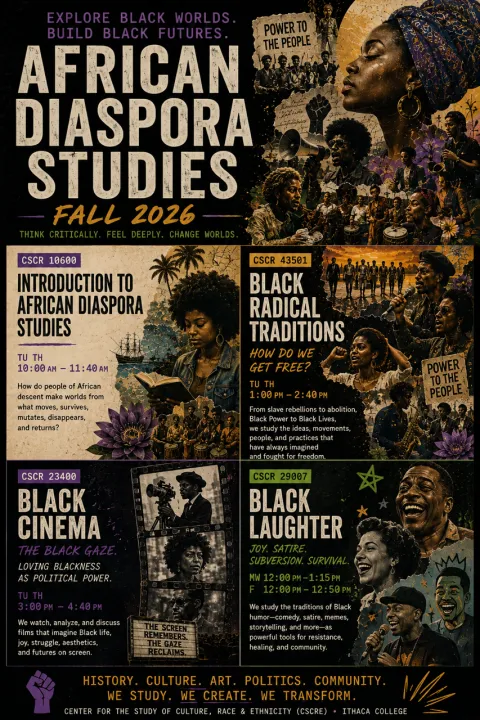
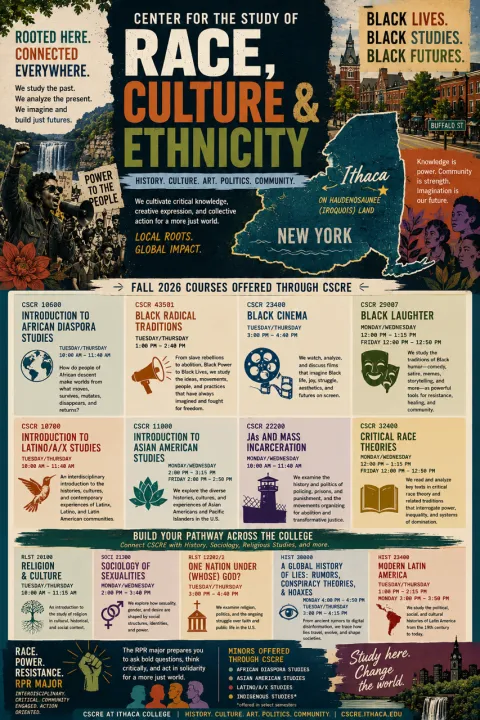
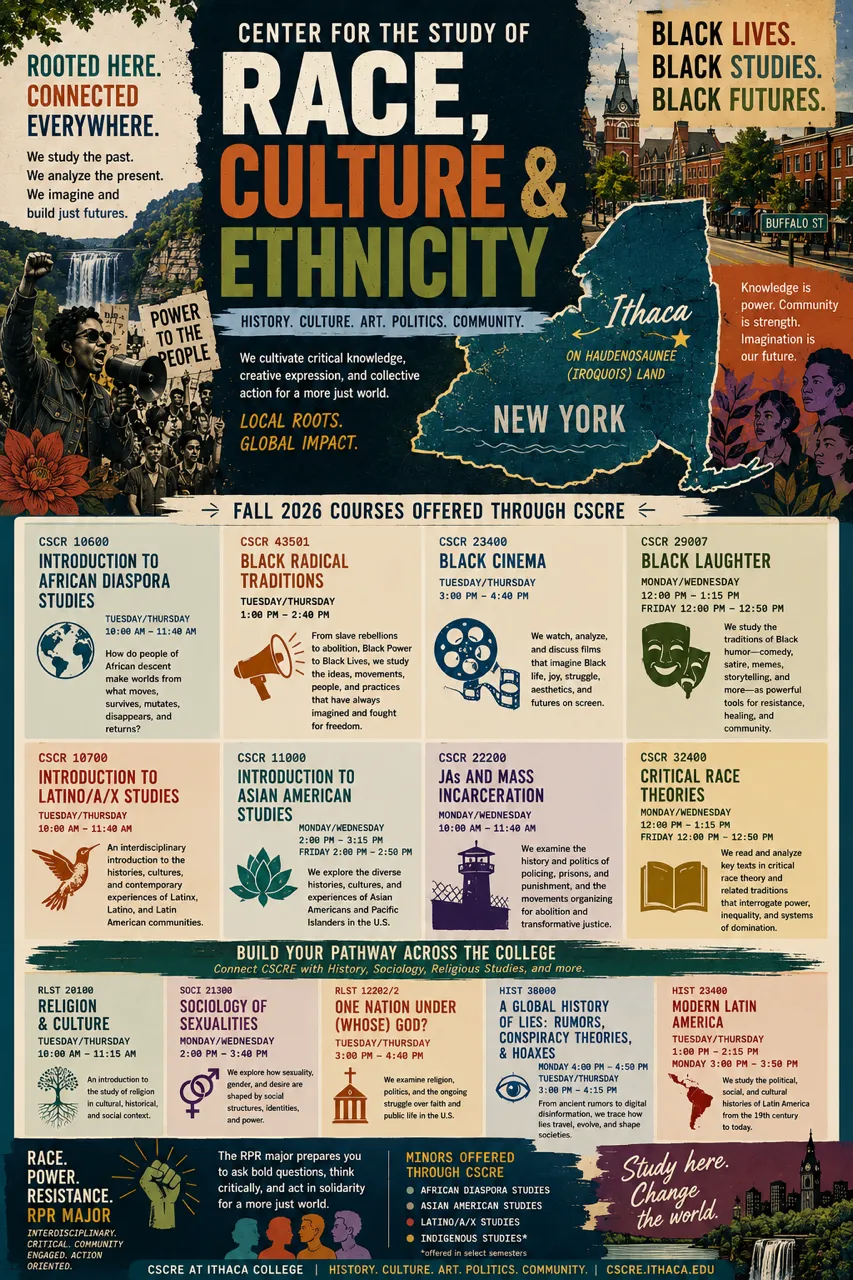
- Black Radical Traditions
- Black Church Studies
- Black Geographies
- Medical Apartheid
- Race, Reproduction, and Justice
- Pan-Africanism
- Black Political Thought
- Indigenous Studies
- Black abolition and freedom struggles
Question: How have Black communities imagined freedom, transformed institutions, and challenged injustice?
Film, Photography & Visual Worlds
Study cinema, photography, fashion, architecture, visual art, material culture, cities, decay, visuality, and digital media while asking how Black people have been seen, represented, remembered, imagined--and how they have created new ways of seeing themselves.
- African Cinema
- Black Cinema
- Global Cinemas
- Black Horror Film Traditions
- Black Romantic Comedy
- South African Visual Culture
- Blaxploitation Cinema
- Black Superheroes
- Black Visual and Material Culture
Question: How do images shape memory, identity, desire, and history?
Music, Sound & Performance
Study music not only as entertainment, but as history, theory, memory, archive, improvisation, spirituality, intimacy, political expression, and collective imagination. Students think with and learn from musicians, DJs, artists, and scholars about listening, sound, silence, rhythm, performance, and Black expressive culture.
Courses may explore:
- Hip Hop Feminism
- Hip Hop Cultures
- Rap Music
- Black Popular Culture
Alongside traditions such as: Jazz, Blues, Funk, Soul, R&B, Reggae, Afrobeats, Highlife, Afro-punk, house, Southern music, gospel, experimental sound, and DJ culture alongside questions of listening, silence, migration, religion, embodiment, and Black expressive life.
Question: How do breath, rhythm, improvisation, silence, vibration, worship, dance, and performance become ways of knowing and imaging otherwise?
Gender, Sexuality & Identity
- Black Feminism
- Black Women's Studies
- Black Masculinities
- Black Queer Studies
- Black Sexualities
- Black Girlhood Studies
- Race and Gender
- The Black Lesbian Archive
- Intimacy, Desire, and Black Life
Question: How do people create identities, kinship, desires, and communities?
Technology, Environment & Futures
Explore artificial intelligence, Black ecologies
Building the worlds to come.
Explore artificial intelligence, Black ecologies, environmental justice, science fiction, digital cultures, and the ethical questions shaping our collective future.
- Artificial Intelligence and Race
- Black Feminist Science, Health, Medicine, and Technology
- Black Ecologies
- Black Outdoors
- Black Metaphysics
- Technology and Liberation
- Science Fiction and Black Futures
Question: How should we live with emerging technologies?
Literature, Philosophy & Ways of Knowing
Imagining otherwise.
Read novels, essays, philosophy, religious thought, folklore, speculative fiction, erotica, and poetry that ask what it means to be human, how we make meaning, and how different traditions imagine justice, morality, healing, and liberation.
Courses may include:
- Toni Morrison
- Slow Reading with bell hooks
- Future offerings might explore
- Blackness and the Human
- Good and Evil Across Traditions
- Black Philosophy
- African and Afro-Diasporic Spiritualities
- Non-Western Medicine and Healing
- Black Cosmology and Moral Imagination
- Fashion, Identity, and Black Dandyism
Questions: What does it mean to be human? How do different cultures imagine justice, morality, spirituality, healing, and the sacred?
Pair african diaspora studies with your major
Build Your Own Path:
African Diaspora Studies is a 20 credit minor that works alongside almost any major.
Complete:
- Two foundational courses introducing African Diaspora Studies.
- Elective courses chosen around your interests and career goals.
Whether you're preparing for graduate school or entering the workforce, you can shape the minor around your own passions. African Diaspora Studies complements nearly every field. Students take courses across the college in:
- Biology
- Business
- Economics
- Education
- English
- Environmental Science
- Film and Media
- History
- Latin American and Caribbean Studies
- Music
- Philosophy and Religion
- Politics
- Physical Therapy
- Sociology
- Theater
- Women's, Gender, and Sexuality Studies
- World Languages and Cultures
African Diaspora Studies brings these disciplines into conversation, helping students understand complex problems from multiple perspectives.
Learn by doing
Learning extends beyond the classroom.
Students create films, podcasts, museum exhibitions, digital archives, research projects, performances, multimedia installations, community partnerships, and public scholarship, and publish their work in popular culture and academic journals.
Students also engage with archives, filmmakers, artists, musicians, museums, scholars, and communities throughout New York and beyond.
where can it take you?
African Diaspora Studies develops skills that employers consistently value:
- Critical thinking
- Communication
- Research
- Ethical reasoning
- Leadership
- Cross-cultural collaboration
- Creative problem solving
- Public speaking
- Community engagement
- Digital storytelling
Our alumni have become:
- Award-winning filmmakers
- Film, television, and multimedia professionals
- Actors and Broadway performers
- DJs, musicians, and recording artists
- Fashion designers
- Journalists
- Writers and poets
- Architects
- Physicians
- Teachers and school leaders
- University professors
- Lawyers
- Engineers and technology professionals
- Museum and cultural center directors
- Artists
- Nonprofit leaders
- Community and government leaders
- Professionals working around the world
What is african diaspora studies?
African Diaspora Studies explores the histories, cultures, ideas, movements, and futures of people of African descent across the globe. The field examines how Black communities have shaped--and continue to shape--the world through politics, religion, science, music, literature, technology, medicine, education, and the arts. More than an interdisciplinary field, African Diaspora Studies offers ways of understanding power, creativity, justice, and freedom that help students engage the defining questions of the twenty-first century.
Meet your professor
M. Nicole Horsley, Associate Professor and Coordinator of African Diaspora Studies
"My classes ask students to think critically, create boldly, and imagine new possibilities. Whether we are studying Black cinema, artificial intelligence, superheroes, visual culture, sexual health and wellness, visual culture, or music, we begin with the same belief: curiosity is the first step toward changing the world."
Join the Conversation
African Diaspora Studies is more than a minor. It is a community of artists, scientists, educators, filmmakers, musicians, entrepreneurs, caregivers, researchers, elders, people in our neighborhoods, kin folks, philosophers, and storytellers committed to understanding--and transforming--the world.