Barbara J. R. Bernstein’s exhibition, Art Coming out of Experience, presents over a dozen never-before-shown works created in Ithaca. Autobiographical and diaristic in nature, Bernstein’s vivid, colorful paintings chronicle her life and times through dynamic, highly stylized compositions. Her canvases offer chimeric, ambiguous narratives that illuminate a rich interior life—at times confronting social class and civic order, while elsewhere finding wonder in the mundane.
Art Coming out of Experience
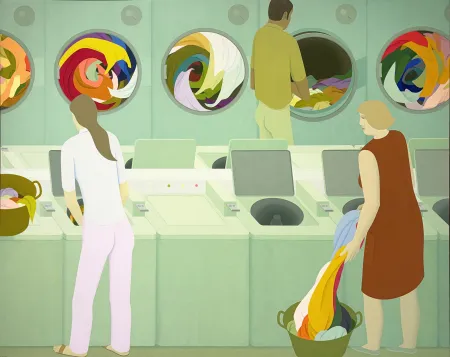
At a laundromat, 1975/76 oil on hardboard
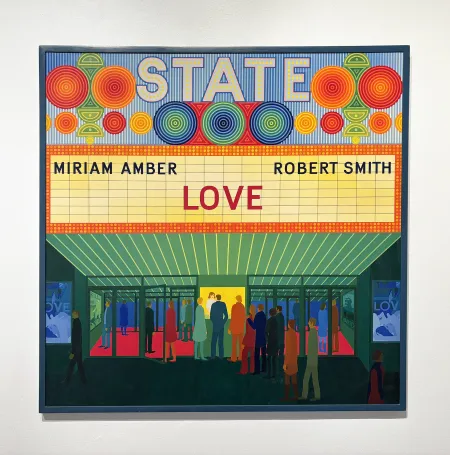
Movie House, 1970, oil on hardboard
Barbara J. R. Bernstein was born in Berlin in 1935 to a Jewish father and a Gentile mother—a perilous time to come into the world for a mixed-heritage family under the shadow of the rising Nazi regime. Prior to the war, Bernstein’s parents, Johanna Moosdorf and Paul Bernstein, were intellectuals deeply engaged in literature and trade union politics respectively. As the National Socialist Party [Nazi] tightened its grip in the 1930s, the mounting pressures of authoritarianism and antisemitism strained their lives and marriage. The couple eventually were forced to separate – but only on paper - to protect the children due to rules against race mixing —and Johanna moved Barbara and her brother Thomas to her hometown of Leipzig, working as a clerical typist to support them.
Tragically, Paul was taken to the Theresienstadt Ghetto in what is now the Czech Republic, and later deported to Auschwitz, where he was murdered by the Nazis. He was one of six million European Jews, alongside millions of other victims including the Roma and Sinti people, political dissidents, and people with disabilities, systematically killed across Europe by the Nazi regime.
Throughout her youth in Leipzig, roughly 90 miles south of Berlin, Barbara’s true identity remained a closely guarded secret to ensure her survival. Even after 1945, lingering antisemitic sentiment and the authoritarian control of the newly established Soviet occupation required the family to remain quiet about their origins. The post-war era in East Germany brought severe resource shortages, trauma, and a bout of illness that left a young Barbara bedridden. During her convalescence, her mother—a remarkably progressive woman and a recognized writer—encouraged her to draw and paint. This enthusiastic early practice blossomed into formal study, culminating in a master’s degree at the Berlin Academy of Arts (Hochschule für Bildende Künste ), laying the foundation for her creative life.
Bernstein’s profound empathy extended beyond her human experiences. At age thirteen, witnessing a pig desperately fighting for its life on the way to slaughter, she swore off meat entirely—a vanishingly rare choice in mid-century Germany. She remains deeply committed to this ethos today, having lived as a strict vegan for nearly sixty years.
Eager to leave Germany behind, Bernstein secured a visa and immigrated to the United States in 1960 at the age of 25. She eventually settled in Ithaca, New York, where she worked as an illustrator for Cornell University’s Department of Plant Biology from 1974 until 1992, when her role was phased out at the dawn of the digital revolution. While her Cornell years were productive, it was in her private home studio on Cascadilla Street that she cultivated her truest artistic voice, surrounded by art, ideas, and close friendships.
My own introduction to that voice came in the spring of 2025, sparked by a serendipitous email from Bernstein’s sister-in-law, Dorothy Solinger. Though unsolicited gallery submissions can be difficult to manage, the image she attached was undeniable. It led to my first of many conversations with the remarkable Barbara Bernstein—and, ultimately, to this exhibition.
- Paul M. Nicholson, Director, Handwerker Gallery