Faculty Highlight: Interview with Colleen Countryman

By Beth Ellen Clark Joseph, February 16, 2026
Colleen Countryman was interviewed by Beth Ellen Clark Joseph in the first faculty highlight.
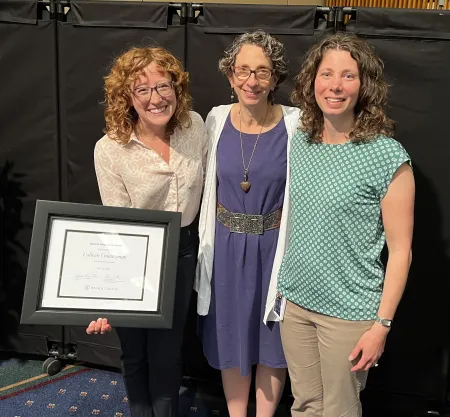
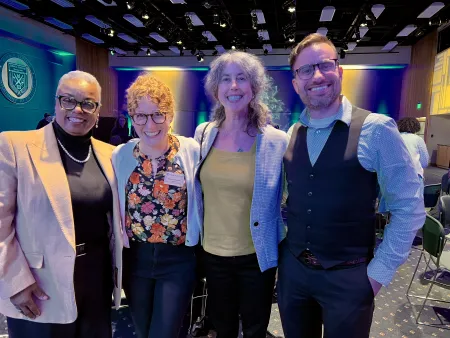
Beth Ellen Clark Joseph (third from left) celebrates the conferring of Colleen's tenure (second from left) along with IC President La Jerne Terry Cornish (far left) and Colleen's partner (far right).

Beth Ellen Clark Joseph (third from left) celebrates the conferring of Colleen's tenure (second from left) along with IC President La Jerne Terry Cornish (far left) and Colleen's partner (far right).

The faculty nominated Colleen Countryman for our newsletter Faculty Highlight feature, so I sat down with Colleen one day and interviewed her. What follows is my conversation with Colleen.

Beth: Colleen – congratulations on being nominated for this first “Faculty Highlight” edition!! I am delighted to have the opportunity to interview you! First – can you tell us about your recent professional successes and high points?

Colleen: Well, I just got tenure! I’m very excited about that and hopefully I’ll be going on sabbatical next year. I’m also really excited about my sabbatical research proposal.
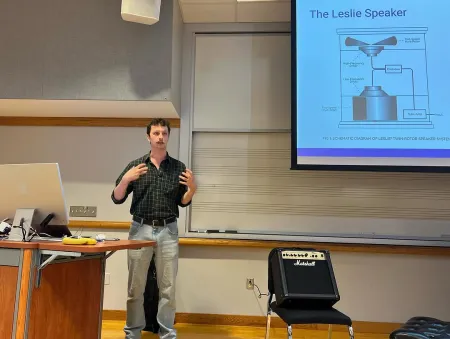
Matt Madden '18 shares his insights on Leslie speakers to a large audience.

Matt Madden '18 shares his insights on Leslie speakers to a large audience in the Whalen Center for Music.

Beth: What is the focus of your research proposal?

Colleen: The idea is that I would be building supplementary instructional materials for my Physics of Music class. 

The focus will be on creating a set of videos that is both accessible and engaging to students at Ithaca College and beyond! In my conversations with students in class as well as informal conversations I've had with musicians in the Ithaca community, I get the sense that videos and 3D models explaining the physics behind instruments could be of real interest! For example, there is a great video of a Ruben's tube, but it doesn't explain what's physically going on. I think there's a desire to better understand these things!

I'd also love to look into developing a series of 3D models to help us understand what's going on inside the instrument as it's being played. For example, a trumpet cut-away could allow us to better understand how the valves change the effective length of the instrument, producing different pitches. 

And I think it could provide a great opportunity for further collaboration with our colleagues in the School of Music, Theatre, and Dance. For example, I helped organize a collaboration with the Sound Recording Technology program to bring alum Matt Madden back to give a talk to both Music and Physics students about guitar pedals he’s designed and created. That went really well, and Matt’s talk was great. I'm looking forward to more opportunities like those in the future!

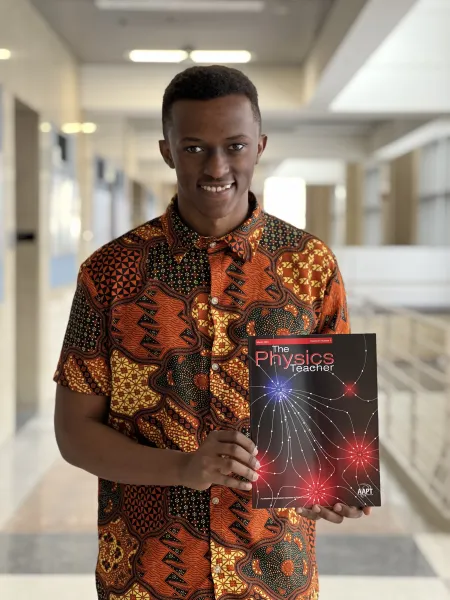
Ted Mburu's simulation was featured on the cover of The Physics Teacher.

Ted Mburu's simulation was featured on the cover of The Physics Teacher.

Beth: I hear that your physics education simulations are still getting a lot of attention. Is that right?

Colleen: Yes! I’m still very pleased with the computer simulations and games that were created by alumni Ted Mburu, Aashutosh Sen, and Mikolaj Konieczny – those are still getting a lot of attention and having a big impact on how introductory and advanced classes are taught. In particular, the Electric Field and Coriolis Effect (non-inertial reference frame) simulations are attracting lots of users online. From time to time, I hear from other physics professors who are requesting new features (or sometimes requesting bug fixes!). Some of these new feature requests will be offered as research projects to future students.

I’m also excited that Ted’s work led to his placement at CU Boulder in the department of Engineering Education Research where he is conducting doctoral research in a new field: topological acoustics!

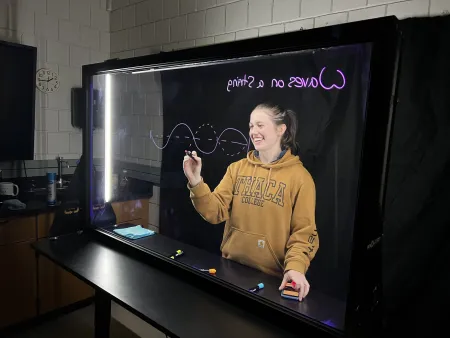
Keely Higgins develops supplementary instructional videos for Physics of Music using a light board in the PER lab.

Keely Higgins develops supplementary instructional videos for Physics of Music using a light board in the PER lab.

Currently, I have two students working on “vibe coding” projects which allow students to more directly focus on the physics elements of a simulation while guiding AI agents through the programmatic elements. Additionally, Suryash Malviya ’26 has continued to work on a project that he and Samuel Smith ’25 worked on last year, building 3D models of physics concepts in Unity, a game engine which would allow the models to be exported to AR and VR devices. Finally, I am working with Keely Higgins ’27 on developing supplementary instructional videos for Physics of Music. She is in the phase of testing the videos with focus groups right now.

Colleen received a Teaching Award from Melanie Stein thanks to support and a nomination from Kelley Sullivan.

Colleen received a Teaching Award from Provost Melanie Stein thanks to support and a nomination from Kelley Sullivan.

Beth: For sure – we are all excited to see what Ted comes up with for his PhD dissertation in topological acoustics!! Wow! So, Colleen, you’ve had some other big successes recently, can you tell us about those too?

Colleen: Yes – I’m also excited to have received the Teaching Excellence Award for 2023.

And I had been doing a lot of work with the Society of Physics Students, but now I’ve moved on to co-chairing the Ithaca College Educational Technology Advisory Committee (ETAC). We report to Provost Melanie Stein and Chief Informational Officer Dave Weil. There are always a lot of hardware and software decisions/choices to make for the ETAC. I enjoy this work because I think it’s cool to hear how people use technologies on campus. When I do work for the ETAC it feels like I’m witnessing the leading edge of something new and super cool. I get to evaluate new stuff and, if it’s deemed pedagogically beneficially, cost-effective, and useful, then we help introduce it to the rest of the campus.

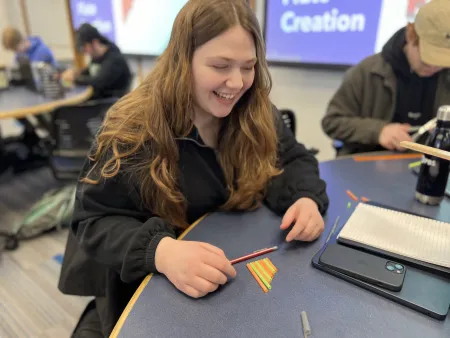
Students in physics of music calculated the lengths of pipe necessary to create specific pitches in a C major scale and created their own "pan flutes!"

Students in physics of music calculated the lengths of pipe necessary to create specific pitches in a C major scale and created their own "pan flutes!"

Beth: You’ve recently developed a new class for the Department of Physics & Astronomy. Can you tell us about that too?

Colleen: Yes – my Physics of Music class was new in 2024 – and I’m teaching it now for the 3rd time.

Beth: What changes have you made over time to improve it?

Colleen: Mostly I’ve been working on the flow of the narrative. When I put this class together I picked up different pieces from various textbooks, so it was very choppy. This is the first year that I feel like I have a cohesive story: What is music, how do musical instruments create music, how does music propagate to our ears, how do our ears and brains process it? Every physics concept we introduce has a very specific application in music. We study the violin, the piano, organ pipes and flutes, and membranophones like the drums. Then, students do presentations on the physics behind their own chosen instrument. Some of my favorite projects have been about more obscure instruments like the hurdy-gurdy, the theremin, or hardingfele. I hope to provide more opportunities in class to explore these unique instruments!

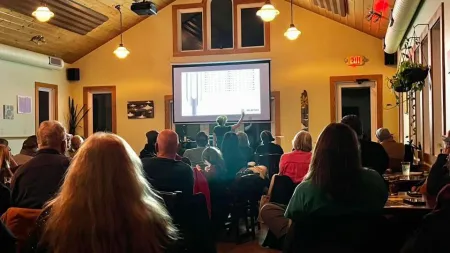
Colleen gives a talk on the physics of music in Dryden, NY.

As part of a "Science and Suds" series at Hopshire Brewery in Dryden, NY, Colleen discussed some of her favorite parts of her Physics of Music class. Photo courtesy of Andy Adelewitz.

Beth: Is everyone in the class a musician?

Colleen: About 1/3 of the class is composed of music majors or students with a high aptitude for music theory. And the other 2/3 of the students have little to no experience in music. The class is capped at 50 - and we usually get 50 students! Professor Luke Keller’s class Physics of Sound has changed in response – his class now includes a bit more electronics and circuitry – for example how to make a microphone, how to make a speaker, etc.

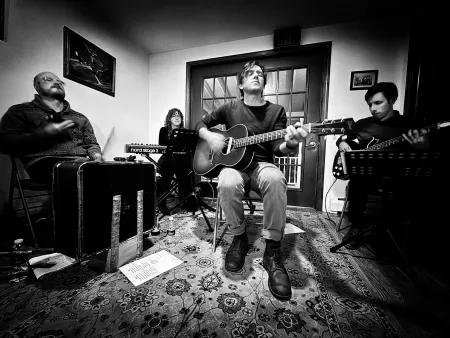
Louiston playing an acoustic set in Burdett, NY.

Louiston playing an acoustic set as part of a "Folk at the Farmhouse" series in Burdett, NY. Photo courtesy of Curtis Corlew.

Beth: Colleen, you also play keyboard in a band?

Colleen: Yes, I enjoy playing piano in a couple of local bands. I love the experience of communicating through music. Most recently, I play with Louiston (led by Americana singer/songwriter Lou DiPietro). The band’s new album, Tiny Devastations in Granular Living, is on streaming platforms. Playing with bands has allowed me to play some shows in NYC, Rochester, and Buffalo, which is fun.

Beth: How much time do you spend in rehearsal with these bands?

Colleen: It varies, but in a given month, I can usually count on about one rehearsal and two or three gigs. Usually, it’s a very do-able time commitment. I actually think that the creative work with these bands has helped me become a better physics professor. I like to think that my experiences can help me approach problems in innovative ways!

Beth: Well, thank you so much for working with me today and congratulations, once again, on all of your achievements!! We are proud that you’re a member of our department, and we’re all excited to follow your interesting and innovative career!